
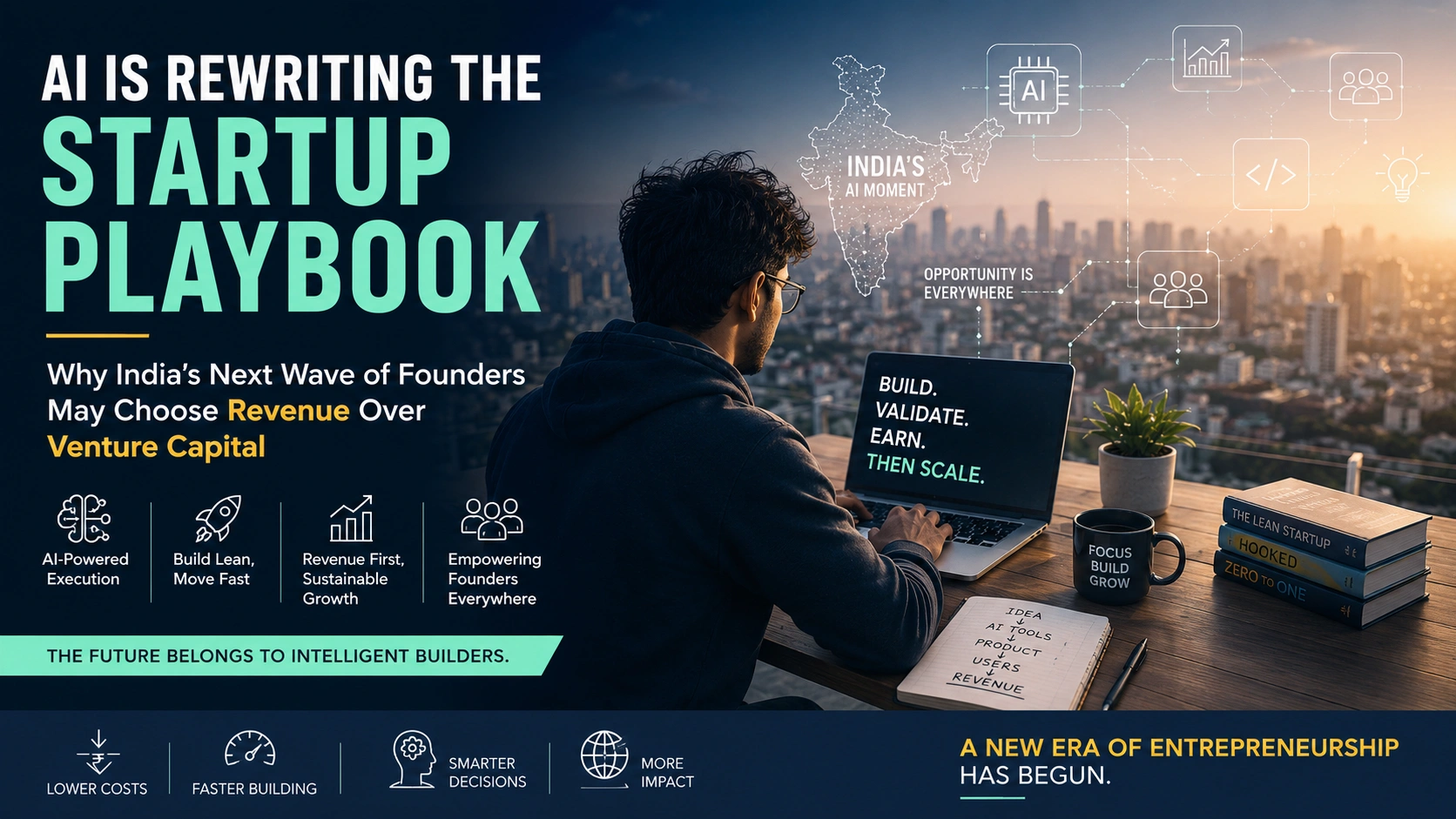
AI Is Rewriting the Startup Playbook — And Why India’s Next Wave of Founders May Choose Revenue Over Venture Capital
For decades, the startup dream followed a familiar script. A founder came up with an idea, chased investors, raised capital, hired a team, burned cash to acquire users, and hoped scale would arrive before the runway disappeared.
That script is now being rewritten.
Artificial intelligence is beginning to reshape the foundations of entrepreneurship itself. The shift is so significant that even venture capitalists are openly acknowledging it.
A recent discussion sparked by insights from Rita McGrath of Columbia Business School and investor Muneer Satter has reignited debate around the rise of the “AI-armed founder.” The central idea is simple yet disruptive: founders equipped with AI tools can now build, test, market, and operate businesses at a fraction of the cost required just a few years ago.
And when the cost of building falls dramatically, the rules of entrepreneurship inevitably change.
The Rise of Lean Intelligence
For years, startups needed substantial capital simply to begin. Building products, creating content, conducting research, designing websites, marketing services, or scaling operations demanded specialized teams and expensive infrastructure.
AI is compressing those costs at remarkable speed.
A founder today can use AI to generate content, analyze markets, automate workflows, create designs, build websites, edit videos, conduct research, optimize SEO, and even prototype products — often within hours instead of weeks.
The result is a new kind of startup model: lean, fast-moving, and highly efficient.
Human creativity, judgment, storytelling, and leadership still matter deeply. But AI is allowing small teams to operate with the productivity levels that once required entire organizations.
That shift is changing startup economics across the world.
Venture Capital Is Entering a New Phase
This does not mean venture capital is disappearing.
Large-scale sectors such as deep-tech, advanced manufacturing, semiconductors, EV infrastructure, and biotechnology will continue to require major investment. Venture capital will remain essential for businesses that need aggressive scaling and global expansion.
What AI is changing is the early stage of entrepreneurship.
Earlier, founders often needed funding before they could even validate an idea. Today, many can launch products, build audiences, test markets, and generate revenue before approaching investors.
That changes the balance of power.
Increasingly, founders are no longer seeking investment merely to survive. They are seeking it strategically to accelerate growth after proving traction.
Across the global startup ecosystem, a quieter shift is emerging — one that values sustainability over hype, profitability over vanity metrics, and intelligent growth over reckless cash burn.
India may be entering that phase faster than many expected.
India’s AI Moment Could Redefine Entrepreneurship
India has never lacked entrepreneurial ambition. What many founders outside major metro cities often lacked was access — access to capital, networks, mentors, and startup ecosystems.
AI is beginning to reduce those disadvantages.
A founder sitting in Guwahati, Shillong, Imphal, Dimapur, Agartala, or Itanagar today has access to the same AI tools being used in Bengaluru, Singapore, London, or Silicon Valley. The barriers to experimentation and execution are falling rapidly.
That democratization of capability could become one of the most important economic stories of the decade.
India’s next startup wave may not always emerge from giant office spaces and massive funding rounds. Some of the most innovative ventures may come from lean AI-enabled teams building sustainable businesses with discipline, creativity, and deep understanding of niche markets.
The rise of AI-powered media platforms, creator-led businesses, digital education ventures, micro SaaS startups, and sustainability-focused enterprises already points toward that transformation.
Increasingly, founders are choosing to focus on revenue before fundraising.
A decade ago, that approach may have appeared limiting. Today, it looks increasingly strategic.
Why This Shift Matters for North East India
For investment-starved regions like North East India, this transition could become transformative.
One of the region’s biggest historical challenges has not been talent or ideas, but limited access to investors, institutional networks, and startup ecosystems. As a result, many aspiring entrepreneurs either migrated elsewhere or struggled to scale their ambitions locally.
AI may help change that equation.
A young entrepreneur in the North East today can build a digital media platform, launch AI-assisted services, create niche tourism ventures, develop educational products, start creator-driven businesses, or build sustainability and bioeconomy startups with far lower operational costs than ever before.
The region’s strengths — biodiversity, bamboo resources, organic agriculture, handloom traditions, music, tourism, storytelling, and creative youth culture — can now intersect with AI-enabled execution.
That is where the real opportunity lies.
The future of entrepreneurship in regions like the North East may depend less on waiting for large investors and more on building lean, intelligent, revenue-generating ventures that prove viability first.
And once viability is visible, investment often follows.https://thequantiq.com/the-next-billion-dollar-startups-may-not-use-ai-at-all/
The Rise of the AI-Augmented Founder
Perhaps the most important entrepreneurial skill of the coming decade will not simply be coding or fundraising.
It will be orchestration.
Founders who learn how to combine AI tools with creativity, storytelling, community-building, and strategic thinking could become extraordinarily effective operators.
A single founder today can research markets, create media content, automate repetitive work, engage audiences, prototype ideas, and manage operations with unprecedented efficiency.
This is giving rise to what many now describe as micro teams with macro impact.
The implications are enormous. It could reshape startup economics, creator ecosystems, employment patterns, and even the future relationship between founders and investors.
A Different Philosophy of Building
or years, startup culture conditioned founders to believe that success depended on raising capital quickly, hiring aggressively, and scaling at all costs.
The AI era is encouraging a different mindset:
build lean, validate early, generate revenue, and scale intelligently.
This is not about reducing ambition. It is about reducing unnecessary dependence.
Some of the most resilient businesses of the next decade may not be the ones that raised the most money, but the ones that learned how to operate efficiently while staying adaptable.
In an uncertain global economy, efficiency itself is becoming a competitive advantage.
The Shift Has Already Begun
The conversation around AI and entrepreneurship is no longer theoretical.
The tools are becoming more accessible. The cost of execution is falling. The barriers to participation are collapsing.
As a result, entrepreneurship itself is becoming more decentralized.
That may ultimately become one of AI’s most transformative impacts — not replacing human ambition, but expanding who gets to participate in building the future.
India’s next generation of founders may no longer wait for perfect funding conditions before starting up.
They may simply begin building.
And in that new era, intelligent execution, resilience, and revenue generation may matter more than the size of the first investment cheque.https://thequantiq.com/indias-younger-generation-is-redesigning-the-meaning-of-work-risk-and-ambition/




3 Comments