
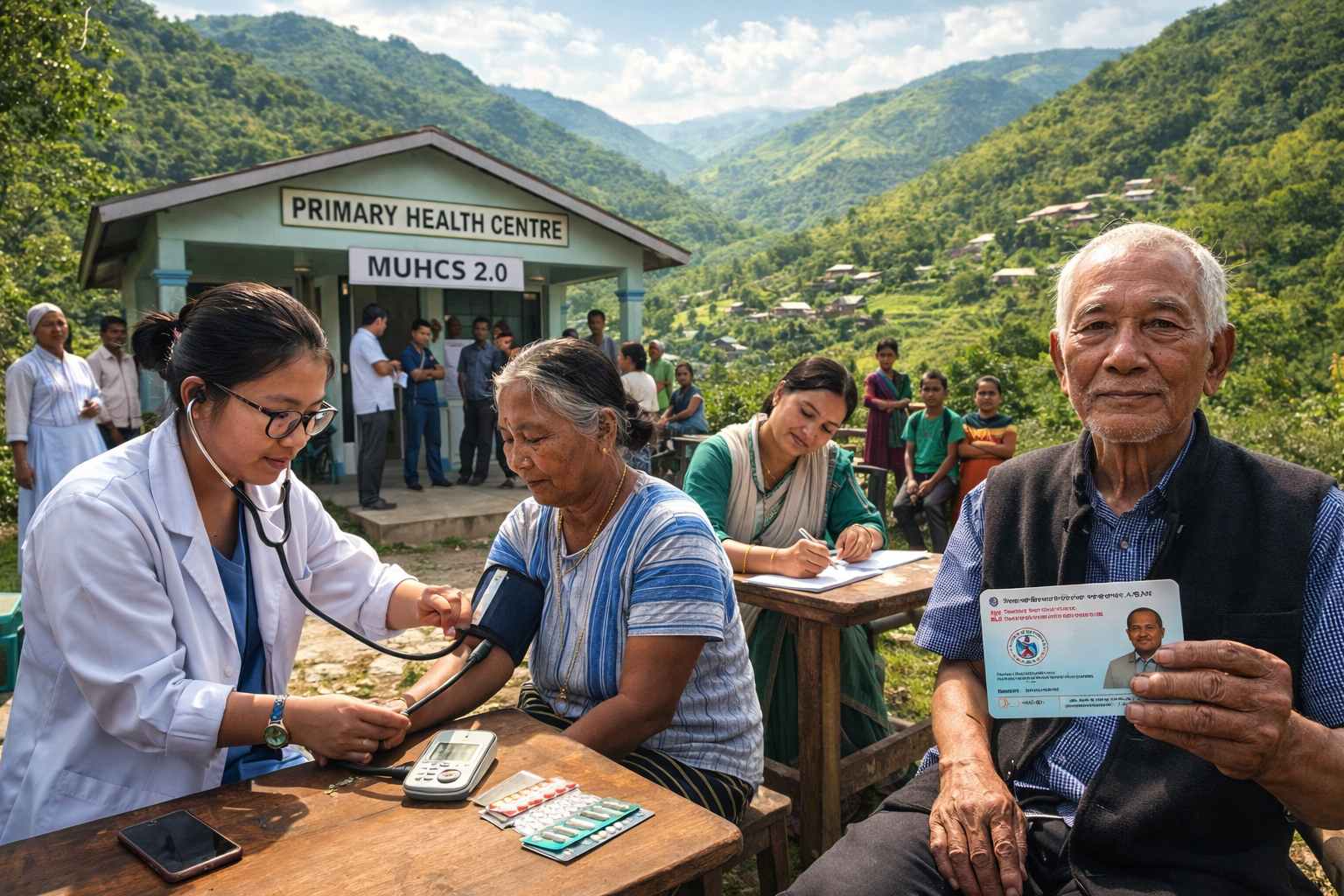
Mizoram’s Healthcare Model Is Quietly Outperforming India’s Big States
Mizoram’s Universal Health Care Scheme 2.0 is redefining public healthcare delivery in India. Here’s how a small state is achieving big results through smart policy design and execution.
In a country where scale often overwhelms systems, Mizoram is quietly demonstrating the power of precision.
On March 16, 2026, the state rolled out the upgraded Mizoram Universal Health Care Scheme (MUHCS 2.0)—a policy move that, at first glance, appears routine. Another scheme, another launch, another set of benefits.
But beneath that surface lies a model that challenges one of India’s most persistent assumptions: that only large states can drive large outcomes.
Mizoram is proving the opposite.
A Compact State, A Complete Vision
With a population of just over a million, Mizoram enjoys a structural advantage that many of India’s larger states do not: administrative proximity.
But proximity alone does not guarantee performance.
What sets Mizoram apart is its ability to convert that advantage into execution. MUHCS 2.0 is not merely an expansion of benefits—it is a recalibration of the system itself, with a sharper focus on financial sustainability, emergency care efficiency, and universal coverage.
At its core, the scheme offers health coverage of up to ₹5 lakh per family per year on a floater basis, aligning it with the national benchmark set by Ayushman Bharat.
But the similarity ends there.
The Financial Architecture: Welfare, Engineered for Sustainability
Public healthcare schemes in India often struggle under the weight of their own ambition.
Mizoram’s approach is different.
The funding structure of MUHCS 2.0 reflects a layered, carefully balanced model:
- ₹130 crore allocated by the state for FY 2026–27
- Over ₹800 crore in external funding from the Asian Development Bank (ADB) to strengthen healthcare infrastructure
- Approximately ₹26.42 crore annually contributed by state employees
This is not just budgeting. It is financial engineering.
By combining internal resources with multilateral funding and stakeholder contributions, Mizoram is attempting something rare in public policy: sustainability without dilution.
From Coverage to Saturation: The Real Achievement
India has made significant strides in expanding health insurance coverage. But coverage alone does not guarantee access.
Mizoram has gone a step further—towards what policymakers call saturation.
The state was recently recognised at the national level for achieving one of the highest levels of health card penetration under converged schemes. In simpler terms, most eligible citizens are not just covered—they are enrolled, identified, and integrated into the system.
This distinction matters.
Because the success of any welfare scheme lies not in its design, but in its last-mile delivery.
Convergence as Strategy, Not Compromise
One of the defining features of MUHCS 2.0 is its seamless convergence with the central Ayushman Bharat Pradhan Mantri Jan Arogya Yojana (AB PM-JAY).
In many parts of India, overlapping schemes create confusion, duplication, and inefficiency.
Mizoram is taking a different route.
By aligning state and central programs, it is building a unified healthcare access system—one that simplifies beneficiary experience, optimises hospital utilisation, and reduces administrative friction.
This is governance thinking at its most practical.
The Human Interface: Where Policy Meets Reality
Schemes succeed or fail at the point of interaction.
Recognising this, Mizoram has introduced a 24/7 call centre (8065293906) under MUHCS 2.0 to handle enrolments, grievances, and real-time support.
It may seem like a small addition.
It is not.
In a geographically challenging state, where access to physical offices can be limited, a responsive digital and tele-support layer becomes a critical bridge between policy and people.
Add to this a clearly defined enrolment window until April 15, 2026, and the intent becomes evident: structured rollout, not open-ended ambiguity.
Why Mizoram Works: Culture, Capacity, and Cohesion
To understand why Mizoram is succeeding where others struggle, one must look beyond policy documents.
Three underlying factors stand out:
1. High Literacy and Awareness
Citizens are more likely to understand, trust, and utilise government schemes.
2. Community-Centric Governance
Local institutions and social cohesion enhance compliance and participation.
3. Administrative Agility
Smaller bureaucratic layers allow faster decision-making and implementation.
These are not easily replicable advantages. But they offer lessons.
The Replicability Question
Can Mizoram’s model be scaled to larger states like Uttar Pradesh or Bihar?
Not in its entirety.
Scale introduces complexity—diverse populations, administrative fragmentation, and infrastructural gaps.
But elements of the Mizoram model are transferable:
- Scheme convergence to reduce duplication
- Digital and call-centre driven grievance systems
- Blended financing models involving multilateral agencies
If adopted thoughtfully, these components could significantly improve healthcare delivery even in larger states.
The Larger Message: Governance Quality Over State Size
Mizoram’s healthcare story carries a broader implication for India’s development narrative.
It challenges the idea that size determines success.
Instead, it points to a more nuanced truth: that governance quality, policy design, and execution discipline matter far more than scale.
In doing so, it also repositions the North East—not as a peripheral region seeking development, but as a laboratory of effective governance.
A Small State with a Big Singal
MUHCS 2.0 may not dominate national headlines. It may not command the scale of flagship central schemes.
But it offers something equally valuable: a working model.
A model that shows how to move from policy to impact, from coverage to utilisation, from intent to outcome.
In the quiet hills of Mizoram, India’s healthcare debate is being rewritten—not through grand declarations, but through disciplined execution.
And sometimes, that is where real transformation begins.https://thequantiq.com/mizorams-green-revolution-from-quiet-frontier-to-ginger-hub-and-northeast-connectivity-powerhouse/