The Fragile Lifeline: Why Mizoram’s Fuel Supply Tells a Bigger Story About Northeast India
When a Bridge Fails, an Economy Pauses
In most parts of India, a damaged bridge is an inconvenience.
In Mizoram, it can become a crisis.
Because in this hill state, supply chains do not have redundancy. They have dependency.
In March 2026, the administration in Lunglei district quietly activated an emergency mechanism—a Joint Control Room to monitor the supply of fuel and cooking gas. It did not make national headlines. But it revealed something fundamental.
Mizoram’s economy runs on a lifeline that is both narrow and fragile.
The Anatomy of Vulnerability
The state’s geography defines its logistics.
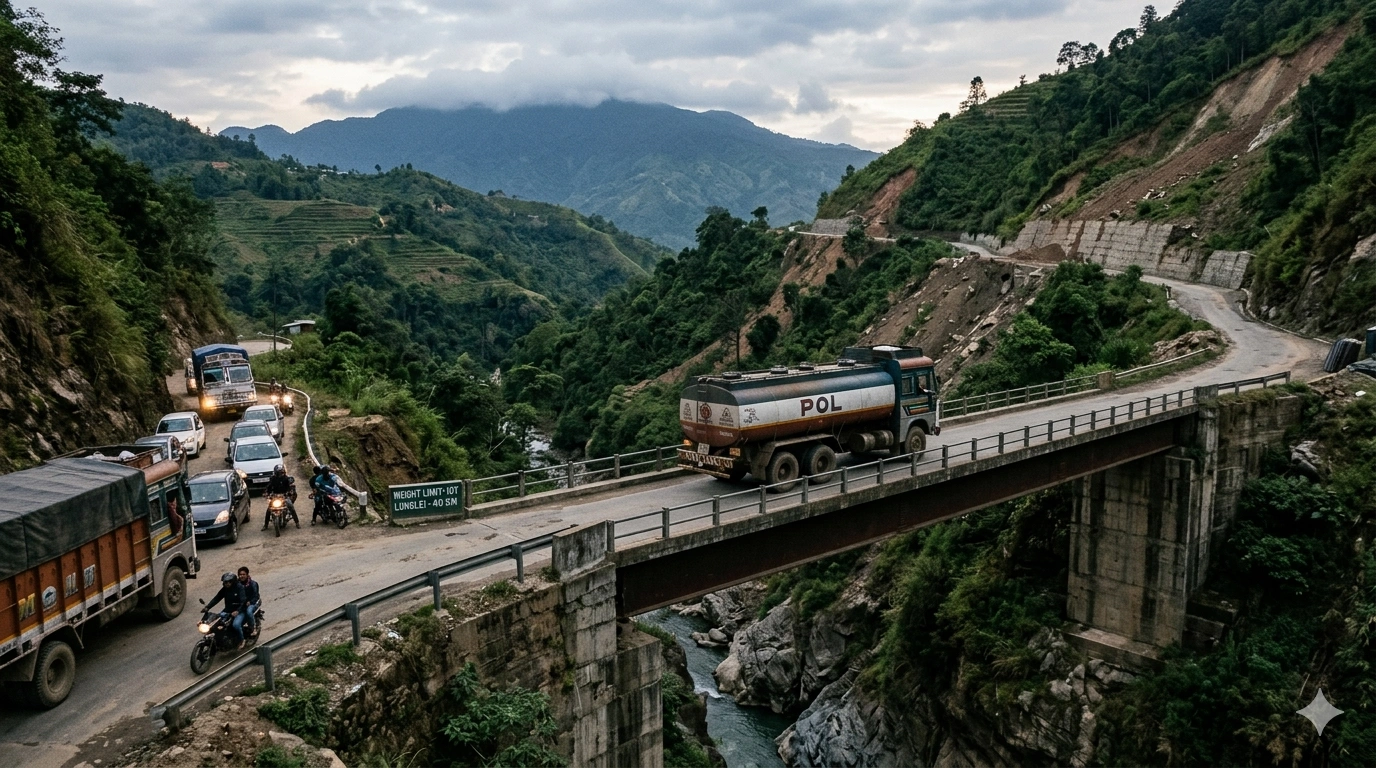
There is no rail connectivity to its southern districts. Road corridors—often single-route, winding through hills and river crossings—carry everything: fuel, food, construction materials, essentials.
A disruption at any point—landslides, floods, or a bridge failure—can ripple across districts like Lawngtlai, Lunglei, and Champhai.
And when the supply chain breaks, it does not just delay goods.
It disrupts daily life.
Why Fuel Becomes the First Signal
Fuel is the most sensitive indicator of supply stress.
Petroleum, Oil & Lubricants (POL) and LPG move through specialised tankers navigating difficult terrain. Any disruption in movement quickly reflects in stock levels.
This is why the state’s Food, Civil Supplies and Consumer Affairs department maintains a daily stock report—a rare example of granular transparency in supply monitoring.
What Mizoram has, perhaps without realising it, is a real-time dashboard of vulnerability.
The Shadow of Infrastructure
The memory of the 2023 railway bridge collapse during the Bhairabi–Sairang project still lingers. It was not just a tragedy—it was a reminder that infrastructure creation in the Northeast carries high risk and long timelines.
Even as new roads and divisions are inaugurated, every addition creates a new responsibility: maintenance.
And here lies a structural imbalance.
Construction is often funded by central schemes.
Maintenance is largely the state’s burden.
This creates a cycle where infrastructure expands faster than it can be sustained.
The Governance Response
The activation of the Lunglei control room reflects a shift in governance—from passive monitoring to active intervention.
The mandate was clear:
- Track stock levels
- Prevent hoarding
- Counter misinformation
In a region where panic can amplify scarcity, information becomes as important as supply.
The Quantiq View
Mizoram’s fuel monitoring system offers a lesson that extends beyond the state.
Supply chains are not just about infrastructure.
They are about resilience.
The real question is not how much infrastructure is built, but how well it can withstand disruption.
If Mizoram’s model of daily transparency evolves into predictive monitoring—tracking stock levels, seasonal disruptions, and logistics gaps—it could become a template for the entire Northeast.
Because in fragile geographies, resilience is not optional.
It is survival.https://thequantiq.com/india-digital-census-2027-northeast/