
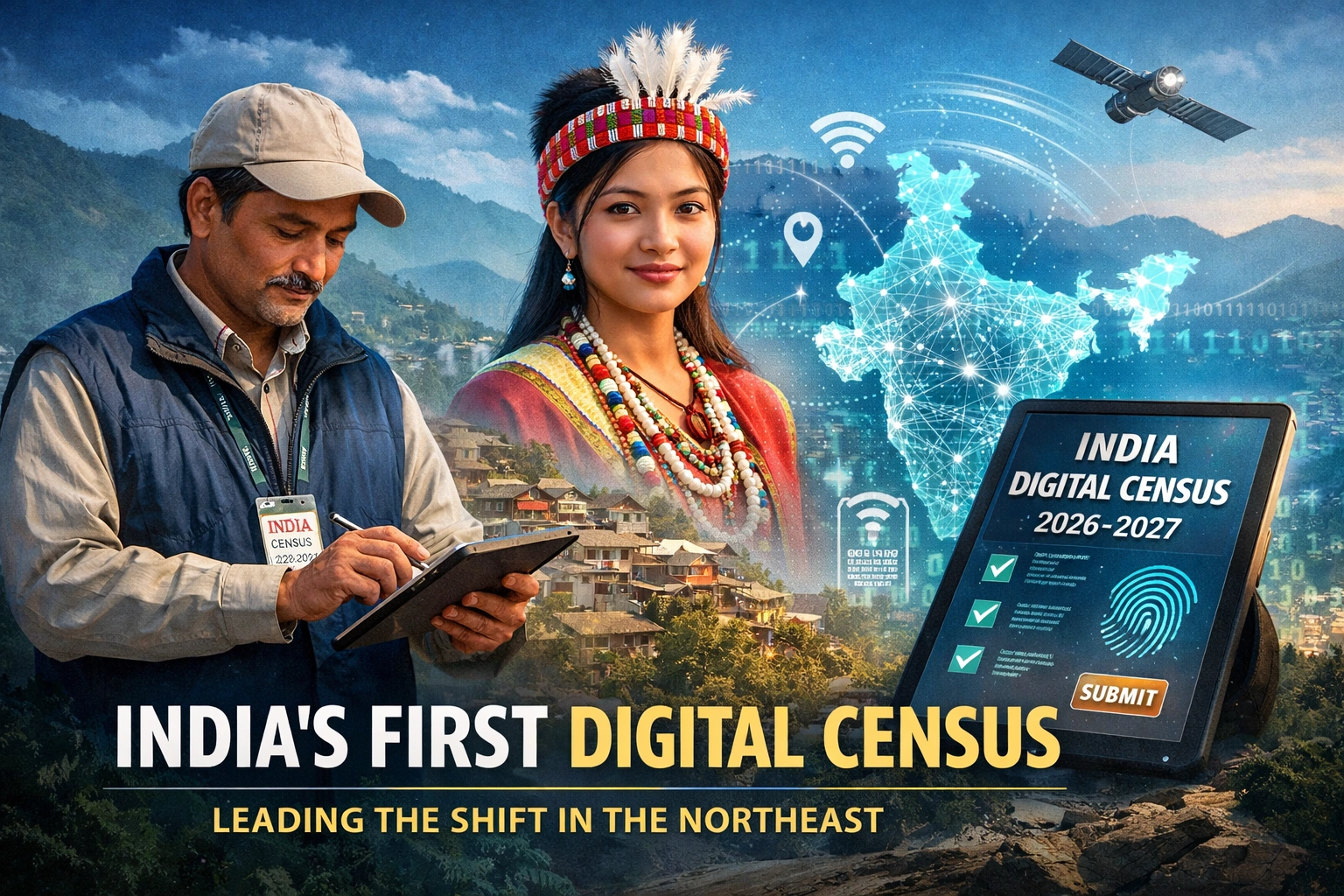
India’s First Digital Census Begins: Why the Northeast Is Leading the Shift
Counting India, Again—But Differently
India has always counted itself in ink.
Enumerators with registers, households marked manually, data compiled over years. It was slow, imperfect, but familiar.
On 1 April 2026, that familiarity ended.
India began its first fully digital census—an exercise that is not just administrative, but transformational. And in a quiet but significant twist, the Northeast has emerged at the front of this transition.
The First Wave—and the Northeast’s Place in It
Sikkim and Mizoram are among the first regions where this new system is being tested. Not alone, but prominently.
This matters.
Because for decades, the Northeast has often been a late entrant in national rollouts. Here, it is part of the vanguard.
The framing of this as “Sikkim’s digital census” misses the point. This is India’s digital census—and the Northeast is helping define how it works.
The Radical Idea: Let Citizens Count Themselves
The most significant shift lies in a simple but powerful idea: self-enumeration.
For the first time, citizens can enter their own data through an online portal, generating a unique ID that enumerators later verify. It is a move that shifts the census from a state-driven exercise to a participatory one.
And the response, even on the first day, suggests readiness. Tens of thousands of households logged in and completed the process within hours of launch.
This is not just compliance. It is adoption.
The Technology Behind the Exercise
Behind this seemingly simple interface lies a complex digital architecture built by Centre for Development of Advanced Computing.
Satellite mapping, multilingual applications, offline functionality, and real-time monitoring systems converge into a single ecosystem designed to handle one of the largest data exercises in human history.
For a country of India’s scale and diversity, this is not just ambitious—it is unprecedented.
Why This Census Matters More Than the Last
India last conducted a census in 2011.
Since then, the country has changed—economically, socially, digitally. Entire welfare systems have been built on data that no longer reflects reality. Migration patterns have shifted. Cities have expanded. Rural economies have transformed.
In the Northeast, these changes are even more pronounced.
States like Sikkim have seen rapid urban concentration driven by tourism, while remote regions continue to grapple with uneven development. Planning without updated data has meant navigating in partial darkness.
This census is, in many ways, a data correction exercise for a decade and a half of change.
The Stakes: Beyond Numbers
Census data does not sit in reports. It shapes outcomes.
It determines how funds are allocated, how constituencies are drawn, where hospitals are built, how schools are planned. It defines visibility—who is counted, and therefore, who is prioritised.
For the Northeast, this is particularly critical.
Accurate data means accurate representation.
Scale Meets Experimentation
The scale of Census 2027 is staggering—millions of enumerators, thousands of training sessions, and a nationwide digital backbone.
But what makes it truly interesting is not the scale.
It is the experiment.
Will citizens embrace self-enumeration?
Will digital systems hold under pressure?
Will the data be cleaner, faster, more actionable?
These are not technical questions. They are questions about the future of governance in India.
The Quantiq View
This census is not just about counting people.
It is about redefining how the state understands them.
If successful, India moves toward a future where governance is real-time, data-driven, and participatory.
And in that future, the Northeast is not catching up.
It is helping lead.https://thequantiq.com/the-border-boom-inside-indias-%e2%82%b911000-crore-bet-on-frontier-villages/




One Comment