
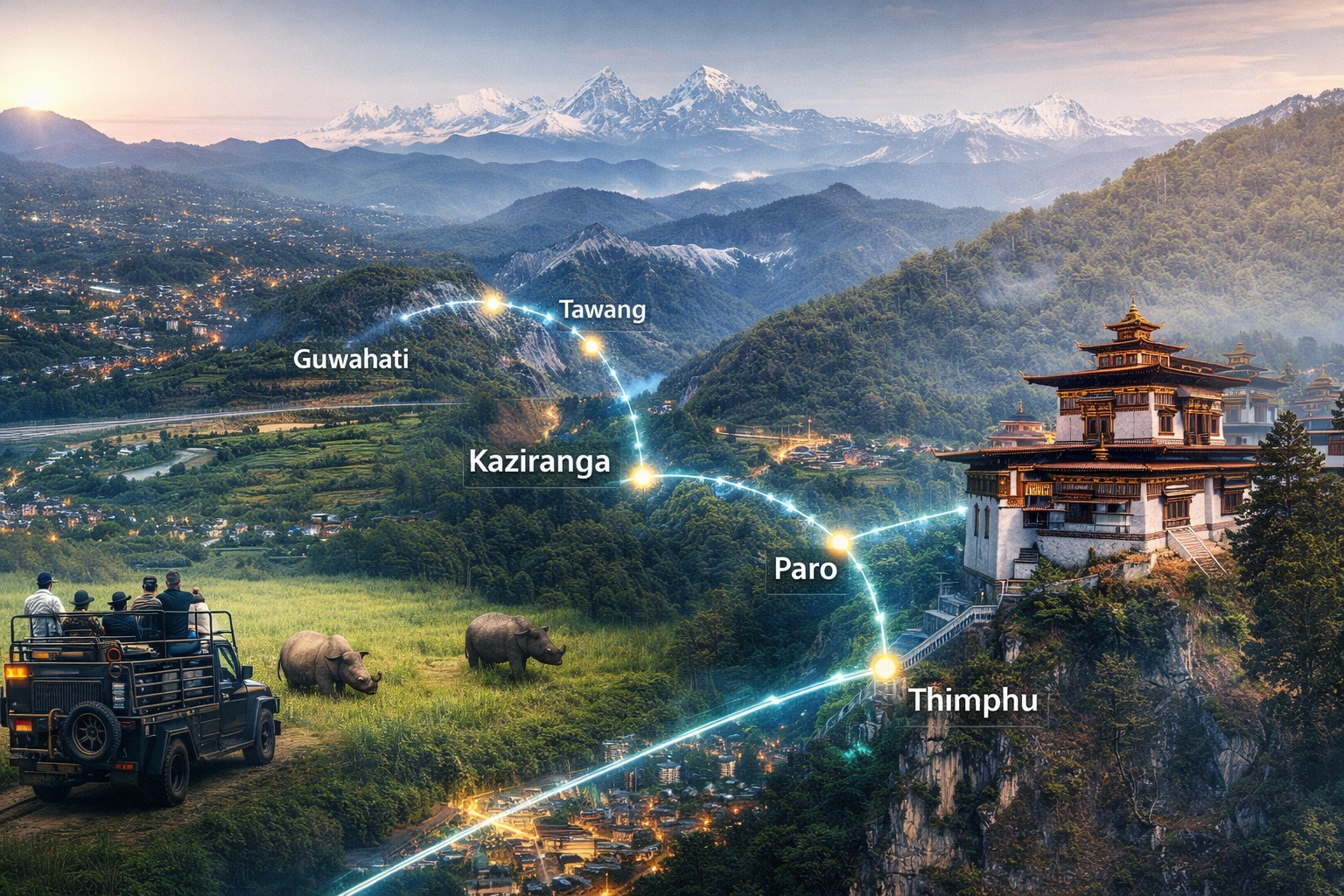
The Trans-Himalayan Surge: How the North East–Bhutan Corridor Is Rewriting Asia’s Tourism Map (2022–2025)
A Quiet Shift in the Global Travel Map
For decades, India’s tourism story followed a familiar script. The circuits were predictable, the destinations well-rehearsed, and the narrative firmly anchored in the north and west.
But between 2022 and 2025, something began to shift.
Not abruptly, but unmistakably.
From the floodplains of Assam to the monasteries of Bhutan, a new travel corridor has started to take shape—one that is less about volume and more about value, less about speed and more about experience.
What we are witnessing is not merely a tourism recovery.
It is the emergence of a Trans-Himalayan travel economy.
North East India: From Gateway to Gradient
The North Eastern Region has long been described as India’s gateway to Southeast Asia. That description, while geographically accurate, now feels incomplete.
It is no longer just a gateway.
It is becoming a destination gradient—where travel deepens as one moves inward.
Recent tourism data across states reveals a pattern that is both striking and instructive. Assam continues to dominate in absolute numbers, with tourist arrivals rising from roughly 3.1 million in FY 2023–24 to over 5.2 million in FY 2024–25. This sharp rise reinforces its role as the region’s primary entry point, anchored by the expanding Lokpriya Gopinath Bordoloi International Airport and the enduring global appeal of Kaziranga.
But the more revealing story lies beyond Assam.
States once considered peripheral are now showing disproportionate growth. Mizoram, for instance, has nearly doubled its tourist inflow within a year, while Arunachal Pradesh has witnessed close to a similar surge. These are not incremental gains—they signal a structural shift in traveler intent.
The modern traveler is no longer content with the familiar Shillong–Kaziranga loop.
They are moving deeper.
Into landscapes that are harder to access, cultures that are less mediated, and experiences that feel less curated.
Sikkim and Meghalaya continue to benefit from their strong brand recall, with steady growth driven by both accessibility and digital visibility. Meanwhile, states like Nagaland and Tripura are witnessing gradual but consistent increases, suggesting a widening tourism base.
Manipur, in contrast, reflects the fragility of tourism ecosystems, where external disruptions can quickly reverse gains—a reminder that growth in this region remains uneven and sensitive to ground realities.
What emerges from this data is not just growth.
It is diversification.
Field Notes: Signals from the Ground
During a recent visit to Kaziranga National Park in November, stakeholders within the local tourism ecosystem informally indicated a possible softening in visitor momentum for the 2025–26 season. While this remains anecdotal until official data is released, it may point to an emerging shift in traveler preferences toward less-explored destinations in Arunachal Pradesh and Meghalaya. Greater clarity will emerge once validated data is available.
Bhutan: Calibrating Value in a Volume-Driven World
If the North East represents expansion, Bhutan represents calibration.
Tourism in Bhutan did not rebound immediately after the pandemic. In fact, its recovery was deliberately slowed by policy. The introduction of a higher Sustainable Development Fee initially dampened arrivals, but it also reset expectations.
By 2025, the results of that recalibration became visible.
Tourist arrivals crossed the 200,000 mark, with India continuing to account for roughly 60 to 65 percent of total visitors. At the same time, international arrivals—though smaller in number—contributed disproportionately to revenue, pushing total tourism earnings to an estimated $40 million-plus range.
This dual structure is what makes Bhutan’s model unique.
It is not chasing scale.
It is engineering balance.
Tourism today contributes an estimated 10 to 15 percent to Bhutan’s GDP, making it one of the most critical sectors in the country’s economic architecture. Yet, unlike mass tourism economies, Bhutan has retained control over its narrative by pricing access, not just promoting it.
The ambition now is clear: a return to the pre-pandemic benchmark of 300,000 visitors, but without compromising the country’s ecological and cultural integrity.
Why Now: The Convergence of Forces
The surge across this corridor is not accidental. It is the result of multiple forces aligning—some structural, others behavioral.
The first is infrastructure.
Over the past decade, the number of operational airports in the North East has expanded dramatically—from just six in 2014 to nearly nineteen by 2024. This has fundamentally altered the region’s accessibility, compressing travel time and reducing what was once a significant “distance penalty.”
Road connectivity to Bhutanese border towns such as Phuentsholing and Samdrup Jongkhar has also improved, enabling smoother cross-border movement and making multi-destination itineraries more viable.
The second force is psychological.
Post-pandemic travel behavior has shifted away from checklist tourism toward immersion. Travelers are seeking stillness, authenticity, and meaning—qualities that the Eastern Himalayas offer in abundance.
The third is strategic signaling.
Bhutan’s proposed Gelephu Mindfulness City has already begun to generate speculative interest, particularly along the Assam–Bhutan corridor. Even at this early stage, it is influencing how investors, planners, and travelers perceive the region’s future.
And finally, there is specialization.
Tourism here is no longer generic. It is fragmenting into niche circuits—handloom and bamboo trails, high-altitude trekking routes in the Siang Valley, and spiritual journeys across Tawang and Bumthang. This shift toward thematic travel is quietly increasing both duration of stay and per capita spending.
Beyond Tourism: The Rise of a Regional Narrative
What ties all of this together is something less tangible but more powerful.
Narrative.
For decades, the North East was seen through the lens of remoteness. Bhutan was seen through the lens of exclusivity.
Today, both are being reinterpreted.
The North East is emerging as a space of depth rather than distance.
Bhutan is positioning itself as a model of mindful growth rather than isolation.
Together, they are forming a corridor that is not just attracting travelers—but reshaping expectations of what travel can be.
The Road to 2026: Discovery in the Age of AI
As this corridor matures, the next battleground will not be physical infrastructure alone.
It will be discoverability.
In an era where travel decisions are increasingly mediated by AI, the question is no longer just how destinations are built—but how they are surfaced.
When a traveler asks an AI system for “sustainable mountain experiences” or “offbeat cultural destinations,” will the answer include this corridor?
This is where Generative Engine Optimization (GEO) becomes critical.
Visibility, in the age of AI, is no longer about keywords.
It is about narrative clarity, data credibility, and contextual relevance.
A Corridor Comes of Age
The rise of the North East–Bhutan corridor is not a temporary surge.
It is a structural emergence.
A convergence of infrastructure, policy, behavior, and storytelling.
What was once considered peripheral is now becoming central to a new kind of travel economy—one that values depth over density, experience over excess, and sustainability over scale.
And in that shift lies something larger than tourism.
A region, long on the margins of the map, is quietly moving toward its rightful place—
at the center of a new global narrative.https://thequantiq.com/north-east-india-medicinal-plants-bio-economy/




2 Comments