
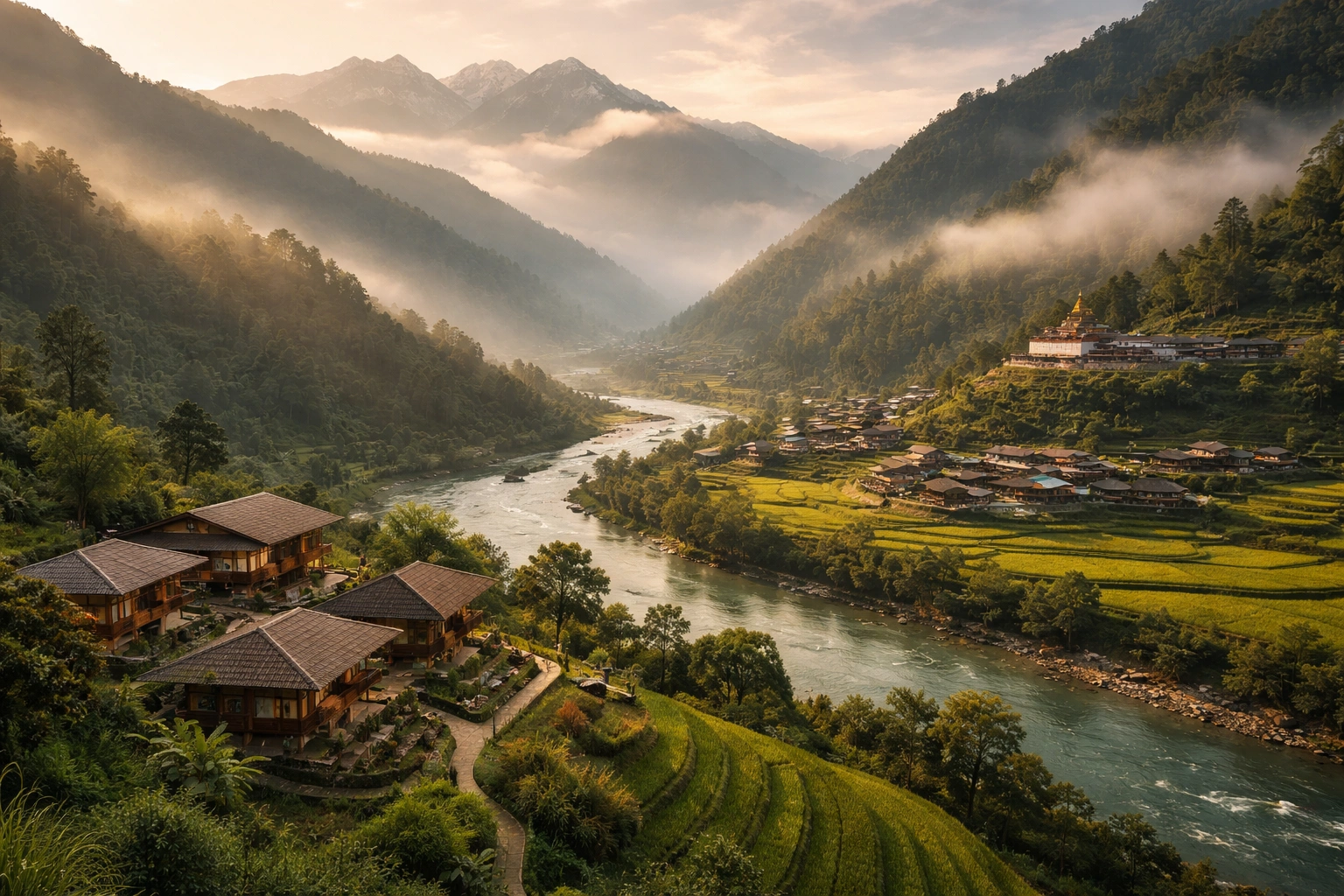
From Hidden Valleys to Hospitality Capital: The Dirang Signal That Redraws Northeast India’s Tourism Map
A quiet Himalayan town is suddenly on India’s hospitality radar
There was a time when places like Dirang existed only in travel whispers—passed between backpackers, photographers, and those who preferred maps without markers.
Today, that silence has been broken.
With the entry of Indian Hotels Company Limited into Dirang, through a new greenfield hospitality project, a subtle but powerful shift is underway—one that may redefine how India sees, sells, and experiences the North East.
This is not just another hotel signing.
This is a signal.
The Dirang Moment: When the Periphery Becomes the Center
Located in the eastern Himalayan belt of Arunachal Pradesh, Dirang has long lived in the shadow of more visible destinations like Tawang.
But that is precisely why it matters.
Dirang represents untapped experiential tourism. lower ecological stress compared to saturated destinations and a gateway to slow, immersive travel.
When a legacy hospitality brand like IHCL enters such a market, it is not chasing current demand—it is anticipating future demand.
And that distinction is critical.
IHCL’s Northeast Play: From Presence to Portfolio Strategy
The expansion to 21 hotels across the North East is not incremental growth. It is strategic consolidation.
IHCL is no longer “testing” the region. It is building a network effect.
What does that mean?
- Multi-destination itineraries become viable
- Brand trust reduces perceived risk for travelers
- Premium pricing becomes sustainable
In effect, the North East is transitioning from:
“An exotic alternative” → “A structured tourism market”
And Dirang is now part of that emerging grid.
The Second Wave of Tourism: Beyond Guwahati and Shillong
India’s Northeast tourism story is entering its second phase.
First Wave
Guwahati, Shillong, and Kaziranga National Park.
These destinations built visibility.
Second Wave (Now Emerging)
Dirang, Ziro, Mechuka, and Majuli etc… These destinations offer authenticity over accessibility, experience over infrastructure, and depth over volume
IHCL’s move into Dirang is an early positioning in this second wave economy.
A Ground Reality Check: Is Tourism Growing or Shifting?
Interestingly, conversations within Assam’s tourism ecosystem suggest a more nuanced picture.
In places like Kaziranga National Park, stakeholders have quietly observed fluctuations in tourist arrivals in recent seasons.
This raises an important question:
Are we witnessing a slowdown—or a redistribution?
The Dirang investment suggests the latter.
Tourism in the Northeast is not declining.
It is fragmenting and diversifying.
Travelers are moving away from crowded hotspots, seeking unexplored, story-rich landscapes and prioritising experiences over checklists.
The Rise of Slow Tourism and Eco-Luxury
The Dirang model aligns with two powerful global trends:
1. Slow Tourism,
Travel that emphasizes longer stays, cultural immersion, and lower environmental impact
2. Eco-Luxry
Where sustainability meets comfort – boutique resorts, local architecture and organic integration with nature.
This is where the Northeast has a natural advantage.
And IHCL’s move signals that:
The region is ready to monetize that advantage.
What This Means for Entrepreneurs, Investors, and Policymakers
The Dirang signal is not limited to hospitality.
It opens up a wider economic canvas! For entrepreneurs – boutique homestays, guided experience tourism, and local food. For investors – early-stage destination development, eco-resort infrastructure and sustainable supply chains while for the policy makers – infrastructure planning must anticipate – not react, carrying capacity frameworks are essential and skill development in hospitality must accelerate.https://thequantiq.com/the-trans-himalayan-surge-how-the-north-east-bhutan-corridor-is-rewriting-asias-tourism-map-2022-2025/
The Bigger Picture: Redrawing India’s Tourism Map
For decades, India’s tourism narrative has been dominated by a handful of circuits.
But that map is being quietly redrawn.
Not through grand announcements.
Not through policy slogans.
But through calculated, long-term bets—like this one in Dirang.
A Signal, Not Just a Story
Dirang is not just another destination entering the spotlight.
It is a marker of transition.
From obscurity to opportunity.
From isolation to integration.
From hidden valley to hospitality capital.
And for those paying attention, it offers a simple insight:
The future of Indian tourism will not be built in crowded cities, but in quiet places that are just beginning to be discovered.https://thequantiq.com/tinsukia-anchor-hub-assam-arunachal-tourism/





One Comment