
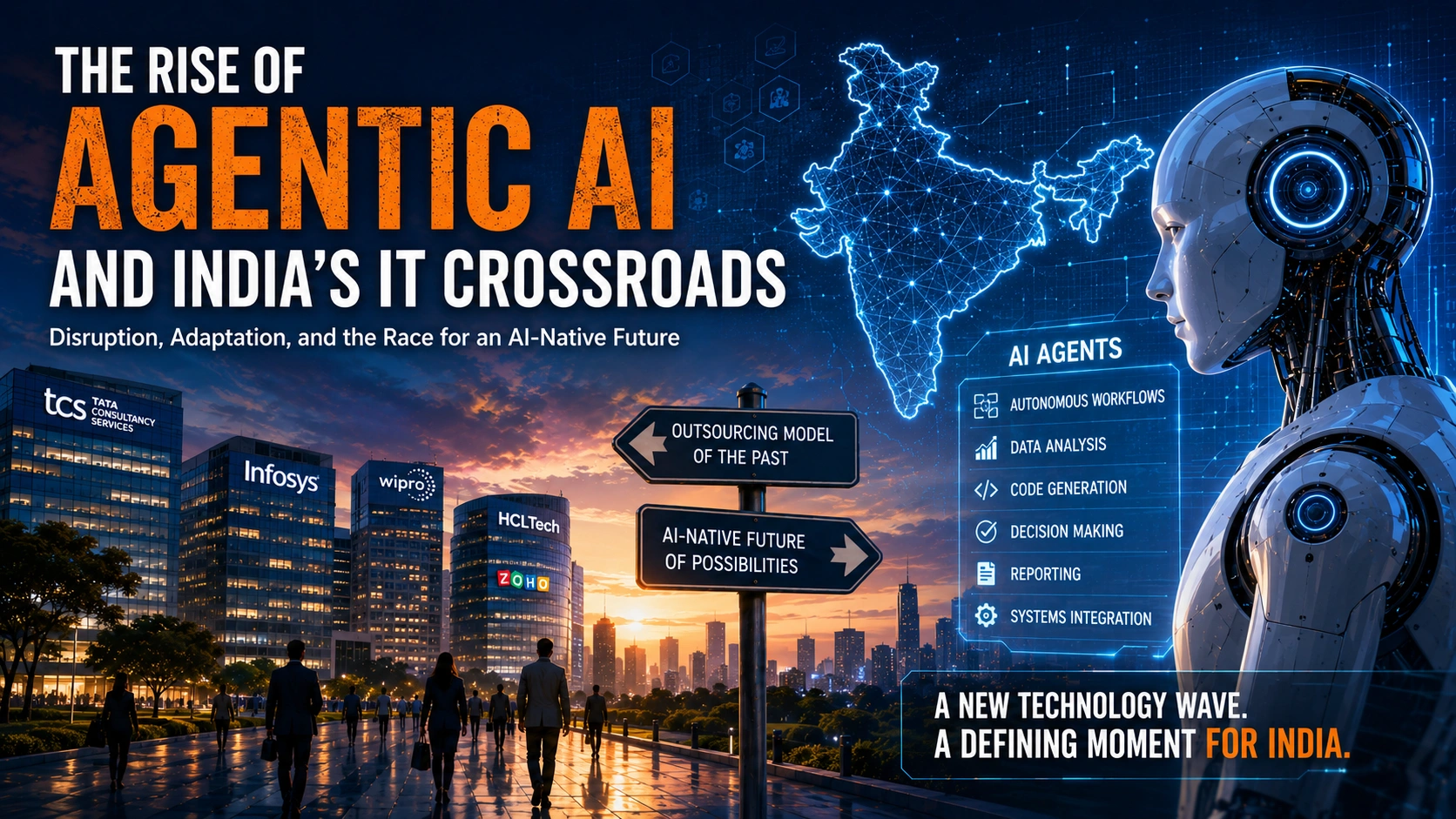
The Rise of Agentic AI and India’s IT Crossroads
For nearly three decades, India’s IT services industry stood as one of the country’s greatest economic success stories. From Bengaluru to Hyderabad, from Pune to Chennai, India built a global reputation as the world’s digital back office. Millions of engineers powered software maintenance, customer support, testing, consulting, integration, and enterprise technology operations for global corporations.
That model transformed India’s urban middle class. It created global giants such as Infosys, Tata Consultancy Services, Wipro, and HCLTech. It helped India emerge as a trusted global technology partner.
But a new technological wave is now beginning to challenge the very logic on which that success was built.
The next phase of artificial intelligence is no longer about chatbots generating answers or writing emails. The industry is moving toward “agentic AI” — systems capable of autonomously executing tasks, coordinating workflows, making decisions, using software tools, interacting with databases, generating reports, writing code, and increasingly acting like digital workers rather than passive assistants.
And if this transition accelerates as many industry leaders expect, India’s IT services sector may be entering the biggest structural transition in its history.
The disruption is no longer theoretical.
This week, Anthropic launched a suite of AI agents designed specifically for financial institutions, capable of handling financial modeling, research, auditing workflows, and document-intensive operations that traditionally required large teams of analysts and associates.
This matters because the global outsourcing economy has historically depended on exactly these kinds of repetitive knowledge-intensive workflows.
The implications extend far beyond Silicon Valley.
For years, India’s outsourcing advantage rested on a simple equation: highly skilled English-speaking talent available at significantly lower costs than Western markets. But agentic AI changes the economics of digital labour itself. If autonomous AI systems can execute substantial portions of repetitive white-collar work continuously, globally, and at rapidly falling marginal costs, the traditional labour arbitrage model begins to weaken.
That does not necessarily mean Indian IT giants are doomed. In fact, many of them clearly understand what is coming.
Rather than resisting the shift, several Indian technology majors are already attempting to reposition themselves for the agentic AI era.
Infosys has emerged as one of the most aggressive Indian players in this transition. The company has launched initiatives such as the “Agentic AI Foundry” and integrated agentic frameworks into its Topaz AI ecosystem. Infosys has also partnered with OpenAI to accelerate enterprise AI transformation through autonomous and composable AI services.
More importantly, Infosys is not merely speaking the language of generative AI marketing. Its own white papers increasingly discuss multi-agent systems capable of project orchestration, predictive risk management, software development automation, and autonomous enterprise workflows.
Similarly, Tata Consultancy Services is actively positioning itself around what it calls “AI-led technology services.” TCS has been showcasing “agentic AI,” autonomous enterprise systems, and AI-native operating models across partnerships with cloud and infrastructure giants.
The Tata Group’s larger AI ambition is becoming increasingly visible. TCS has openly spoken about building AI infrastructure at scale and becoming an “AI-led” technology company rather than merely a traditional outsourcing player.
Yet perhaps the most interesting Indian story in this transition may not come from the traditional IT giants at all.
It may come from Zoho.
Unlike many Indian IT service firms that historically depended on outsourced enterprise work, Zoho spent years quietly building its own global software ecosystem. That distinction may prove crucial in the AI era.
While much of India’s technology industry focused on services, Zoho focused on products.
Now the company is rapidly evolving into an agentic AI platform player. Its “Zia Agents” ecosystem and “Zia Agent Studio” are designed to allow businesses to create autonomous AI agents capable of acting across workflows, applications, and enterprise functions.
Zoho’s newly introduced Model Context Protocol initiatives are particularly significant because they aim to transform business applications into “agent-ready systems” where AI agents can not only generate responses but also take actions across software environments.
That is a fundamentally different direction from traditional outsourcing.
It suggests that India’s future AI competitiveness may increasingly depend on companies building platforms, ecosystems, products, and proprietary AI infrastructure rather than relying primarily on labour-intensive service delivery.
This may ultimately become the defining strategic challenge for India’s technology economy.
Can India transition from being the world’s outsourced workforce to becoming a creator of AI-native products and autonomous enterprise systems?
The answer will determine whether the country remains a global technology powerhouse or gradually loses its competitive edge.
The concern is not simply job loss. The deeper issue is economic restructuring.
Agentic AI threatens to automate layers of middle-skill cognitive work that were previously considered relatively safe from technological disruption. Software testing, documentation, compliance analysis, customer interaction, project coordination, junior analytics, and portions of consulting workflows are increasingly becoming automatable.
Recent developments from Anthropic’s Claude ecosystem demonstrate how rapidly these systems are evolving. Claude Code, one of the company’s flagship agentic coding tools, can autonomously execute coding tasks, interact with systems, edit files, and operate through iterative decision-making loops.
Researchers are now studying agentic coding systems not merely as assistants but as semi-autonomous execution frameworks capable of handling increasingly complex workflows.
This is where India faces a paradox.
The country possesses one of the world’s largest pools of digital talent. But much of its IT workforce remains concentrated in process-heavy implementation work rather than frontier AI innovation.
If AI dramatically improves productivity, companies may eventually require fewer people for many traditional digital operations. A single AI-augmented engineer may soon perform work that previously required entire teams.
That could alter hiring patterns across India’s urban technology ecosystem.
At the same time, however, AI may also create enormous opportunities for countries and companies capable of adapting quickly.
India still retains several strategic advantages:
a vast technical workforce, entrepreneurial energy, English-language dominance, a thriving startup ecosystem, and growing digital infrastructure.
The winners of the next decade may not necessarily be the companies with the largest headcount. They may be the firms capable of combining:
- AI infrastructure,
- proprietary enterprise data,
- domain expertise,
- workflow orchestration,
- and human-AI collaboration at scale.
That transition has already begun.
And it extends beyond the technology sector itself.
Agentic AI will likely affect banking, manufacturing, logistics, consulting, education, healthcare, governance, media, and research. Even industrial giants such as Tata Steel may eventually deploy autonomous AI systems across supply chains, predictive maintenance, industrial analytics, and enterprise operations.
This is why the current AI race is not merely another software cycle.
It is an economic restructuring event.
For India, the question is no longer whether AI will change the technology industry.
The real question is whether India can evolve fast enough to shape the next AI economy instead of merely servicing it.
Because in the age of agentic AI, the future may belong not to the cheapest workforce — but to the smartest ecosystems.https://thequantiq.com/future-of-work-india-wef-skills-crisis-ai/



One Comment