India’s Cotton Reset Could Shape the Future of Sustainable Textiles
A New Push for India’s Cotton Economy
For decades, cotton has quietly remained one of the strongest threads running through India’s economic fabric. It feeds sprawling textile clusters, supports millions of farmers, powers export earnings, and sustains an industry that employs more people than almost any other manufacturing sector in the country. Yet somewhere along the journey, the sector began to lose momentum. Productivity stagnated. Climate stress intensified. Global competition sharpened. And the world’s fashion economy started changing faster than India’s cotton ecosystem could adapt.
Now, New Delhi appears determined to change that trajectory.
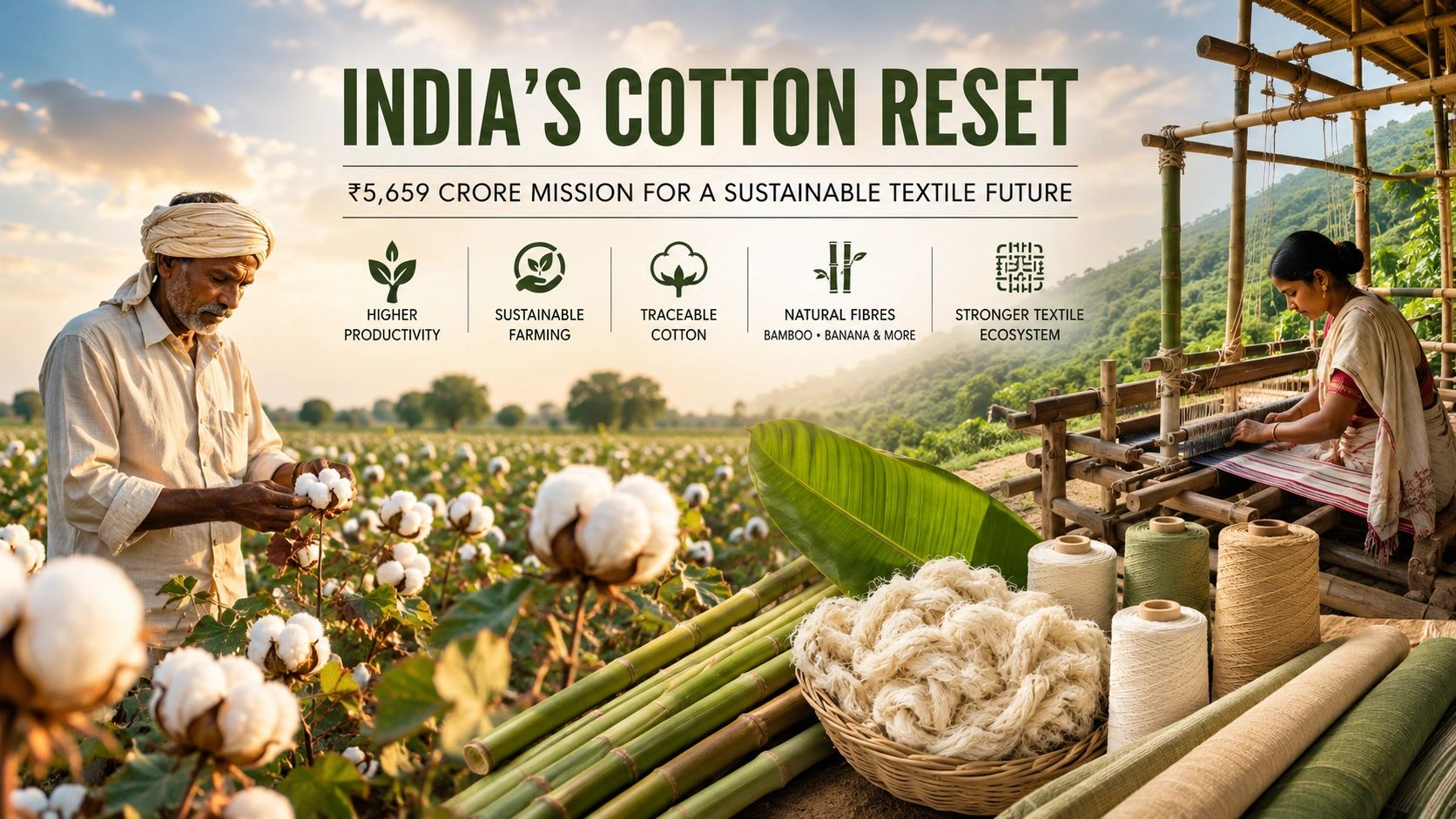
In a significant policy move, the Union Cabinet has approved a ₹5,659 crore national mission aimed at revitalising India’s cotton productivity and strengthening the country’s position in the rapidly evolving global textile economy.
But beneath the government language and administrative framing lies a much larger story — one that goes beyond cotton fields and enters the future of sustainable fashion, traceable supply chains, regenerative agriculture, and India’s ambition to emerge as a trusted global sourcing destination in the post-China textile era.
This is not merely an agriculture story. It is an economic positioning story. And perhaps more importantly, it is a signal that India may finally be preparing for the next generation of the global textile economy.
Why India Is Rethinking Cotton
The newly approved mission seeks to address multiple structural weaknesses that have held back India’s cotton sector for years. Low farm productivity, declining soil health, erratic climate patterns, pest attacks, and inconsistent fibre quality have increasingly affected both farmers and textile manufacturers. While India remains one of the world’s largest cotton producers, yield levels in several regions continue to lag behind competing countries.
The government’s intervention aims to modernise this ecosystem from the ground up.
The mission will focus on improving seed technology, promoting climate-resilient farming practices, enhancing fibre quality, strengthening research, and creating a more transparent cotton value chain. It also seeks to improve traceability under initiatives such as Kasturi Cotton Bharat, which attempts to position Indian cotton as a premium and trusted global product.
That last part may ultimately prove more important than many realise.
The Global Textile Industry Is Changing
The global textile industry is undergoing a profound transformation. International brands are no longer looking only at cost and scale. Increasingly, they are under pressure to prove where their raw materials come from, whether farmers are being treated fairly, how much carbon is embedded in production, and whether the supply chain meets environmental and ethical standards.
Traceability is becoming a competitive advantage. Sustainability is becoming market currency. And transparency is slowly becoming unavoidable. In that changing landscape, India sees an opening.
For years, countries like Bangladesh and Vietnam dominated export-led garment manufacturing, while China controlled vast sections of the global textile supply chain. But geopolitical shifts, supply chain diversification strategies, and the growing search for sustainable alternatives are now creating opportunities for new leadership. India wants a larger share of that future.
The cotton mission appears to be designed not merely to increase production, but to reposition Indian textiles for a new global narrative — one centred around sustainability, authenticity, and natural fibres.
The Hidden Opportunity Beyond Cotton
Interestingly, one of the most overlooked aspects of the announcement lies beyond cotton itself.
The mission also references diversification into alternative natural fibres including bamboo and banana fibre. That small detail carries enormous long-term implications.
Across the world, the fashion industry is searching for alternatives to synthetic and environmentally damaging materials. Bamboo fibre, banana fibre, hemp, flax, and regenerative natural textiles are increasingly entering conversations around sustainable fashion and circular economy models.
India possesses a unique advantage here. From the bamboo-rich landscapes of the Northeast to banana-producing belts across southern and eastern India, the country has access to diverse natural fibre ecosystems that remain vastly underutilised. If supported with innovation, design capability, processing infrastructure, and branding, these fibres could create entirely new rural economies while helping India build a differentiated identity in the global textile market.
This is precisely where the story becomes larger than agriculture policy. It begins to intersect with climate action, slow fashion, rural livelihoods, indigenous textile traditions, and future manufacturing.
Why Northeast India Could Become Important Again
For regions like Northeast India, the implications could be particularly significant. The region already possesses a rich handloom heritage, deep cultural relationships with natural fibres, and growing interest in sustainable textile entrepreneurship. A stronger national push toward diversified natural fibres could eventually create new opportunities for artisans, weavers, agroforestry ventures, and decentralised textile ecosystems.
The global appetite for authentic, ethical, and story-driven textiles is growing steadily. Consumers increasingly want to know not only what they are wearing, but who made it, how it was sourced, and what impact it leaves behind.
India has often spoken about its textile legacy through the lens of history. What is now emerging is the possibility of projecting that legacy into the future.
More Than an Agriculture Mission
Of course, announcements alone do not guarantee transformation. India’s agricultural missions have historically struggled with implementation gaps, fragmented execution, and limited last-mile impact. The success of this initiative will ultimately depend on whether research institutions, farmers, textile manufacturers, startups, exporters, and policymakers can work in alignment over a sustained period.
But the broader direction is unmistakable. The world’s textile economy is entering a new phase where sustainability, traceability, ecology, and material innovation will matter as much as manufacturing scale and labour costs.
India appears to have recognised that shift. And in doing so, the country may be preparing not merely to grow more cotton — but to redefine its place in the future of global textiles.https://thequantiq.com/industrial-hemp-northeast-india-slow-fashion/