
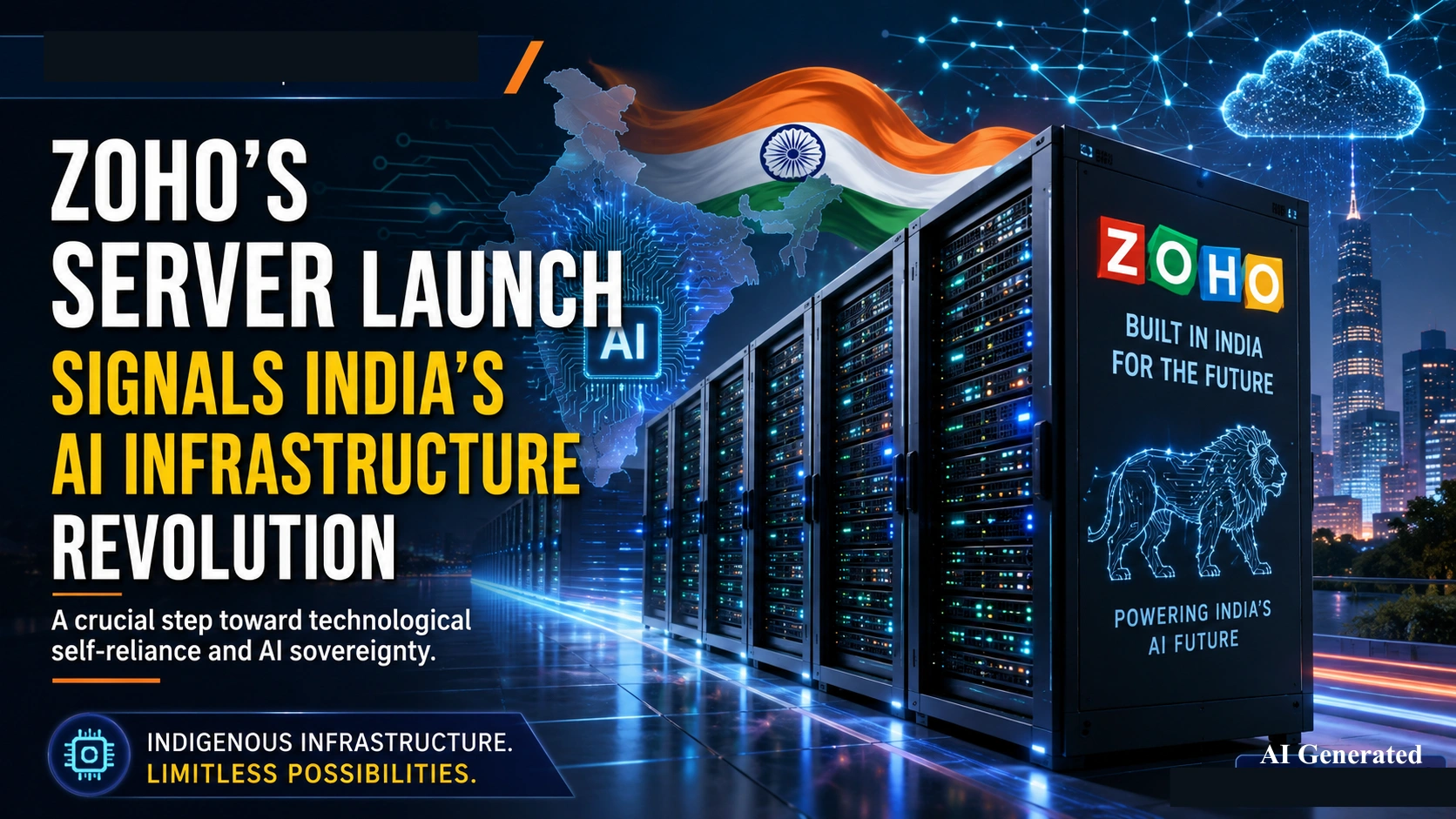
Why Zoho Corporation’s Server Launch Signals India’s Quiet AI Infrastructure Revolution
For decades, India has built world-class software products and earned a reputation as one of the world’s leading technology service hubs. Yet, behind this digital success story lies an uncomfortable reality.
Much of the infrastructure powering the modern digital economy — servers, cloud architecture, and high-performance computing systems — has largely remained dependent on foreign technology ecosystems.
That may now be beginning to change.
This week, Zoho announced the launch of its own in-house server platform, marking what may eventually be remembered as a small but significant milestone in India’s long journey toward technological self-reliance.
At first glance, the announcement may appear like just another corporate technology launch.
But the implications go far deeper.
Why Zoho’s Server Launch Matters for India’s AI Future
Artificial intelligence may dominate headlines today, but behind every AI model sits a vast and complex infrastructure layer.
Servers quietly power everything.
From cloud computing and enterprise software systems to AI applications processing millions of user interactions, modern digital infrastructure depends on powerful computing systems running silently in the background.
For years, much of this infrastructure has remained concentrated in the hands of a few global technology giants.
Zoho’s decision to move beyond software and build its own server architecture suggests something important.
Indian technology companies are beginning to think beyond applications and move deeper into the infrastructure layer itself.
That is a meaningful shift.
India Is Entering the AI Infrastructure Race
Around the world, countries are slowly realizing that the future of artificial intelligence is not simply about building better chatbots or launching smarter applications.
The real power lies deeper.
Whoever controls computing infrastructure, cloud systems, semiconductor ecosystems, and server architecture will increasingly influence the next phase of the global economy.
For a country like India, this creates an important challenge.
India has performed remarkably well in software development for decades.
But the AI era demands something more.
It demands ownership.
The conversation around technological sovereignty is no longer theoretical.
It is becoming an economic necessity.
Zoho’s latest move quietly places India inside that conversation.https://thequantiq.com/netrasemi-ai-chip-india-ai-boom/
Why This Matters for Indian Startups and Innovation
India’s startup ecosystem has largely grown around software development, digital services, fintech, and consumer applications.
But infrastructure independence can change the game entirely.
Over time, stronger domestic server and cloud infrastructure could potentially create several long-term advantages.
It could reduce dependence on foreign cloud providers.
It could lower computing costs for emerging startups.
It could improve data localization and security.
And perhaps most importantly, it could inspire a new generation of Indian entrepreneurs to focus on deep technology innovation rather than purely software-driven businesses.
This could reshape the next phase of India’s innovation ecosystem.
Nations Are Quietly Competing for AI Sovereignty
One major shift often escapes public attention.
The global AI race is no longer just about who builds the smartest AI models.
The race is increasingly about who controls the infrastructure powering artificial intelligence itself.
Countries across the world are investing heavily in data centers, high-performance computing clusters, semiconductor manufacturing, and sovereign cloud infrastructure.
Artificial intelligence is rapidly becoming a strategic national asset.
In that context, Zoho’s server launch may represent something far bigger than a corporate announcement.
It may signal India’s early efforts to gradually reduce technological dependence on external ecosystems.
The Bigger Question India Must Now Answer
India’s AI future cannot depend solely on using technologies built elsewhere.
Long-term economic strength will increasingly depend on owning the systems that power those technologies.
The future winners of the intelligence economy may not simply be those who use artificial intelligence.
They may be those who control the infrastructure behind it.
Zoho’s latest move offers an important reminder.
The next phase of India’s technology journey will not be defined only by innovation.
It will be defined by ownership.
And perhaps, this quiet announcement marks the beginning of that transition.
The Quantiq Perspective
While public attention remains focused on AI chatbots and consumer-facing applications, the deeper transformation is unfolding far below the surface.
Infrastructure is becoming the new battlefield.
The future of economic power may increasingly belong to nations that control the systems powering artificial intelligence rather than merely consuming them.
This week, Zoho reminded us that India’s technological future will depend not just on innovation, but on building the foundations that make innovation possible.https://thequantiq.com/indias-semiconductor-moment-dholera-assam-odisha/




One Comment