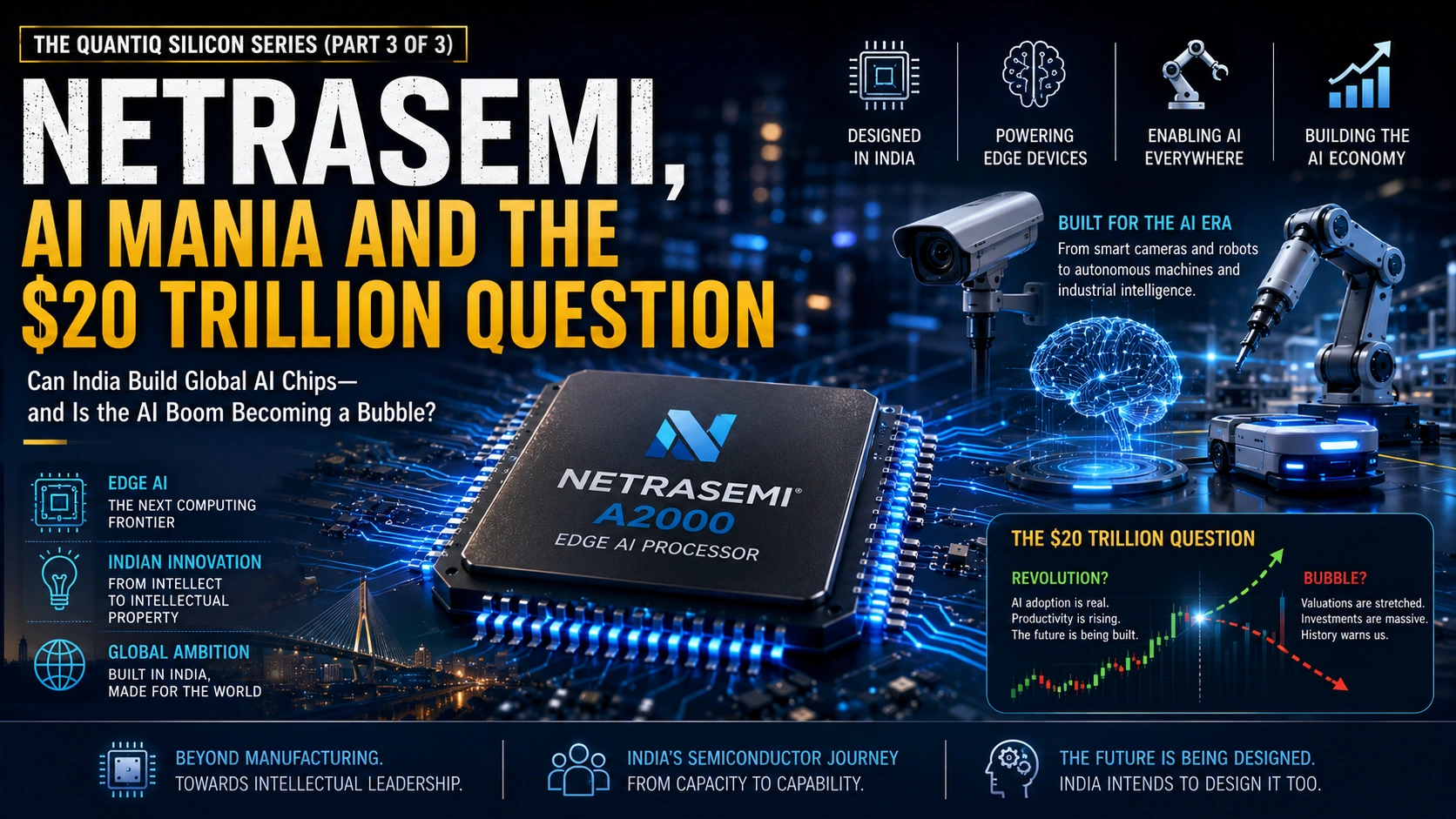
Netrasemi, AI Mania and the $20 Trillion Question
Can India Build Global AI Chips—and Is the AI Boom Becoming a Bubble?
India’s semiconductor ambitions are often discussed in terms of factories, investments and government incentives.
But there is another side to the story.
Factories manufacture chips.
Intellectual property creates value.
As India builds fabrication plants in Gujarat, assembly and testing facilities in Assam, and advanced packaging capabilities in Odisha, a critical question remains:
Can India build semiconductor companies capable of creating globally competitive chip architectures?
A startup from Kerala believes the answer is yes.
In May 2026, Netrasemi announced the successful silicon bring-up of its A2000 edge AI processor, a milestone that places the company among a small group of Indian startups attempting to develop indigenous semiconductor intellectual property.
At the same time, another question is increasingly dominating global boardrooms and investment circles.
As hundreds of billions of dollars flow into AI infrastructure, are we witnessing the birth of the next great technology revolution—or the early stages of a massive speculative bubble?
The answer may determine not only the future of AI, but also the future of India’s semiconductor ambitions.https://thequantiq.com/indias-semiconductor-moment-dholera-assam-odisha/
India’s Semiconductor Challenge Is Bigger Than Manufacturing
In the first two parts of this series, we examined how semiconductors became the foundation of the modern digital economy and how India is building manufacturing capabilities across Gujarat, Assam and Odisha.
Yet manufacturing alone does not guarantee technological leadership.
History offers numerous examples of countries that became manufacturing powerhouses without controlling the intellectual property that generated the highest value.
The semiconductor industry is no different.
The companies that create chip architectures, software ecosystems and proprietary technologies often capture a disproportionate share of profits.
This is precisely why NVIDIA became one of the world’s most valuable companies.
It does not merely manufacture chips.
It owns intellectual property.
For India, the next stage of the semiconductor journey is therefore clear.
The country must learn not only how to manufacture chips, but also how to design them.
Netrasemi — A Different Kind of Indian Startup
When discussions turn to Indian startups, the conversation often revolves around e-commerce, fintech, food delivery or software platforms.
Semiconductors belong to a different universe.
Developing a semiconductor product requires years of engineering effort, expensive design tools, complex validation processes and access to global fabrication facilities.
Failure rates are high.
Development cycles are long.
Capital requirements are substantial.
This is what makes Netrasemi’s progress noteworthy.
Founded in Thiruvananthapuram, Kerala, the company has spent years quietly working on AI-focused semiconductor technologies while attracting support from investors who believe India can build deep-tech companies rather than merely software businesses.
Its successful A2000 silicon bring-up represents more than a technical achievement.
It represents proof that Indian engineers can build sophisticated semiconductor products intended for global markets.
The A2000 — Why This Chip Matters
At first glance, some readers may wonder why a startup chip deserves national attention.
The answer lies in what the chip is designed to do.
Unlike NVIDIA’s flagship data-centre processors, the A2000 targets edge AI.
Edge AI refers to artificial intelligence that operates directly on devices rather than relying on distant cloud servers.
This segment is expected to become one of the fastest-growing areas of the AI economy.
Examples include:
- Smart surveillance systems
- Industrial automation
- Robotics
- Smart-city infrastructure
- Autonomous machines
- Automotive driver-assistance systems
- Agricultural monitoring systems
As AI increasingly moves beyond data centres and into the physical world, demand for specialised edge processors is expected to grow rapidly.
Netrasemi’s strategy is therefore not to compete head-on with NVIDIA.
Instead, it seeks to participate in a fast-growing segment where innovation, efficiency and specialised design matter more than brute-force computing power.
That is a much smarter battle to fight
Why the 12nm Decision Was a Strategic Choice
One of the most misunderstood aspects of the semiconductor industry is the obsession with process nodes.
The headlines often celebrate 2nm and 3nm breakthroughs, creating the impression that anything larger is obsolete.
The reality is more nuanced.
Many commercially successful semiconductor products continue to use mature manufacturing nodes because they offer better economics, lower risks and proven reliability.
Netrasemi’s choice of a 12nm process reflects this reality.
Rather than chasing technological prestige, the company focused on creating a commercially viable product.
For edge AI applications, power efficiency, cost optimisation and scalability often matter more than having the smallest transistor size.
In that sense, the decision reflects strategic maturity rather than technological limitation.
The Sridhar Vembu Signal
Every startup needs capital.
Some startups also attract conviction.
Netrasemi’s investor base includes Sridhar Vembu, founder of Zoho Corporation and one of India’s most respected technology entrepreneurs.
That matters.
Vembu has consistently argued that India must move beyond service-led growth and develop indigenous technological capabilities.
His support for Netrasemi therefore carries significance beyond finance.
It signals confidence in the idea that India can create globally relevant semiconductor intellectual property.
In a country often accused of underinvesting in deep technology, that signal is important.
The Road Ahead Will Not Be Easy
The semiconductor industry is notoriously unforgiving.
A successful chip design does not automatically translate into commercial success.
Companies must secure customers, build ecosystems, establish partnerships and scale manufacturing.
Competition is intense.
Capital requirements remain high.
Global technology giants possess enormous advantages.
Netrasemi faces all of these challenges.
Its future is not guaranteed.
Yet that does not diminish the importance of what it has already achieved.
The company’s existence expands the boundaries of what Indian startups can realistically aspire to build.https://thequantiq.com/silicon-sovereignty-wars-ai-chip-industry/
The $20 Trillion Question — Is the AI Bubble Already Forming?
Every transformational technology creates excitement.
Sometimes it also creates excess.
The railway boom did.
The internet boom did.
Artificial Intelligence may be following a similar pattern.
The debate today is not whether AI is transformative.
Most serious observers agree that it is.
The debate is whether markets are pricing that transformation correctly.
The Numbers That Make Investors Nervous
The world’s largest technology companies are investing at extraordinary speed.
Billions of dollars are being committed to data centres, AI accelerators, networking infrastructure and energy systems.
Entire industries are reorganising themselves around AI.
The scale of spending has led some investors to ask whether infrastructure is being built faster than revenue can justify.
In other words:
Is the world overbuilding for AI?
Or is it simply preparing for demand that has not yet fully arrived?
The Case for Caution
Sceptics point to history.
During the dot-com era, investors correctly predicted that the internet would transform the world.
They were wrong only about timing.
Many companies collapsed long before the technology fulfilled its promise.
A similar pattern could emerge in AI.
Some startups will fail.
Some business models will disappoint.
Some valuations may prove difficult to justify.
That possibility should not be ignored.
The Case for Optimism
The bullish argument is equally compelling.
Unlike many past technology bubbles, AI is already generating measurable economic value.
Businesses are deploying AI in software development, healthcare, logistics, manufacturing, finance and scientific research.
Productivity gains are becoming increasingly visible.
New applications continue to emerge.
Supporters therefore argue that today’s infrastructure investments resemble the construction of railways, electricity grids and internet backbones.
The costs arrive first.
The benefits arrive later.
If this view proves correct, the current AI buildout may eventually look conservative rather than excessive.
Three Possible Futures
Scenario One: The Soft Landing
AI adoption continues steadily.
Revenue growth catches up with infrastructure spending.
Valuations cool but remain healthy.
The industry matures without major disruption.
Scenario Two: The Correction
Investor expectations move ahead of commercial reality.
Funding becomes more selective.
Many startups disappear.
Stronger companies survive and emerge more resilient.
Scenario Three: The Shock
A major geopolitical event, economic crisis or semiconductor supply-chain disruption triggers a broader market downturn.
This remains the least desirable scenario but cannot be entirely dismissed given the strategic concentration of semiconductor manufacturing.
The Quantiq’s Assessment
The global semiconductor race is not merely about technology.
It is about economic power.
It is about intellectual property.
It is about industrial capability.
And increasingly, it is about national resilience.
India’s semiconductor ambitions are still in their early stages.
The country remains years behind the world’s leading semiconductor powers.
Yet something important has changed.
For the first time, India is simultaneously building capabilities across multiple layers of the semiconductor value chain.
Gujarat is developing fabrication capacity.
Assam is entering assembly and testing.
Odisha is building advanced packaging and compound semiconductor capabilities.
Meanwhile, companies such as Netrasemi are attempting to create intellectual property rather than simply consume it.
That combination matters.
Manufacturing creates capacity.
Intellectual property creates leverage.
The countries that dominate the semiconductor era will ultimately need both.
Will every semiconductor project succeed?
Probably not.
Will every AI startup survive?
Almost certainly not.
Will the AI economy experience corrections and volatility?
History suggests it will.
But those uncertainties should not distract from a larger reality.
The semiconductor age has already begun.
The AI age has already begun.
The question is no longer whether India will participate.
The question is whether India can move from participation to leadership.
Netrasemi’s greatest contribution may not be the A2000 chip itself.
It may be the idea it represents.
The idea that Indian companies can design advanced technologies, create intellectual property and compete in industries long dominated by others.
If that idea takes root, the impact could extend far beyond semiconductors.
And that may ultimately prove to be the most important story of all.
Series Complete
This article concludes The Quantiq Silicon Series, a three-part exploration of the semiconductor industry, artificial intelligence, and India’s emerging role in one of the world’s most strategic sectors.
Part 1: The Silicon Sovereignty Wars — How NVIDIA, TSMC and ASML came to dominate the global AI chip ecosystem.
Part 2: India’s Semiconductor Moment — How Gujarat, Assam and Odisha are helping shape India’s semiconductor geography.
Part 3: Netrasemi, AI Mania and the $20 Trillion Question — Why intellectual property, innovation and the future of AI may determine India’s place in the semiconductor era.
Together, these articles examine the global race for semiconductor leadership and the opportunities and challenges facing India as it seeks to move from participation to technological leadership in the age of Artificial Intelligence.
The Quantiq will continue tracking developments in semiconductors, AI infrastructure, deep-tech innovation and India’s journey towards technological sovereignty.



2 Comments