Manorom Gogoi: Building a Sovereign Producer Economy, One Plate at a Time
How a journalist turned social-preneur is using Tholgiri to connect Assam’s farmers, food producers, weavers and artisans with consumers while bringing authentic Assamese food and culture to the world.
The Quantiq Founder Series | Editorial Profile

There are restaurants that serve food. There are restaurants that create an ambience. And then there are businesses that quietly make an argument about how an economy could work.
Tholgiri, founded by journalist-turned-social-preneur Manorom Gogoi, belongs to the third category.
Walk into Tholgiri in Uzan Bazar, Guwahati, and the first impression is unmistakably Assamese. The food, the weaves, the artisanal products, and the interiors are designed to create an immediate sense of place. Yet the most interesting part of Tholgiri is not what a visitor sees around the dining table.
It is what happens before the food reaches it.
According to Gogoi, only two ingredients used at Tholgiri come from outside Assam: salt and onions. The rice, vegetables, meat, tea and cooking oil are sourced from farmers, producers and artisans within the state.
That is much more than a sourcing preference.
It is Gogoi’s attempt to practise what he calls a sovereign producer economy.
And unlike many economic ideas that remain confined to seminars and policy discussions, this one is being tested every day through a functioning business.
A Journalist Who Started Asking a Different Question
Gogoi has spent more than two decades in journalism, working across reporting, sub-editing, editing, print, and television. He was also part of the founding team behind Budhbar, a media platform conceived as an alternative to the conventional advertising-dependent media model, with a greater emphasis on community participation and support.
Even today, Gogoi continues to identify himself as a journalist.
Tholgiri, therefore, is not a complete departure from his earlier life. In many ways, it is an extension of the same instinct that drove him to journalism: observing a problem, asking uncomfortable questions and trying to understand what lies beneath it.
The idea for Tholgiri, however, did not originate in a newsroom. It began at a roadside eatery near Disangmukh in Sivasagar district.
After attending a seminar, Gogoi was served a traditional Assamese meal featuring Kumol Chaul, Doi and Gur. What caught his attention was not simply the food. The small eatery was full of regular customers, despite being located away from Assam’s urban centres.
He began wondering whether the same food could find a market in cities. His question was remarkably simple:
“If our delicacies are sellable in such a remote place, why can’t we market it in urban cities?”
That question eventually became Tholgiri.
The Supply Chain Came Before the Restaurant
Gogoi did not begin by finding a restaurant space and then searching for suppliers.
He began with the producers.
Before Tholgiri opened, he travelled across Assam, speaking at more than a hundred meetings and seminars to understand whether farmers, weavers and artisans could be brought into a functioning supply network.
Today, Tholgiri works directly with more than 2,000 farmers, producers and weavers across Upper and Lower Assam. Its vendors include small producers who supply rice, Pitha, Laru and other traditional consumables. Gogoi says the payment system is deliberately transparent, with suppliers paid at the point of supply or in advance, while some producers receive lump-sum advances.
The impact becomes more meaningful when viewed from the perspective of the people behind those supplies.
According to Gogoi, his vendors earn an average of around ₹30,000 a month through their association with Tholgiri. In one particularly striking example, a vendor from Majuli earned ₹1.5 lakh in a single month.
For a small producer making Pitha or Laru, or supplying rice and other traditional food products, a dependable urban market can make a significant difference.
This is where the idea of a sovereign producer economy moves beyond theory.
Tholgiri is not merely sourcing locally. It is attempting to create a market for local producers.https://thequantiq.com/brand-north-east-doner-value-chain-strategy/
Not Just a Restaurant, but an Assamese Experience
Gogoi prefers not to describe Tholgiri simply as a restaurant.
He calls it an experience centre.
The distinction is deliberate. Food, crafts and weaves are brought together within a space designed to evoke Assamese hospitality and traditional aesthetics. The objective is to give visitors a sense of Assam rather than simply serve them a meal.
The food itself is central to that experience.
Alongside rice-based dishes and traditional Assamese meals, Tholgiri presents Jolpan and is exploring ready-to-eat and ready-to-serve formats that could take familiar Assamese foods to consumers beyond the traditional context.

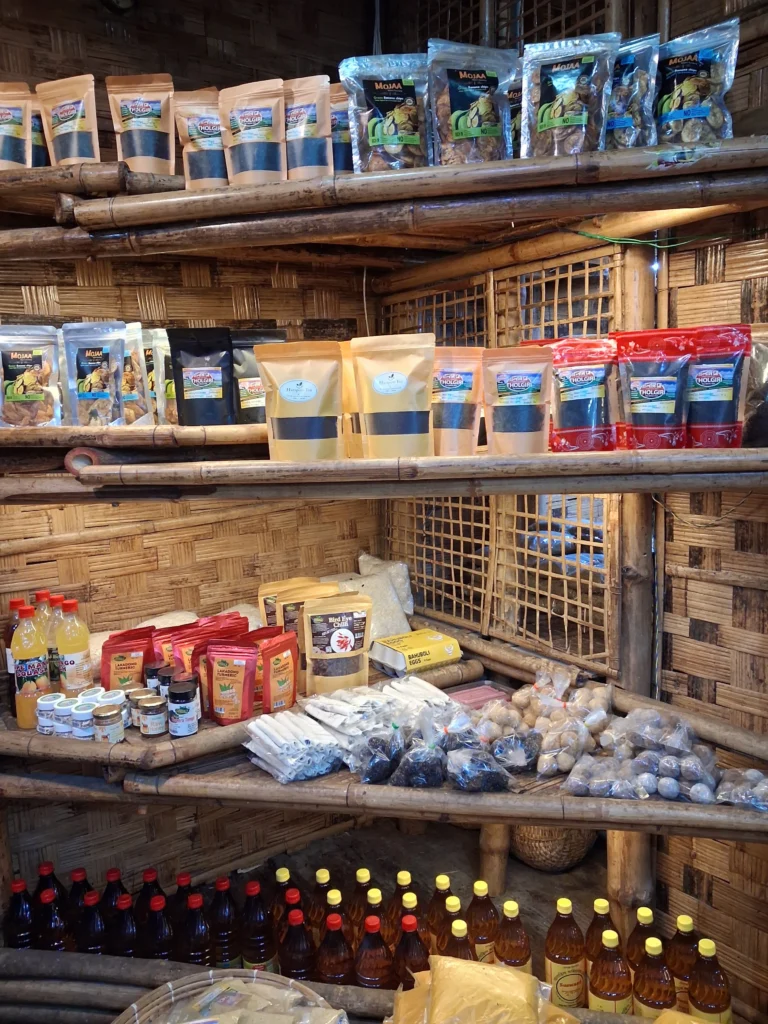
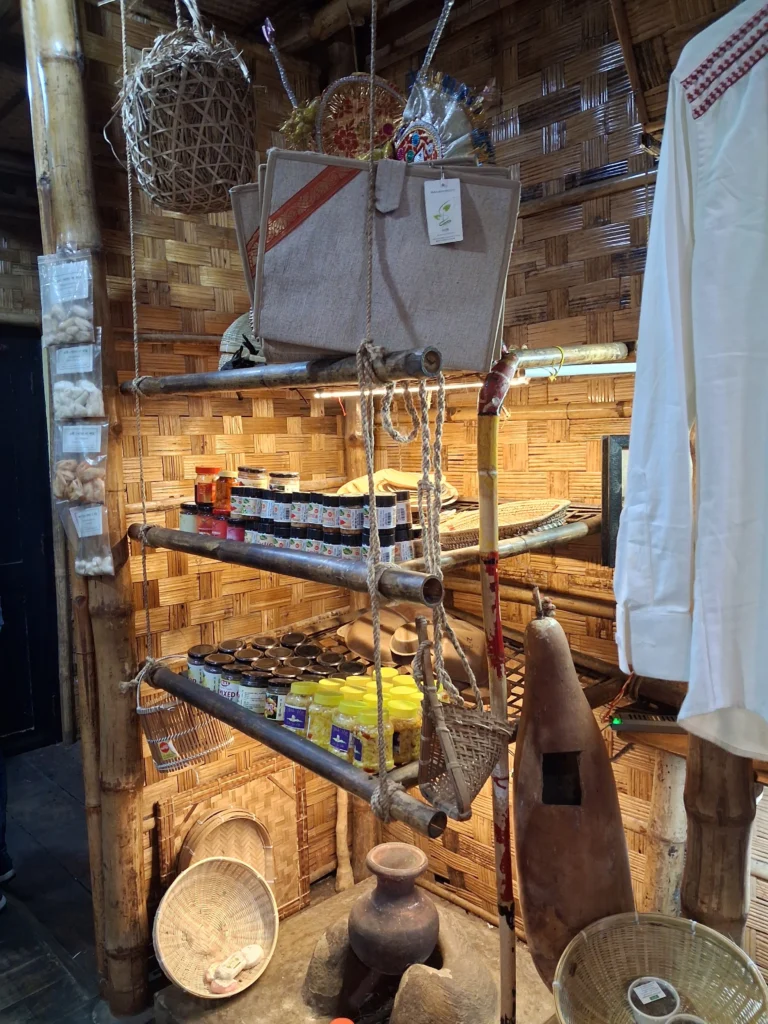
This is where its Repast concept becomes particularly interesting.
Kumol Chaul (Soft Grain Repast) presents Assam’s distinctive self-softening rice as a contemporary food proposition. Hooroom (Puffed Heritage Repast) repositions the light, roasted native rice preparation as a heritage cereal. Chira-Doi (Cultured Rice Repast) brings together flattened rice, curd and jaggery in a familiar Assamese combination, while Sandoh Guri (Roasted Grain Repast) offers roasted rice meal as a traditional yet potentially contemporary food product.
Then there are Pitha (Artisanal Repast) and Laru (Artisanal Repast), carrying with them the memory and craftsmanship of Assamese kitchens.
The challenge is to make these products accessible to consumers who may have never encountered them before without stripping away what makes them authentically Assamese.
That is where entrepreneurship becomes important.
When Food Heritage Becomes a Market Opportunity
Traditional food is often discussed as cultural heritage.
Gogoi appears to see another possibility.
He sees an economic opportunity.
A bowl of Chira-Doi is part of everyday Assamese life. But when its ingredients, preparation, presentation, and packaging are thoughtfully developed, it can become an introduction to Assamese food culture for someone living thousands of kilometres away.
The same is true of Kumol Chaul, Hooroom, Sandoh Guri, Pitha and Laru.
The objective should not be to industrialise traditional food until it loses its character. Instead, the opportunity lies in creating formats that allow these foods to travel while retaining the identity, taste and cultural context that make them distinctive.
That could become increasingly valuable in a global food market where consumers are looking for authenticity, provenance and stories that connect products to a place.
The World Has Already Found Tholgiri
For a business that is deeply rooted in Assam, Tholgiri’s customer base has been surprisingly global.
Gogoi says Tholgiri has served food lovers looking for authentic Assamese delicacies from all continents, with international visitors forming an important part of its audience. There have also been numerous repeat visitors from abroad, suggesting that the experience has become more than a one-time curiosity for some international guests.
The business’s early international visibility was helped by independent bloggers, including one from the United States and another from Azerbaijan, whose coverage generated millions of views. Word of mouth from visitors subsequently helped extend the reach.
There is an important lesson here. A business does not necessarily have to become less local to become global. Sometimes, the opposite is true.
The more genuinely a product expresses its place, its people and its culture, the more distinctive it can become in an increasingly crowded global marketplace.https://assamtourism.gov.in/
From Food to a Bigger Economic Argument
Ask Gogoi about Tholgiri and the conversation soon moves beyond food.
He is a strong believer in what he describes as a sovereign economy, rooted in Assam’s ability to produce more of what it consumes rather than continually depending on finished products brought in from outside.
His thinking is partly informed by his understanding of Assam’s economic history. He points towards an earlier producer-oriented economy and the region’s extraordinary agricultural diversity, particularly its rich rice heritage.
His concern is that Assam has gradually become too dependent on consumption.
“We cannot afford to remain a net-net consumer state for long. The consumer economy rut has been keeping us poor.”
For Gogoi, the issue is not consumption itself. It is what happens when a region repeatedly sends money outside to buy finished products that could potentially be produced, processed and branded locally.
If rice is grown in Assam, processed in Assam, turned into a food product by an Assamese enterprise and sold to consumers in Assam, more of the resulting value remains within the region.
The same principle applies to Pitha, Laru, traditional grains, tea, vegetables, meat and artisanal products.
The scale of one enterprise may be modest compared with Assam’s overall economy.
But the principle is much larger.https://www.mdoner.gov.in/
Local Resources Are Only the Beginning
Gogoi’s philosophy does not end with encouraging people to buy local.
He is equally clear that a producer economy must eventually move towards science, innovation and intellectual property.
He points to Assam’s tea industry as an example. Despite more than two centuries of tea production, he argues that the state has not captured enough value through science-led, value-added products.
In an economy increasingly influenced by technology and artificial intelligence, he believes businesses cannot depend indefinitely on emotional narratives about regional identity.
“We cannot sustain a business selling emotion or narratives which can be copied in minutes by anybody. We need science-led innovation and patents to build a strong, resilient, and prosperous Assam.”
That distinction is crucial. A sovereign producer economy cannot simply mean producing locally.
It must eventually mean innovating locally, owning intellectual property locally, building brands locally, and selling globally.
A Business That Has Grown Without Losing Its Roots
Since its launch in 2018, Tholgiri has grown by leaps and bounds, building a strong following among local customers as well as visitors from across India and abroad. Tourist season from September to April brings a steady flow of domestic and international visitors, while long weekends can see local customers queuing for a taste of authentic Assamese food.
The growth is significant because it has happened without Tholgiri abandoning the very principles on which it was founded. Its sourcing remains deeply rooted in Assam, its producer network continues to expand, and the experience centre has retained its emphasis on Assamese food, crafts, weaves and hospitality.
That makes Tholgiri an interesting entrepreneurial proposition. Being deeply local has not prevented it from growing; in many ways, its authenticity appears to have become one of the reasons for its appeal.
Yet Gogoi has no immediate ambition to turn Tholgiri into a national restaurant chain.
He wants to expand its scale without necessarily expanding its geography.
The reason is understandable. A franchise can reproduce a menu, an interior and a brand identity. It cannot automatically reproduce the relationships with farmers, producers, weavers and artisans that have taken years to build.
Tholgiri’s model depends on those relationships.
For Gogoi, therefore, growth appears to mean deepening the ecosystem rather than simply multiplying outlets.
That is a very different way of defining entrepreneurial success.
The Tholgiri Lesson: Resources Ours, Value Ours
Strip away the food, the interiors and the hospitality, and Tholgiri becomes a fascinating economic experiment.
Its philosophy can be expressed in five simple ideas:
Resources Ours. Process Ours. Value Ours. Brand Ours. Wealth Ours.
That is the essence of the Sovereign Producer Economy that Tholgiri attempts to demonstrate in practice.
The strongest evidence is not Gogoi’s rhetoric.
It is the business itself.
More than 2,000 producers and weavers are connected to the enterprise. Small vendors supplying rice, Pitha, Laru and other consumables are able to access an organised market. According to Gogoi, vendors earn around ₹30,000 a month on average, with some individual months reaching much higher levels.
For a region seeking to retain more economic value within itself, that is an important distinction.
The money generated by a product should not disappear from the region as soon as the product leaves the farm, workshop or village.
It should circulate through the producer, processor, entrepreneur, designer, retailer and service provider before reaching the consumer.
That is how local production becomes a local economy.
The Quantiq Verdict
Whether Tholgiri’s exact model can be replicated elsewhere remains an open question. Perhaps it does not need to be replicated in exactly the same form. Its larger contribution lies in the question it raises about how businesses in Northeast India can create more value from what the region already produces.
What would happen if more businesses were built around the resources, skills and traditions of the Northeast rather than around products imported from outside the region? Could traditional food become a consumer brand? Could local producers become regular suppliers to organised markets instead of depending mainly on fragmented demand? And could Assam’s extraordinary food heritage become an economic asset that reaches consumers far beyond the region?
These questions point towards a different way of thinking about entrepreneurship. Instead of beginning with what the Northeast does not have, entrepreneurs could begin with the resources, skills and knowledge that already exist around them.
Manorom Gogoi is not presenting his answer through a policy paper or a development blueprint. He is testing the idea through Tholgiri, by connecting producers with consumers and turning traditional Assamese food into an experience that has attracted visitors from across India and around the world.
That is what makes Tholgiri worth watching. It is not simply a destination for authentic Assamese food; it is a small but functioning demonstration of how local resources can create markets, livelihoods and new forms of value within the region.
A sovereign producer economy does not begin with a government notification. It begins when an entrepreneur looks at what a region produces, understands what its people can create, sees what consumers are buying from elsewhere and decides to build the missing connection.
Manorom Gogoi has chosen to build that connection one producer, one product and, quite literally, one plate at a time.