
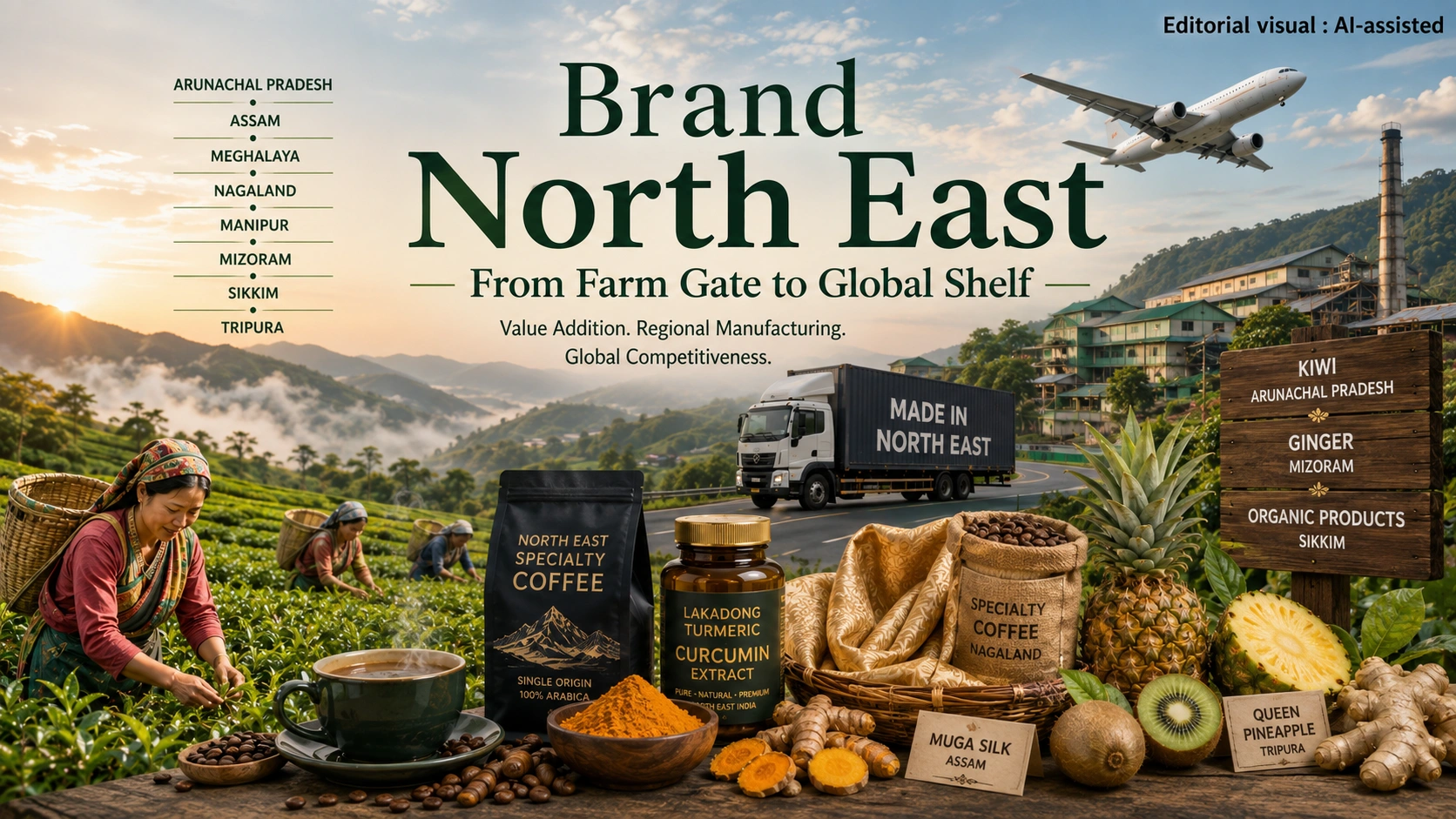
From Farm Gate to Global Shelf: Can ‘Brand North East’ Finally Unlock the Region’s Economic Potential?
DoNER Minister Jyotiraditya Scindia’s July 2026 message signals a welcome shift towards value chains and branding. But can it help the Northeast move beyond exporting raw materials to building globally competitive industries?
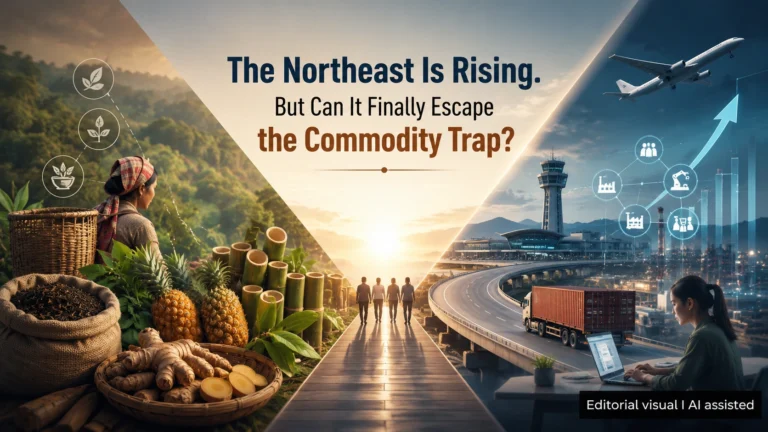
For generations, Northeast India has been celebrated for its breathtaking landscapes, rich biodiversity and extraordinary agricultural wealth. From Assam’s golden Muga silk and premium tea to Meghalaya’s Lakadong turmeric, Nagaland’s coffee and Tripura’s Queen pineapple, the region possesses products that are admired far beyond India’s borders. Yet, despite this abundance, the Northeast has struggled to translate its natural advantages into sustained industrial growth and large-scale wealth creation.
The reason is not difficult to understand. While the region produces some of the country’s finest raw materials, a significant share of their economic value is created elsewhere. Crops are harvested in the Northeast, but they are often processed, branded, packaged and marketed outside the region. By the time these products reach consumers, the highest profits, skilled jobs and intellectual property have already moved beyond the Northeast.
It is against this backdrop that the July 2026 monthly message from Union Minister for Development of North Eastern Region (DoNER), Jyotiraditya M. Scindia, deserves close attention. Rather than announcing another standalone government scheme, the Minister outlines a broader economic vision centred on ‘Brand North East’ and a compelling objective—taking the region’s unique products from the farm gate to the global shelf.
The message marks an important evolution in policy thinking. It suggests that the conversation is gradually moving beyond increasing agricultural production towards building globally competitive value chains capable of creating industries, generating employment and strengthening regional brands.https://thequantiq.com/india-handloom-sector-innovation-assam-silk/
A Shift from Production to Prosperity
Development policies have traditionally measured success by production volumes. More tea, more turmeric or more ginger often translated into better performance. However, production alone rarely guarantees prosperity if the products leave the region in their raw or semi-processed form.
The Minister’s message acknowledges this reality. Farmers across the Northeast have long produced commodities of exceptional quality, yet they frequently receive only a small share of the value generated from them. Processing, packaging, certification, branding and international marketing—activities that create significantly higher economic returns—are often undertaken elsewhere.
This distinction may appear technical, but it has profound implications for the region’s future.
A farmer selling raw Lakadong turmeric earns income from cultivation. A company producing high-purity curcumin extracts, developing premium nutraceutical products and exporting them under a globally recognised brand captures substantially greater value. The same principle applies to coffee, bamboo, Muga silk, spices, fruits and many other products where the Northeast enjoys a natural competitive advantage.
By emphasising integrated value chains rather than production alone, the Ministry appears to be recognising that economic transformation depends not merely on what the region grows, but also on what it manufactures, brands and exports.
The Emergence of ‘Brand North East’
One of the most significant aspects of the Minister’s message is the formal articulation of ‘Brand North East’ as an economic strategy rather than a marketing slogan.
According to the letter, every Northeastern state has identified a flagship Unique Selling Proposition (USP) through a structured process based on four broad considerations: comparative agro-climatic advantage, cultural significance, economic transformation potential and global market readiness.
This represents a more focused approach than attempting to promote dozens of products simultaneously. By concentrating policy attention, investments and institutional support around carefully selected flagship sectors, governments can improve coordination while creating stronger market identities.
The products identified reflect the distinctive strengths of each state. Assam is advancing Mission Senjori to strengthen the global positioning of Muga silk. Meghalaya is building around its internationally acclaimed Lakadong turmeric. Arunachal Pradesh is focusing on kiwi cultivation, Nagaland on specialty coffee, Mizoram on ginger, Sikkim on organic agriculture and Tripura on Queen pineapple.
Each of these products already enjoys recognition for quality. The challenge now is to transform that recognition into globally competitive businesses capable of generating higher incomes within the region.https://www.mdoner.gov.in/
More Than Agriculture: Building Complete Value Chains
The Minister’s emphasis on integrated development deserves appreciation because it recognises that agriculture alone cannot drive long-term economic transformation.
Successful regional economies rarely depend solely on producing raw materials. Instead, they build interconnected ecosystems comprising scientific research, processing industries, logistics networks, quality certification, branding, export promotion and entrepreneurship. Every additional stage of this value chain creates new employment opportunities while retaining a larger share of economic wealth within the region.
This is precisely where the Northeast has historically underperformed.
Tea leaves are grown in Assam but often find greater value after blending, packaging and branding elsewhere. Bamboo is harvested across the region, yet high-value engineered bamboo products remain limited. Silk is woven by skilled artisans, but internationally recognised luxury brands built around Northeastern craftsmanship are still relatively few.
The Minister’s vision of connecting farms directly with global markets therefore represents a welcome step. However, the ultimate success of this initiative will depend on whether these value chains actually culminate within the Northeast—or whether the region continues to supply premium raw materials while others capture the greatest economic rewards.
That question lies at the heart of the next phase of the Northeast’s development journey.https://apeda.gov.in/
The Real Test: Can the Northeast Retain More Value?
The ambition articulated in the Minister’s message deserves appreciation because it recognises that the Northeast’s future cannot be built on agriculture alone. However, the true measure of success will not be determined by the number of flagship products identified or the volume of exports achieved. It will be determined by a far more important question: where is the value being created?
For decades, the Northeast has exported not only raw materials but also economic opportunities. Tea, spices, silk, bamboo, fruits and medicinal plants have travelled out of the region, while much of the processing, manufacturing, branding and marketing has taken place elsewhere. Consequently, the highest-value jobs, investments and profits have also accumulated outside the region.
If the Brand North East initiative is to become a genuine catalyst for economic transformation, it must reverse this long-standing pattern. The objective should not merely be to sell more products but to ensure that a greater share of their value is created within the Northeast itself.
From Raw Produce to Global Brands
Every flagship product highlighted in the Minister’s message presents an opportunity to build industries rather than simply expand production.
Take Lakadong turmeric as an example. Meghalaya has already earned global recognition for its exceptionally high curcumin content. Yet the real economic opportunity lies beyond selling dried turmeric. Processing the crop into curcumin extracts, nutraceutical ingredients, wellness supplements and premium health products within Meghalaya could multiply its economic value while creating skilled employment in manufacturing, research and quality testing.
A similar opportunity exists for Assam’s Muga silk. The golden fibre enjoys a reputation unmatched anywhere in the world, but its full potential extends far beyond weaving traditional textiles. Luxury fashion, premium accessories, home décor, designer fabrics and lifestyle products carrying globally recognised Assamese brands could position Muga silk alongside some of the world’s finest natural luxury fibres.
Nagaland’s emerging specialty coffee sector tells a similar story. Around the world, the greatest value in coffee is rarely captured by growers alone. It is generated through roasting, blending, packaging, branding and creating memorable consumer experiences. If these activities develop within Nagaland, the state’s coffee industry could evolve from an agricultural success into a globally recognised premium brand.
The same principle applies to Arunachal Pradesh’s kiwi, Tripura’s Queen pineapple, Mizoram’s ginger and Sikkim’s organic agricultural products. Each possesses the potential to support food processing industries, premium consumer brands and export-oriented enterprises capable of creating thousands of jobs beyond the farm.https://silkmarkindia.com/
Learning from Global Success Stories
International experience demonstrates that successful agricultural economies rarely depend on production alone.
New Zealand transformed kiwi fruit from a relatively obscure crop into one of the world’s most recognised premium fruit brands through coordinated research, quality standards, supply chain management and global marketing. Colombia built an international identity around premium coffee by investing not only in cultivation but also in branding, certification and consumer trust. Sri Lanka’s Ceylon Tea became synonymous with quality because the country consistently protected its geographical identity while promoting value-added exports.
These examples underline an important lesson. Consumers rarely pay premium prices simply because a product is grown in a particular location. They pay for consistent quality, trusted brands, authentic stories and products that solve specific consumer needs.
The Northeast already possesses compelling stories rooted in biodiversity, indigenous knowledge and sustainable production. The challenge now is to convert those stories into globally respected brands owned and managed from within the region.https://thequantiq.com/agarwood-industry-assam-global-fragrance-opportunity/
Building the Ecosystem for Regional Manufacturing
Creating globally competitive brands requires much more than agricultural excellence.
Processing units, food parks, textile clusters, testing laboratories, cold-chain infrastructure, export facilitation centres, design studios and innovation hubs must become integral components of the region’s development strategy. Universities, research institutions and startups should work alongside farmers and entrepreneurs to develop new products, improve quality and strengthen competitiveness.
The Minister’s emphasis on a whole-of-government and whole-of-India approach is therefore encouraging. Coordinated implementation through project monitoring units and digital dashboards could reduce the fragmentation that has often slowed development initiatives in the past.
However, public investment alone will not be sufficient. The Northeast must also become an attractive destination for responsible private investment. Clear policies, reliable infrastructure, easier access to finance and faster regulatory approvals will determine whether entrepreneurs choose to establish manufacturing facilities within the region rather than elsewhere
Technology Can Become the Great Equaliser
The Northeast has one important advantage that previous generations did not enjoy. Digital technologies now allow even relatively small enterprises to compete in international markets.
Artificial intelligence can improve crop forecasting, optimise production and strengthen quality control. Blockchain-based traceability can assure global buyers of product authenticity and ethical sourcing. E-commerce platforms enable producers to reach customers directly across continents without relying entirely on traditional distribution networks. Digital storytelling and data-driven marketing can help regional brands build trust among consumers seeking authentic, sustainable and responsibly sourced products.
If integrated thoughtfully, these technologies can help bridge some of the geographical disadvantages that have historically constrained the region’s industrial development.
A Vision Worth Supporting—And Strengthening
The July 2026 message from the DoNER Minister represents a welcome shift in policy thinking. It acknowledges that branding, integrated value chains and market access must become central pillars of the Northeast’s economic future. That is an important departure from earlier approaches that focused predominantly on increasing production.
Yet the next stage of this journey must be even more ambitious.
The Northeast should aspire not merely to move products from the farm gate to the global shelf, but from the farm gate to globally recognised brands. That means ensuring that processing, manufacturing, research, packaging, branding and innovation increasingly take place within the region itself.
Only then will the Northeast retain a larger share of the wealth created from its extraordinary natural resources.https://thequantiq.com/kaji-nemu-citrus-bioeconomy-northeast-india/
The Quantiq Verdict
The Brand North East initiative has the potential to become one of the most significant economic transformations the region has witnessed in recent decades. By identifying flagship sectors and promoting integrated value chains, the Ministry has laid the foundation for a more focused development strategy.
The next challenge is to ensure that these value chains do not end at the state border. They must culminate in industries, enterprises and globally respected brands that are conceived, manufactured and marketed from the Northeast.
The region has spent decades exporting premium raw materials while importing finished products carrying someone else’s brand. The coming decade offers an opportunity to rewrite that story.
When the Northeast exports a branded Muga silk collection instead of raw silk, premium curcumin supplements instead of turmeric, specialty roasted coffee instead of green beans, or globally recognised food products instead of fresh produce, it will no longer be exporting commodities. It will be exporting innovation, craftsmanship and intellectual property.
That is where lasting prosperity lies. And that is the future that Brand North East should strive to build—not merely a region that grows exceptional products, but one that creates exceptional global brands. https://thequantiq.com/medicinal-plants-botanical-extract-industry-northeast-india/

4 Comments