Skip to content
The Quantiq


Subscribe

  • AI & Future TechExpand
    • AI Tools & Reviews
    • AI in Everyday Life
    • Future of Work
    • Robotics & Automation
  • Business & EconomyExpand
    • Policy
    • Corporate & Industry
    • MSME & Startups
    • Finance
    • Digital Economy
  • Innovation & StartupsExpand
    • Funding & VC
    • Rural Innovation
    • Startup Stories
    • Tech Innovations
  • North East InsightExpand
    • Economy of NE India
    • Entrepreneurship in NE
    • Government & Policy
    • Infrastructure & Development
    • Tourism & Heritage
  • SustainabilityExpand
    • The Carbon Ledger
  • IntelligenceExpand
    • Health
    • Auto & Mobility
Subscribe
The Quantiq

From Hidden Valleys to Hospitality Capital: The Dirang Signal That Redraws Northeast India’s Tourism MapThe Trans-Himalayan Surge: How the North East–Bhutan Corridor Is Rewriting Asia’s Tourism Map (2022–2025)THE QUANTIQ | MID-WEEK BRIEFThe Green Goldmine: Monetizing North East India’s Medicinal Bio-WealthThe Sovereign Spine: How Assam’s NDC-NER Is Rewiring India’s Digital Future from the Edge

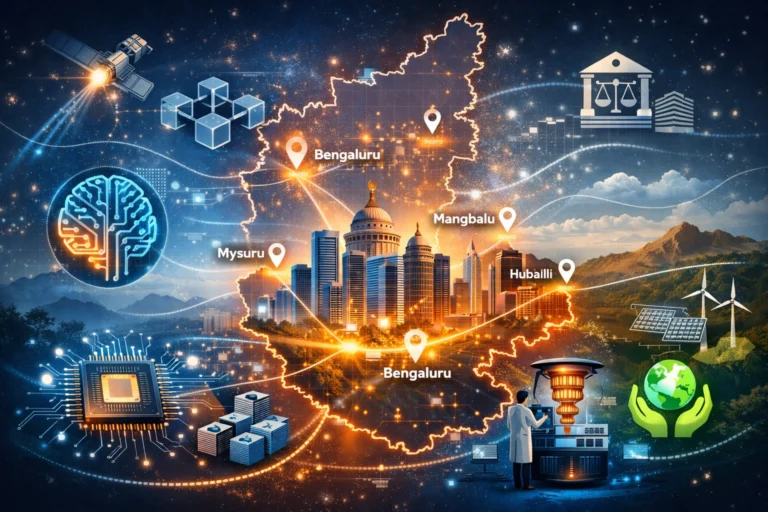
  • A futuristic illustration of Karnataka with Bengaluru at the center, innovation hubs radiating outward, overlaid with icons of AI, chips, governance, and sustainability.
    Business & Economy | Policy

    Karnataka Startup Policy 2025–30: From Startup Hub to State Capacity Builder

    ByTeam TQ January 19, 2026

    For more than a decade, Karnataka—powered by Bengaluru—has been India’s startup capital by default. The state produced unicorns, attracted global venture capital, and became synonymous with India’s technology story. But with the rollout of the Karnataka Startup Policy 2025–2030, the government is signaling something deeper than ecosystem expansion. This is not merely a policy to…

    Read More Karnataka Startup Policy 2025–30: From Startup Hub to State Capacity BuilderContinue

  • NBFC executive reviewing financial data with Indian rupee notes and digital charts, representing credit flow and digital lending in India after the RBI rate cut.
    Business & Economy | Finance | Policy | Uncategorized

    Banking on Bharat: How NBFCs and Digital Lenders Are Reacting to RBI’s Rate Cut

    ByTeam TQ January 14, 2026January 15, 2026

    When the Reserve Bank of India reduced interest rates, the signal went far beyond bond markets and bank treasuries. It directly impacted how credit flows to India’s real economy — especially through NBFCs and digital lenders, which now sit at the heart of MSME, startup, and consumer financing. For borrowers, the question is simple: Will…

    Read More Banking on Bharat: How NBFCs and Digital Lenders Are Reacting to RBI’s Rate CutContinue

  • Human hand and humanoid artificial intelligence reaching toward a glowing digital brain, symbolizing India’s AI governance framework and responsible use of technology.
    AI & Future Tech | Policy

    India’s AI Governance Guidelines: What They Mean for Startups, Innovation, and Compliance

    ByTeam TQ January 12, 2026January 12, 2026

    India has taken a cautious but strategic step into AI regulation. With the release of national AI governance guidelines, the government aims to balance innovation, accountability, and public trust. For startups, this is not just policy — it is a product roadmap signal. Why India Chose Governance Over Regulation Unlike hard regulatory regimes seen elsewhere,…

    Read More India’s AI Governance Guidelines: What They Mean for Startups, Innovation, and ComplianceContinue

  • Reserve Bank of India headquarters overlooking Mumbai skyline with an upward economic growth graph symbolizing India’s 7.3% GDP growth and lower interest rates.
    Business & Economy | Policy

    India’s 7.3% Growth Moment: Why RBI’s Rate Cut Changes the Game for Startups, Jobs, and Consumption

    ByTeam TQ January 12, 2026January 12, 2026

    India enters FY26 with a rare macroeconomic alignment: strong growth expectations and easing monetary policy. The Reserve Bank of India has upgraded India’s GDP growth outlook to 7.3% while simultaneously cutting the repo rate to 5.25%. For policymakers, this signals confidence. For startups, businesses, and job seekers, it reshapes the economic playing field in tangible…

    Read More India’s 7.3% Growth Moment: Why RBI’s Rate Cut Changes the Game for Startups, Jobs, and ConsumptionContinue

  • Abstract editorial illustration symbolising India’s fiscal system and public trust, featuring governance, transparency, public services, and economic growth in muted blue and saffron tones.
    Business & Economy | Policy

    India Shows Strong Public Trust in Tax System: Global Survey Highlights Positive Citizen Perceptions

    ByTeam TQ January 6, 2026January 6, 2026

    A new global survey on tax perceptions reveals that India ranks among the countries with the strongest public trust in its tax system, reflecting a positive and evolving fiscal culture among Indian taxpayers. The findings come from the “Public Trust in Tax 2025: Asia and Beyond” report, a collaborative study by the Association of Chartered…

    Read More India Shows Strong Public Trust in Tax System: Global Survey Highlights Positive Citizen PerceptionsContinue

  • AI & Future Tech | Policy

    The Cognitive Leap: India’s Blueprint for Human Capital in the AI Era

    ByTeam TQ January 5, 2026January 5, 2026

    As the global discourse around Artificial Intelligence remains locked in a binary of “existential risk” versus “efficiency gains,” India is carving out a third path: AI as a Public Utility. On January 5, 2026, at the banks of the Brahmaputra, a high-level convening at IIT Guwahati signaled a departure from traditional policy-making. The Human Capital…

    Read More The Cognitive Leap: India’s Blueprint for Human Capital in the AI EraContinue

  • Indian MSME exporter with export goods, representing credit and collateral support for Indian exports.
    Business & Economy | MSME & Startups | Policy

    India Launches Lifeline for MSME Exporters With Credit Cost Cuts & Collateral Support

    ByTeam TQ January 3, 2026January 3, 2026

    In a strategic push to strengthen India’s export competitiveness, the Ministry of Commerce & Industry has operationalized two major financial interventions under the Export Promotion Mission (EPM), delivering long-awaited relief to Micro, Small, and Medium Enterprises (MSMEs). Unveiled just days into the New Year, the measures directly address two chronic pain points faced by Indian…

    Read More India Launches Lifeline for MSME Exporters With Credit Cost Cuts & Collateral SupportContinue

  • Illustration showing young professionals in India engaging with artificial intelligence and digital learning technologies, representing the Skill the Nation initiative.
    AI & Future Tech | AI in Everyday Life | Policy

    SkillTheNation: How India Is Rewriting the Rules of the AI Age

    ByTeam TQ January 2, 2026January 2, 2026

    India has begun 2026 with a clear message to the world: the future belongs to skilled minds, not just smart machines. In a significant New Year move, President Droupadi Murmu launched the #SkillTheNation AI Challenge, reinforcing India’s commitment to preparing its people for an AI-driven economy. The announcement follows the remarkable success of the SOAR…

    Read More SkillTheNation: How India Is Rewriting the Rules of the AI AgeContinue

  • Namrup-IV ammonia-urea fertiliser complex in Assam symbolising India’s push for urea self-reliance and industrial growth in the Northeast.
    Business & Economy | Economy of NE India | Policy

    The Nitrogen Fortress: Inside Namrup-IV’s Industrial Renaissance

    ByTeam TQ December 21, 2025December 21, 2025

    On a historic Sunday in Upper Assam, the steady flow of the Dilli River was joined by a louder current — the applause of thousands — as Prime Minister Narendra Modi laid the foundation stone for the Namrup-IV Ammonia–Urea Complex. Valued at approximately ₹10,600 crore, this brownfield expansion is not merely another fertiliser project. It…

    Read More The Nitrogen Fortress: Inside Namrup-IV’s Industrial RenaissanceContinue

  • Business & Economy | Policy | Sustainability

    Green GST 2.0: Can 5% Tax Rates Decarbonize the Indian Economy?

    ByTeam TQ December 18, 2025December 18, 2025

    Incentivizing the Industrial Transition India’s GST Council has reduced the GST on renewable energy equipment — including solar modules, wind turbines, and related green tech — from 12% to 5%. It has also cut tax on electrolysers and green hydrogen production equipment to 5%, a move expected to bring down the cost of green hydrogen…

    Read More Green GST 2.0: Can 5% Tax Rates Decarbonize the Indian Economy?Continue

Page navigation

Previous PagePrevious 1 2 3 4 5 Next PageNext
Facebook FacebookInstagram InstagramYouTube YouTube
  • About The Quantiq
  • Contact Us
  • Home
  • Privacy Policy
  • Subscription

© 2026 The Quantiq Media Labs LLP. All trademarks, logos, content, and intellectual property are protected.

  • AI & Future Tech
    • AI Tools & Reviews
    • AI in Everyday Life
    • Future of Work
    • Robotics & Automation
  • Business & Economy
    • Policy
    • Corporate & Industry
    • MSME & Startups
    • Finance
    • Digital Economy
  • Innovation & Startups
    • Funding & VC
    • Rural Innovation
    • Startup Stories
    • Tech Innovations
  • North East Insight
    • Economy of NE India
    • Entrepreneurship in NE
    • Government & Policy
    • Infrastructure & Development
    • Tourism & Heritage
  • Sustainability
    • The Carbon Ledger
  • Intelligence
    • Health
    • Auto & Mobility
Search