
Skip to content
The Quantiq


Subscribe

  • AI & Future TechExpand
    • AI Tools & Reviews
    • AI in Everyday Life
    • Future of Work
    • Robotics & Automation
  • Business & EconomyExpand
    • Policy
    • Corporate & Industry
    • MSME & Startups
    • Finance
    • Digital Economy
  • Innovation & StartupsExpand
    • Funding & VC
    • Rural Innovation
    • Startup Stories
    • Tech Innovations
  • North East InsightExpand
    • Economy of NE India
    • Entrepreneurship in NE
    • Government & Policy
    • Infrastructure & Development
    • Tourism & Heritage
  • SustainabilityExpand
    • The Carbon Ledger
  • IntelligenceExpand
    • Health
    • Auto & Mobility
Subscribe
The Quantiq

From Hidden Valleys to Hospitality Capital: The Dirang Signal That Redraws Northeast India’s Tourism MapThe Trans-Himalayan Surge: How the North East–Bhutan Corridor Is Rewriting Asia’s Tourism Map (2022–2025)THE QUANTIQ | MID-WEEK BRIEFThe Green Goldmine: Monetizing North East India’s Medicinal Bio-WealthThe Sovereign Spine: How Assam’s NDC-NER Is Rewiring India’s Digital Future from the Edge

  • Union Budget 2026 impact on North East India economy and infrastructure
    Business & Economy | Economy of NE India | Finance | Government & Policy | Policy

    Union Budget 2026: What It Really Means for North-East India

    ByTeam TQ February 1, 2026February 1, 2026

    When the Finance Minister rose in Parliament to present the Union Budget, the macro story was familiar: fiscal discipline, capital expenditure, manufacturing, and growth amid global uncertainty. But for the North-East — a region long treated as a footnote in national economic imagination — the real question was simpler and sharper: does this budget finally…

    Read More Union Budget 2026: What It Really Means for North-East IndiaContinue

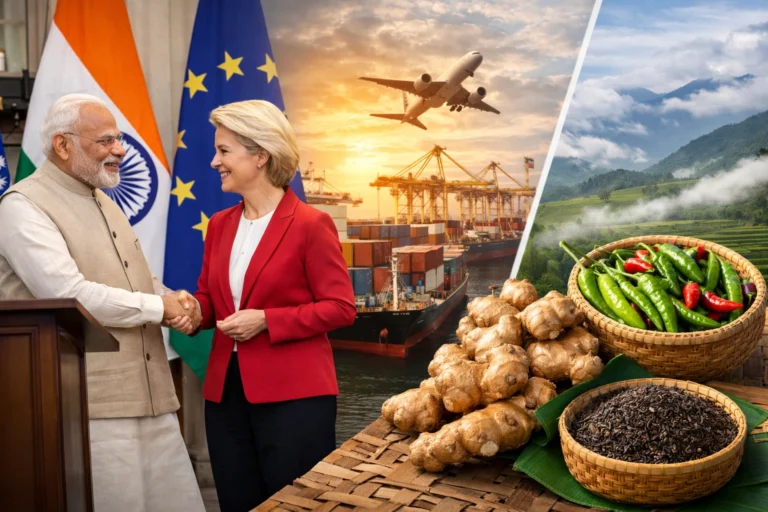
  • Abstract illustration showing North East India highlighted as a green trade hub connecting India and the European Union, with trade routes, bamboo, tea plantations, logistics infrastructure, and sustainability symbols representing the India–EU trade deal.
    Business & Economy | Government & Policy | North East Insight | Policy

    The India–EU Trade Deal and North East India: Strategic Asset or Strategic Blind Spot?

    ByTeam TQ January 28, 2026January 28, 2026

    As New Delhi negotiates what is being billed as the “mother of all trade deals” with Europe, a quieter and more uncomfortable question remains unanswered: where does North East India fit into this grand economic reset? A Deal That Will Reshape India — Unevenly The proposed India–European Union Free Trade Agreement (FTA) is no ordinary…

    Read More The India–EU Trade Deal and North East India: Strategic Asset or Strategic Blind Spot?Continue

  • Abstract illustration for Davos 2026 showing global economic signals through a connected world map, AI technology, capital flows, renewable energy, and international trade.
    Business & Economy | Policy

    WEF Davos 2026: The Signals Shaping the Global Economy — and India’s Make-or-Break Choices

    ByTeam TQ January 25, 2026January 30, 2026

    Once caricatured as elite networking or grandstanding diplomacy, the annual meeting of the World Economic Forum now serves a different function. It is no longer where deals are struck in public view; it is where global alignment is tested. Capital, governments, and technology leaders use Davos to reveal priorities, anxieties, and limits—often through repetition rather…

    Read More WEF Davos 2026: The Signals Shaping the Global Economy — and India’s Make-or-Break ChoicesContinue

  • Abstract visual representing India’s state debt, GDP growth, and fiscal policy challenges.
    Business & Economy | Policy

    The Debt Trap or a Data Mirage? Re-evaluating India’s Fiscal Glide Path

    ByTeam TQ January 24, 2026January 24, 2026

    The Reserve Bank of India’s latest directive asking states to outline a “clear glide path” for reducing public debt has triggered a fresh round of debate in policy circles. On the surface, the numbers appear reassuring. Aggregate state debt-to-GDP has declined from a pandemic-era peak of nearly 31% in FY21 to a projected 29.2% in…

    Read More The Debt Trap or a Data Mirage? Re-evaluating India’s Fiscal Glide PathContinue

  • Abstract illustration showing India’s evolving economy with rising bar charts, a magnifying glass, digital grids, and modern infrastructure symbolizing GDP recalibration from 2011 to 2022–23.
    Business & Economy | Policy

    The Great Recalibration: Beyond India’s 2011 Statistical Horizon

    ByTeam TQ January 23, 2026January 23, 2026

    For over a decade, India’s economy has transformed at a pace rarely seen in modern history. Payments moved from cash to QR codes, consumption shifted from physical goods to digital services, and infrastructure expanded from highways to data centres. Yet, for much of this period, India’s official economic mirror—the National Accounts—remained anchored to a much…

    Read More The Great Recalibration: Beyond India’s 2011 Statistical HorizonContinue

  • Mark Carney speaking at the World Economic Forum in Davos, addressing global leaders on the changing world order and economic fragmentation.
    Business & Economy | Policy

    Mark Carney at Davos: An Erudite Wake-Up Call to a Fragmenting World Order

    ByTeam TQ January 23, 2026January 23, 2026

    When history looks back at the 2026 annual meeting of the World Economic Forum in Davos, one speech is likely to be remembered not for rhetorical flourish or political grandstanding, but for its clarity, sobriety, and intellectual honesty. That speech came from Mark Carney. In a forum often criticised for platitudes and safe consensus, Carney…

    Read More Mark Carney at Davos: An Erudite Wake-Up Call to a Fragmenting World OrderContinue

  • Abstract illustration showing a divided transatlantic landscape with U.S. and EU symbols on one side and India on the other, highlighting shifting global trade dynamics and India’s emerging role as a strategic economic partner.
    Business & Economy | Policy

    U.S.–EU Trade Tensions and the India–EU FTA: Why a Global Reset Is Creating a Major Opportunity for India

    ByTeam TQ January 22, 2026January 22, 2026

    Editor’s Note: This article reflects global trade developments and policy signals as of January 22, 2026. A Quiet Shift in the Global Trade Order The global trade system is changing—slowly, but decisively. For decades, the U.S.–EU partnership has been one of the most stable anchors of the world economy. Today, that certainty is giving way…

    Read More U.S.–EU Trade Tensions and the India–EU FTA: Why a Global Reset Is Creating a Major Opportunity for IndiaContinue

  • World Economic Forum Davos 2026 backdrop symbolising the fragmentation of the global order and the decline of traditional globalization
    Business & Economy | Policy

    Davos 2026 Signals the End of the Old Global Order — And No One Has a Replacement

    ByTeam TQ January 21, 2026January 21, 2026

    The World Economic Forum at Davos has long been accused of living in a bubble — detached from ground realities, obsessed with abstract global cooperation. In 2026, that illusion finally cracked. This year’s Davos didn’t celebrate globalization. It questioned its survival. From blunt declarations that “globalization has failed” to warnings that the old rules-based order…

    Read More Davos 2026 Signals the End of the Old Global Order — And No One Has a ReplacementContinue

  • Abstract illustration of India’s pre-Budget shift toward supply-side growth, showing manufacturing, infrastructure, and rising investment symbolised by an upward growth arrow.
    Business & Economy | Finance | Policy

    India’s Pre-Budget Pivot: Why the Real Economic Shift Is From Demand-Pull to Supply-Push

    ByTeam TQ January 20, 2026January 20, 2026

    As India heads into the Union Budget, a subtle but decisive shift is underway in the country’s economic narrative. Unlike previous years—where tax cuts, consumption boosts, and short-term relief dominated pre-Budget lobbying—industry bodies are now pushing for something far more structural. The message from business is clear:India does not need another demand stimulus. It needs…

    Read More India’s Pre-Budget Pivot: Why the Real Economic Shift Is From Demand-Pull to Supply-PushContinue

  • Digital map of India showing crypto capital outflows to offshore exchanges, highlighting a ₹40,000 crore leakage and the impact of high taxation.
    Business & Economy | Digital Economy | Finance | Policy

    The Crypto “Exodus” and the ₹40,000 Crore Question: When Tax Policy Backfires

    ByTeam TQ January 19, 2026January 19, 2026

    As India approaches the Union Budget, one of the most urgent—and quietly ignored—policy failures is unfolding in the digital asset economy. The country’s crypto industry has issued a last-minute plea to the government: reduce the 1% TDS on virtual digital assets to 0.01%, warning that the current regime has already driven trading activity offshore and…

    Read More The Crypto “Exodus” and the ₹40,000 Crore Question: When Tax Policy BackfiresContinue

Page navigation

Previous PagePrevious 1 2 3 4 5 Next PageNext
Facebook FacebookInstagram InstagramYouTube YouTube
  • About The Quantiq
  • Contact Us
  • Home
  • Privacy Policy
  • Subscription

© 2026 The Quantiq Media Labs LLP. All trademarks, logos, content, and intellectual property are protected.

  • AI & Future Tech
    • AI Tools & Reviews
    • AI in Everyday Life
    • Future of Work
    • Robotics & Automation
  • Business & Economy
    • Policy
    • Corporate & Industry
    • MSME & Startups
    • Finance
    • Digital Economy
  • Innovation & Startups
    • Funding & VC
    • Rural Innovation
    • Startup Stories
    • Tech Innovations
  • North East Insight
    • Economy of NE India
    • Entrepreneurship in NE
    • Government & Policy
    • Infrastructure & Development
    • Tourism & Heritage
  • Sustainability
    • The Carbon Ledger
  • Intelligence
    • Health
    • Auto & Mobility
Search