
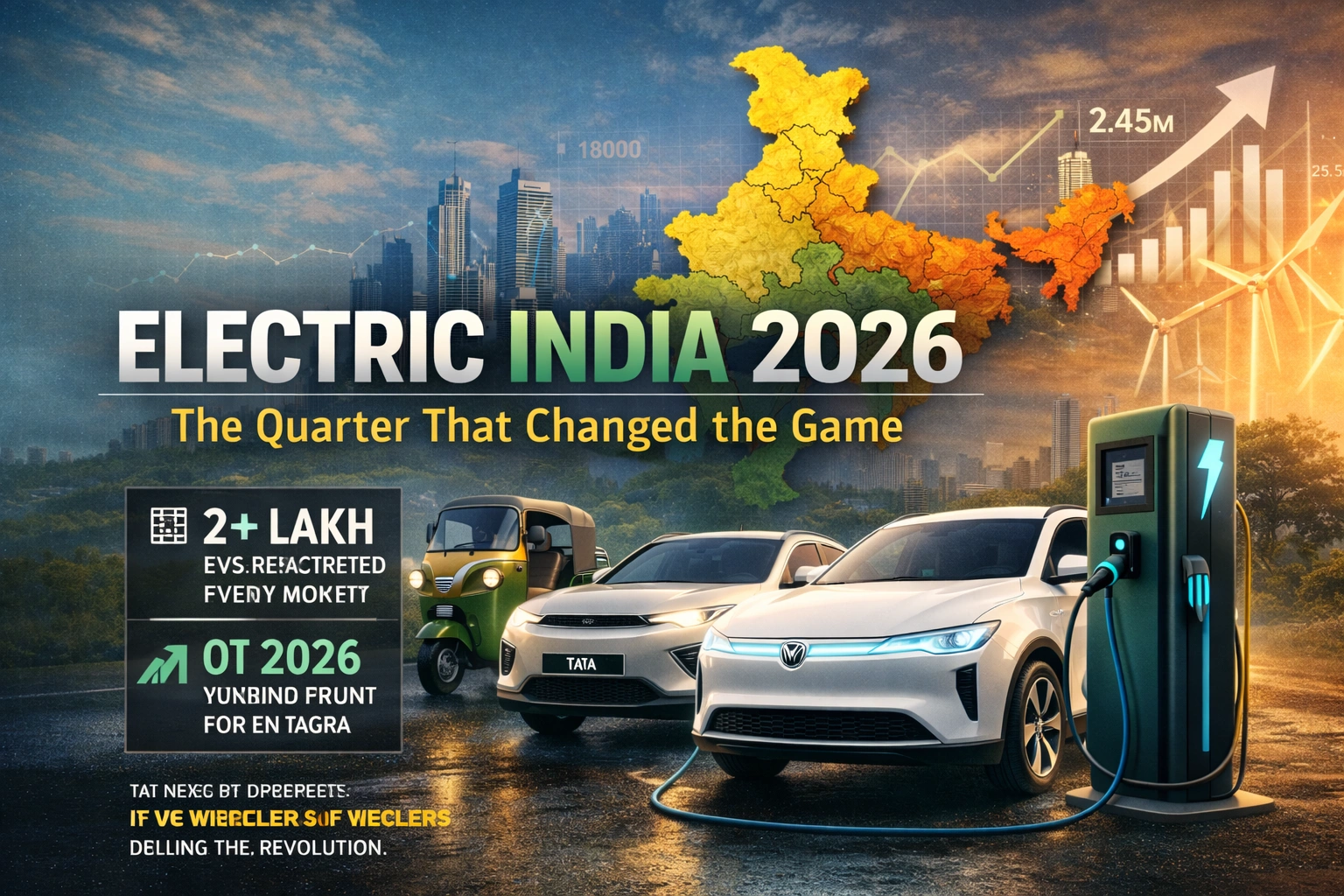
Electric India 2026: The Quarter That Changed the Game
A silent shift on Indian roads
There is a quiet transformation underway on India’s roads. It is not loud, not disruptive in the traditional sense, yet deeply structural. From the crowded lanes of Delhi to the tech corridors of Bengaluru and the expanding urban clusters of Guwahati, the hum of internal combustion engines is increasingly being replaced by the near-silent glide of electric mobility.
The first quarter of 2026 may well be remembered as the period when India’s electric vehicle transition moved beyond early adoption and entered a phase of irreversible momentum. The numbers tell a compelling story, but more importantly, the patterns behind those numbers reveal a market that is evolving unevenly, competitively, and with growing strategic depth.
Q1 2026: A market finding its rhythm
January 2026 opened with remarkable energy, recording over eighteen thousand electric passenger vehicle sales, marking a year-on-year growth exceeding fifty percent. The surge reflected not just pent-up demand, but also increasing consumer confidence in electric mobility as a viable alternative.
February introduced a temporary moderation, with sales settling around thirteen to fourteen thousand units. However, this was less a sign of weakness and more a reflection of seasonal market adjustments. On a year-on-year basis, the growth remained robust, hovering above forty percent, reinforcing the strength of underlying demand.
March, however, brought the quarter to a decisive close. Supported by fiscal year-end buying cycles and fleet demand, EV registrations saw a strong rebound, with monthly volumes likely crossing the two lakh mark across categories. Passenger EV sales also recovered meaningfully from February’s moderation, signalling sustained consumer interest. This end-of-quarter acceleration reinforces a critical shift—the EV market in India is no longer fragile; it is settling into a predictable and structurally upward growth cycle.
Across all categories, including two-wheelers and three-wheelers, monthly EV registrations consistently crossed the two lakh mark, underlining a broader shift beyond the passenger vehicle segment. By the end of the financial year, total EV sales in India reached approximately 2.45 million units, a record that firmly establishes the country as one of the fastest-growing EV markets globally.
What emerges from this quarter is not just growth, but stability within growth—a critical indicator of a maturing market.
The geography of electrification
India’s EV story is not uniform. It is deeply regional, shaped by policy environments, urban density, income levels, and infrastructure readiness.
In North India, Uttar Pradesh has emerged as a volume leader, driven significantly by electric three-wheelers that cater to last-mile mobility and small-scale logistics. The Delhi NCR region continues to demonstrate how policy intervention, incentives, and charging infrastructure can accelerate adoption.
Western India presents a more balanced ecosystem. Maharashtra stands out not just in terms of volume, but also in the diversity of EV adoption across segments. Gujarat, traditionally strong in CNG and conventional fuel vehicles, is now witnessing a gradual but steady transition toward electric mobility.
Southern India reflects the convergence of technology and manufacturing. Karnataka, particularly Bengaluru, represents an early adopter market where consumer awareness and tech affinity drive demand. Tamil Nadu plays a different but equally critical role as a manufacturing hub, anchoring the supply side of the EV ecosystem.
In contrast, Eastern and North Eastern India remain underpenetrated yet full of potential. The slower pace of adoption here is less about resistance and more about gaps in infrastructure, awareness, and ecosystem development. For platforms like The Quantiq, this region presents not just a coverage opportunity, but a chance to shape the narrative of the next phase of India’s EV journey.
The battle for dominance: Brands in transition
The Indian EV market is no longer a one-player story. It is rapidly evolving into a competitive battleground.
Tata Motors continues to hold a dominant position, commanding a significant share of the passenger EV market. Its early investments, strong product lineup, and aggressive pricing strategies have allowed it to build a formidable lead.
Yet, the gap is narrowing. MG Motor India has consolidated its position as a strong challenger, while Mahindra & Mahindra is witnessing accelerated growth, driven by renewed focus and an expanding EV portfolio.
The entry of global players is adding a new dimension. VinFast is positioning itself aggressively, while BYD India is reshaping expectations in the premium segment with its technology-first approach.
Meanwhile, traditional giants like Hyundai Motor India and Kia India are recalibrating their strategies, balancing internal combustion portfolios with gradual EV expansion.
At the top end of the market, BMW India has emerged as a clear leader in the luxury EV segment, capturing a dominant share and signalling that electrification is no longer confined to affordability narratives alone.
Beyond cars: The real engine of growth
To understand India’s EV revolution, one must look beyond passenger vehicles.
Two-wheelers and three-wheelers continue to dominate volumes, forming the backbone of electric mobility adoption. These segments are driven by economics as much as by sustainability, with lower operating costs and faster payback periods making them attractive to both individual users and commercial operators.
Passenger vehicles, while growing rapidly, still account for a relatively small share of total EV penetration. This contrast highlights a uniquely Indian trajectory, where electrification is being led from the bottom of the pyramid upward.
It is a reversal of the pattern seen in many developed markets, and it carries significant implications for manufacturers, policymakers, and investors.https://thequantiq.com/the-carbon-economy-the-new-oil-of-the-21st-century/
The affordability paradox
Despite strong growth, a fundamental challenge persists. The majority of India’s car market operates in the budget segment, typically below the ₹8 lakh price point. Electric vehicles, however, remain priced significantly higher, creating a gap between aspiration and accessibility.
This affordability mismatch is perhaps the single biggest barrier to mass adoption in the passenger vehicle segment. Until EVs become viable within the mass-market price band, the transition will remain uneven.
Infrastructure: The uneven backbone
Charging infrastructure continues to expand, but not uniformly. Urban centres, particularly metros, are witnessing rapid deployment of public charging stations. However, large parts of the country remain underserved.
This uneven distribution creates a psychological barrier as much as a logistical one. Range anxiety, though gradually declining, still influences purchasing decisions, particularly outside major cities.
Looking ahead: The road to 2030
The trajectory for India’s EV market is clear, even if the pace varies across segments and regions. Industry estimates suggest that electric vehicles could account for twenty to thirty percent of total vehicle sales by the end of the decade.
The coming years will likely see intensified competition, greater price rationalisation, and deeper integration of charging infrastructure. New entrants will continue to reshape the competitive landscape, while existing players will be forced to innovate at an accelerated pace.
What began as a policy-driven shift is now evolving into a market-driven transformation.
The Quantiq Insight
The first quarter of 2026 marks a turning point not because of record numbers alone, but because of what those numbers represent. India’s EV market is no longer an experiment. It is an emerging system, shaped by regional diversity, competitive intensity, and structural challenges that are slowly being addressed.
The next phase of this journey will not be defined merely by growth, but by how inclusively and efficiently that growth is distributed across the country.
For India, the question is no longer whether it will go electric. The question is how evenly, how quickly, and how intelligently it can make that transition.https://thequantiq.com/why-indian-cities-cannot-solve-traffic-without-rethinking-mobility/



One Comment