
India’s Food Export Story Is Changing—And Northeast India May Be Its Biggest Winner
There are numbers that impress, and then there are numbers that quietly signal a structural shift. The latest data released by the Ministry of Food Processing Industries belongs firmly to the second category.
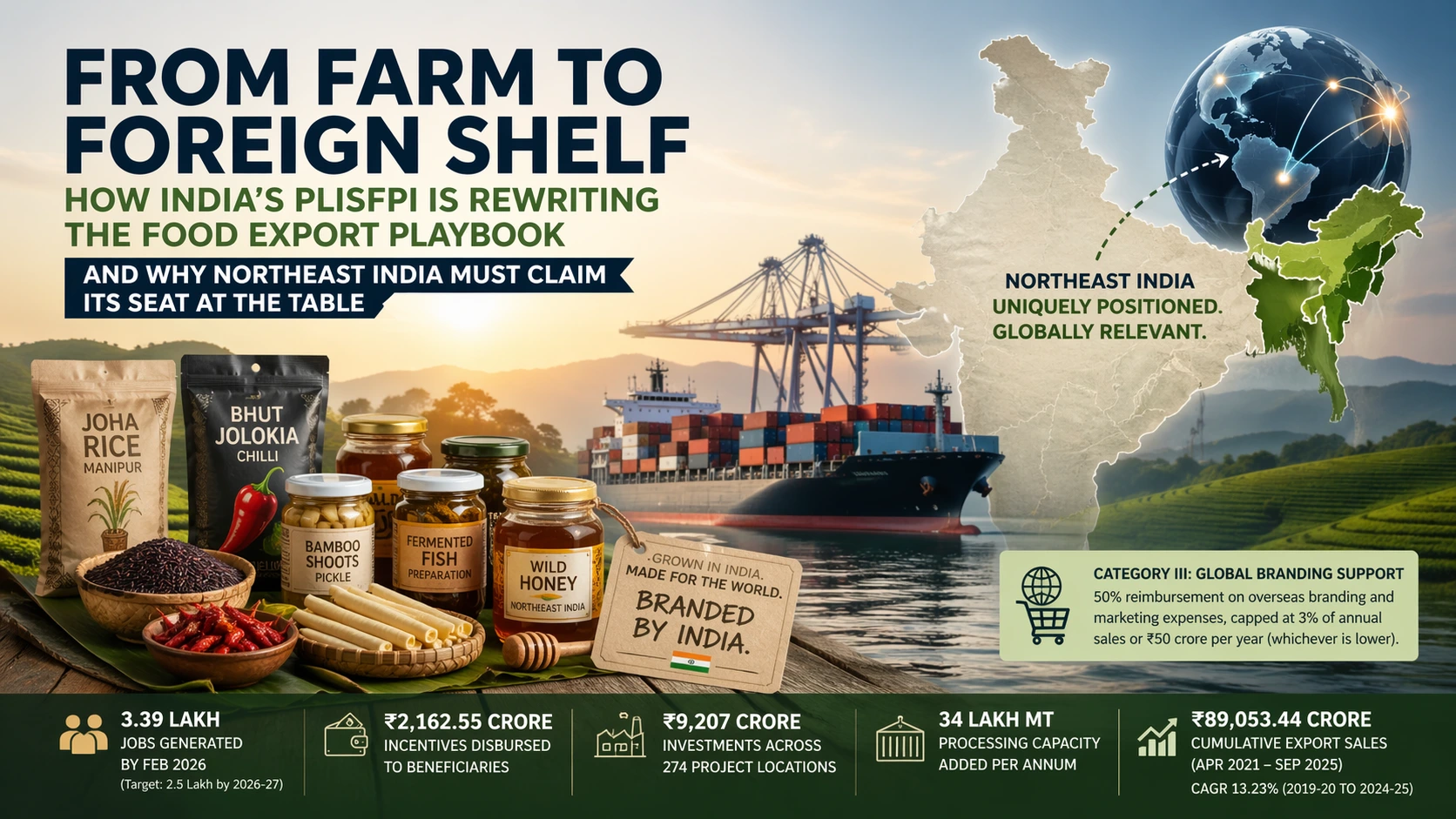
India’s Production-Linked Incentive Scheme for the Food Processing Industry—PLISFPI—has generated approximately 3.39 lakh jobs by February 2026, comfortably surpassing its original target of 2.5 lakh jobs set for 2026–27. At the same time, incentives worth ₹2,162.55 crore have already been disbursed.
A policy that outperforms its employment target by over a third before its deadline is not merely efficient. It is revealing something deeper: that India’s food processing sector has crossed a threshold of readiness that policymakers themselves had underestimated.
Yet the real story is not in the headline numbers. It is buried elsewhere—inside what the scheme calls Category III.
Beyond Production: What PLISFPI Really Represents
The scheme is often described as a production incentive. That description is not wrong—but it is incomplete.
PLISFPI is, in reality, three policy instruments operating under one umbrella. One part rewards scale in manufacturing across key segments like ready-to-eat foods, processed fruits and vegetables, marine products, and dairy. Another is designed for innovation—targeting SMEs working with organic and differentiated products. And then there is the third component, the most consequential of them all: global branding.
Category III is where India departs from its long-standing role as a supplier and begins to think like a market-maker.
Under this component, companies are reimbursed up to 50% of their overseas branding and marketing expenditure, subject to a cap. In practical terms, a company investing ₹10 crore to build shelf presence abroad—whether in Dubai, London, or Tokyo—gets half of that cost back.
That single provision changes the economics of ambition.
Out of 165 approved applications under the scheme, 73 fall under Category III—the largest share. Alongside 69 MSMEs and dozens of contract manufacturing units, the data reveals something unmistakable: Indian companies are not just looking to produce more. They are looking to be seen.
The Infrastructure Beneath the Momentum
Five years into its implementation, PLISFPI has done more than distribute incentives. It has begun to reshape the physical backbone of India’s food economy.
Across 274 project locations, investments totaling ₹9,207 crore have created an additional processing capacity of 34 lakh metric tonnes per annum.
These are not abstract numbers. They translate into cold chains, grading systems, packaging lines, and testing infrastructure—the invisible architecture that turns farm produce into globally tradable products.
Exports tell a similar story. Processed food exports under the scheme have grown at a CAGR of 13.23%, with cumulative sales nearing ₹89,053 crore between April 2021 and September 2025.
Behind these numbers lies a broader shift. India is slowly moving away from exporting raw agricultural commodities toward exporting value-added, branded food products. The share of processed food in total agricultural exports has risen from 13.7% a decade ago to over 20%.
This is not an incremental change. It is a structural transformation.
Selling vs Owning: The Quiet Shift in Strategy
For decades, India has operated as the world’s back-end kitchen. Its rice, spices, and marine products have travelled across continents—only to appear on supermarket shelves under foreign brand names.
The margins, the identity, and the consumer loyalty have belonged elsewhere.
Category III is a direct intervention into that imbalance.
By subsidising brand-building, it allows Indian producers to make a different choice—to move from selling products to owning brands.
This is how countries like Japan and South Korea built global food identities. Brands became cultural ambassadors. Products became narratives.
India has scale. It has diversity. What it has lacked is sustained investment in identity.
That gap is now being addressed—quietly, but decisively.
Northeast India: The Opportunity Hidden in Plain Sight
If there is one region where this policy shift matters most, it is Northeast India.
Historically, the region has remained peripheral to national industrial policy. It lacks large-scale processing infrastructure and dense logistics networks. It has rarely been treated as a primary beneficiary of central schemes.
And yet, paradoxically, PLISFPI’s most relevant components—Category II and Category III—appear almost designed for it.
The Northeast does not compete on scale. It competes on uniqueness.
Its food landscape is defined by products that are inherently differentiated: Bhut Jolokia, Joha rice, black rice from Manipur, fermented fish traditions, wild forest honey, bamboo shoot preparations, indigenous millets. These are not commodities. They are stories.
Globally, the premium food market is increasingly driven by precisely these attributes—origin, authenticity, and cultural specificity.
What Northeast India lacks is not product quality. It is the ecosystem that translates that quality into market-ready formats: certification, processing, packaging, and branding.
That is where PLISFPI becomes more than a scheme. It becomes a bridge.
From Local Produce to Global Shelf
The pathway is neither theoretical nor out of reach. It begins with standardisation—meeting international food safety norms and ensuring consistency. Without that, no product can enter modern retail.
It evolves into aggregation—through Farmer Producer Organisations and cooperative structures that can achieve the necessary scale.
From there, the focus shifts to identity. Brand-building is not an afterthought; it is foundational. Category III’s reimbursement mechanism makes this financially viable in a way it has never been before.
And finally, market entry begins—not with mainstream global retail, but with diaspora markets. Cities like Dubai, London, and Toronto already host communities familiar with Northeast India’s food culture. They are the natural first adopters.
From there, expansion becomes a matter of evidence—sales data, retail partnerships, and brand recognition.
The Millet Window
An additional layer of opportunity comes through the ₹800 crore millet-focused sub-scheme carved out of PLISFPI.
As global demand for ancient grains and health foods rises, indigenous millet varieties from Northeast India—many cultivated through traditional, organic practices—are uniquely positioned to capture premium markets.
When production incentives meet branding support, the result is a dual-engine model. Few regions are as naturally suited to leverage both.
What the Data Is Really Saying
The PLISFPI update is not just a performance report. It is a policy signal.
India is no longer content with being a supplier. It is preparing to become a brand builder.
For Northeast India, this shift arrives at a moment of choice.
The region’s food assets are among the most distinctive in the country. Their value lies not in volume, but in narrative, authenticity, and scarcity.
PLISFPI does not solve every structural challenge. But it lowers the barriers where it matters most—entry, innovation, and visibility.
The Quantiq’s Assessment
The headline number—3.39 lakh jobs—will dominate public discourse. It should.
But the more important numbers for Northeast India are quieter: 69 MSMEs, 73 branding approvals, and a ₹5 crore threshold spread across five years.
These define the entry point.
This is a policy window that is open today but not indefinitely. The scheme runs until 2026–27. Early movers are already positioning themselves.
The question is not whether the opportunity exists. The data has already answered that.
The question is whether Northeast India will act in time—or watch others build global brands from a playbook it was uniquely positioned to lead.
What the region offers the world is not replicable.
The only missing step is to give it a name—and place it on a shelf the world can see.https://thequantiq.com/the-green-skin-economy-how-northeast-indias-pineapple-leaves-and-banana-stems-could-clothe-the-world/
Frequently Asked Questions(FAQ)
What is PLISFPI?
The Production-Linked Incentive Scheme for the Food Processing Industry (PLISFPI) is a Government of India initiative that incentivises food manufacturing, innovation, and global branding to boost exports and create jobs.
How does PLISFPI support exports?
It provides financial incentives for production and reimburses up to 50% of overseas branding and marketing expenses, enabling Indian companies to build global food brands.
Why is PLISFPI important for Northeast India?
The scheme’s SME-focused and branding components align with Northeast India’s strength in organic, unique, and high-value food products, making it ideal for global niche markets.



One Comment