
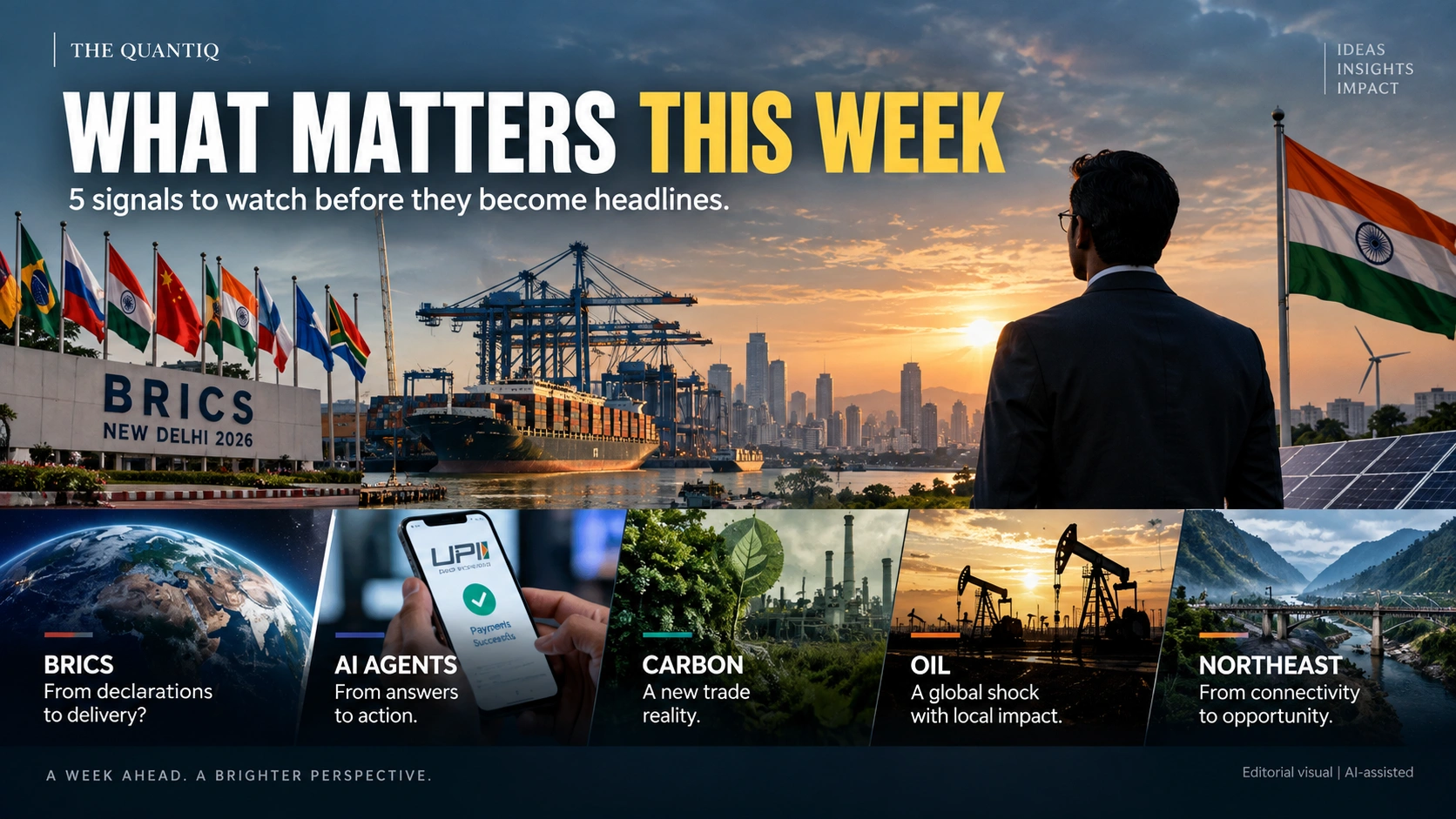
What Matters This Week: 5 Signals to Watch Before They Become Headlines
Some Mondays begin with a long list of headlines. This one begins with something more interesting: several apparently unrelated developments that are pointing towards the same larger shift.
The BRICS summit in New Delhi has put critical minerals, resilient supply chains, AI and cross-border payments firmly on the global agenda. India is moving closer to allowing AI agents to operate within its payments ecosystem. Carbon pricing is beginning to affect the terms on which Indian companies access overseas markets. Meanwhile, renewed energy disruption in West Asia is reminding businesses how quickly geopolitics can reach the factory floor.
And in India’s Northeast, the question is gradually changing from how to connect the region to the rest of the country to what economic capacity that connectivity can actually create.
Here are five signals The Quantiq believes are worth watching this week.
BRICS Has Finished the Summit. Now Comes the Hard Part.
The most important BRICS story after the New Delhi summit may not be the diplomatic language. It may be whether the grouping can turn its growing political weight into practical economic infrastructure.
The expanded 11-member bloc has backed stronger cooperation on local-currency trade, cross-border payments, AI, energy, food security and supply-chain resilience. India also warned against the weaponisation of technology and critical minerals—an increasingly important concern as rare earths and other strategic inputs become central to everything from electric vehicles to defence.
That gives BRICS a potentially much bigger role than simply providing a platform for Global South diplomacy.
But declarations are easy. Interoperable payment systems, reliable supply chains, investment mechanisms and functioning technology partnerships are considerably harder.
AI Is Moving From the Screen to the Checkout
For years, the most visible AI question was whether machines could produce better answers than humans. The next question may be much more practical: can we trust them to act on our behalf?
India is now moving towards that question through UPI. NPCI is developing a framework and registry to identify, verify and monitor AI agents that could eventually make payments under rules set by users. Early applications are expected to involve relatively small, frequent purchases, with more complex transactions potentially following later.
That is a significant change in the relationship between AI and money. An agent that finds a product is one thing. An agent that decides a purchase meets your instructions and executes the payment is something else entirely.
The difficult questions will concern identity, authentication, spending limits, fraud and liability.
Carbon Is Quietly Becoming Part of India’s Trade Policy
Carbon policy used to sound like a conversation between governments, environmental regulators and climate scientists. Increasingly, it is becoming a conversation about exports.
The UK’s decision to recognise India’s Carbon Credit Trading Scheme for its emerging Carbon Border Adjustment Mechanism could allow Indian exporters to receive credit for carbon prices already paid in India, subject to the required verification. The arrangement is particularly relevant to carbon-intensive sectors such as steel, aluminium, cement and fertiliser.
This matters because the carbon embedded in an Indian product can increasingly influence its final cost in an overseas market.
India therefore has a new task: building a carbon market that is not only credible domestically but also trusted internationally.
The numbers are still small compared with India’s enormous industrial economy, but the direction is unmistakable.
The Oil Problem Is Becoming an India Problem
The oil market has started this week with a familiar but uncomfortable question: how long can the disruption in West Asia continue before it begins to materially affect the Indian economy?
Fresh attacks and continuing risks around the Strait of Hormuz have kept crude prices above $100 a barrel, while Indian refiners are drawing on existing inventories to manage immediate supply pressures. The bigger concern is what happens if disruption persists and the available pool of crude becomes progressively tighter.
For India, that is not simply a story about petrol and diesel.
A prolonged oil shock can work its way through freight costs, manufacturing, aviation, inflation, the current account and ultimately household budgets.
It also explains why the BRICS conversation about resilient supply chains and energy security suddenly feels much more concrete.
Is the Northeast Moving From Connectivity to Economic Capacity?
For much of the past decade, India’s Northeast has been described primarily through connectivity: roads, railways, airports, inland waterways and border infrastructure.
A more interesting question is beginning to emerge: what economic activity will that connectivity actually enable?
The Chief Ministers of Assam and Meghalaya recently sought renewed central attention for Externally Aided Projects, with infrastructure and development financing at the centre of the discussion.
The opportunity is considerably larger than transport. Better infrastructure can support manufacturing, food processing, logistics, tourism, technology, energy and cross-border trade—provided private investment and productive capacity follow.
This is where the Northeast’s geography becomes an economic asset rather than simply a logistical challenge.
The transition will not happen automatically. It will depend on execution, skills, industrial ecosystems and the ability to turn public infrastructure into commercially productive networks.
The Quantiq Take
These five stories may look different on the surface, but they share a common thread.
Infrastructure is becoming strategic again.
Payments infrastructure determines how economies transact. AI infrastructure determines who can deploy intelligence at scale. Carbon infrastructure is beginning to influence access to foreign markets. Energy and mineral infrastructure determine industrial resilience. And physical infrastructure determines whether regions such as the Northeast can turn geography into economic advantage.
That is why the most interesting Indian story this week is not any single announcement.
It is the convergence.
India is simultaneously trying to shape the economic architecture of the Global South, prepare its payment system for AI agents, build a credible carbon market, protect itself against external energy shocks and create new economic capacity in its eastern frontier.
The next phase of India’s growth may therefore depend not simply on becoming bigger, but on becoming more resilient, more connected and harder to disrupt.



One Comment