
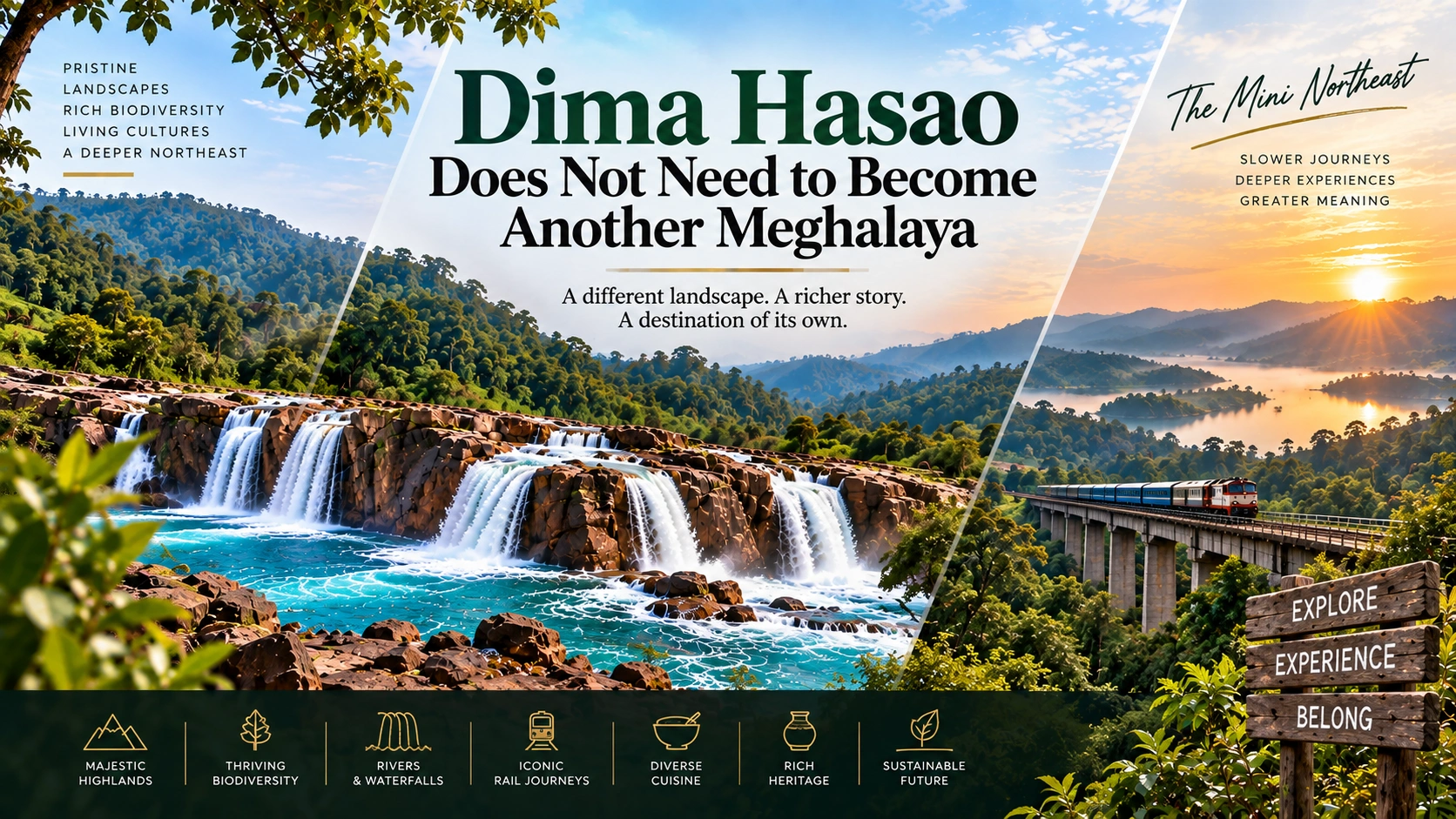
Dima Hasao Does Not Need to Become Another Meghalaya
The real opportunity is not to divert tourists from Meghalaya, but to build a destination brand that attracts people for its own reasons.
For a brief period recently, a conversation began travelling through Assam’s tourism ecosystem faster than any official tourism campaign could have managed.
Could Dima Hasao become an alternative to Meghalaya?
The immediate trigger was a confrontation between tourist taxi operators from Assam and Meghalaya. The situation has since cooled, and tourist movement between the two states has returned to normal. But something else happened during those few days. A narrative emerged in the public imagination: Meghalaya versus Dima Hasao.
That narrative is worth examining, not because Dima Hasao should compete with Meghalaya, but because it raises a much bigger question.
How does an emerging destination build a brand of its own?
The answer begins with a simple realisation.
Dima Hasao does not need to become another Meghalaya. It needs to become Dima Hasao.
A destination is more than its attractions
Tourism promotion has traditionally been built around attractions.
Show the waterfall. Show the mountain. Show the lake. Show the village. Invite the tourist.
But successful destination brands eventually move beyond the attraction itself. They create a particular idea in the traveller’s mind.
Consider Kerala, Goa and Odisha.
All three are coastal states. All have beaches, food, culture and nature. Yet they have developed distinctly different tourism identities.
Kerala has built a broad proposition around nature, wellness, culture, backwaters and immersive travel. In 2024, it recorded more than 22.2 million domestic tourist visits and 738,374 foreign tourist visits, with visitors coming from a diverse range of domestic and international markets.
Goa has a very different personality. Its established association with beaches, leisure, nightlife and lifestyle has gradually been complemented by heritage, wellness, hinterland and experiential tourism. In 2024, Goa recorded about 9.94 million domestic tourist visits and 467,911 foreign tourist visits, according to Ministry of Tourism data.
Odisha offers yet another proposition, combining pilgrimage, temples, heritage, beaches, wildlife, handicrafts, cuisine and cultural experiences. It recorded nearly 9.73 million domestic tourist visits in 2023, according to Ministry of Tourism data, while the state’s tourism department now maintains a much broader portfolio of identified destinations and experiences.
The lesson is not that one destination has a better tourism model than another.
The lesson is more fundamental:
Similar natural assets do not produce identical destination brands.
The identity determines what people come looking for.
The tourist does not buy a waterfall. The tourist buys a promise.
A traveller going to Goa is not necessarily buying a beach.
They may be buying a particular kind of holiday: social, relaxed, energetic, indulgent or experiential.
Someone travelling to Kerala may be seeking wellness, nature, food, culture or a slower journey.
A visitor to Odisha may combine pilgrimage with architecture, heritage, beaches, cuisine or wildlife.
The attraction is important.
But the meaning surrounding the attraction is what creates the destination proposition.
This is precisely where Dima Hasao has an opportunity.
It has mountains, forests, waterfalls, lakes and scenic landscapes. But none of these, individually, is sufficiently distinctive to create a powerful destination brand.
The question is not simply what does Dima Hasao have?
The more important question is:
What does Dima Hasao mean to a traveller?
Dima Hasao’s most powerful asset may be its people
There is a remarkable fact about Dima Hasao that deserves far greater attention.
The district is home to more than a dozen indigenous communities, with the district administration identifying 13 tribal groups.
This is not merely a demographic statistic.
It could become the foundation of a destination proposition.
Dima Hasao is not just a mountain landscape. It is a meeting place of cultures, languages, food traditions, music, festivals, crafts, agricultural practices, oral histories and relationships with the land.
That opens up a potentially distinctive positioning:
Dima Hasao as a living microcosm of Northeast India.
Or, more simply:
The Mini Northeast.
The phrase deserves proper research and consultation before it becomes a formal brand proposition. But the underlying idea is compelling.
A visitor should not come to Dima Hasao merely to see another waterfall.
They could come to experience a different dimension of Northeast India.
From sightseeing to participation
There is an important distinction between displaying culture and experiencing culture.
A tourism brochure can show a traditional costume.
A better tourism experience allows a visitor to meet the person who wears it, understand its significance and perhaps hear the story behind it.
A restaurant can serve indigenous food.
A more meaningful experience might allow a visitor to learn how the food is prepared.
A village can become a photographic stop.
Or it can become a place where visitors stay, walk, listen, eat and learn.
That is the transition from sightseeing tourism to experiential tourism.
It also creates a stronger economic model because the visitor’s expenditure can move through a much wider local ecosystem: homestays, guides, drivers, farmers, cooks, artisans, performers and small businesses.
The community therefore should not be treated as part of the scenery.
The community should become part of the destination brand.
Authenticity cannot be manufactured
This is where Dima Hasao needs to be careful.
There is a temptation for emerging destinations to use words such as untouched, unspoilt and authentic in every tourism campaign.
But authenticity disappears when it becomes a marketing prop.
If villages become overcrowded, rivers polluted and cultural practices staged exclusively for tourists, the very qualities being marketed begin to disappear.
Dima Hasao therefore needs a different ambition:
Access without erasing identity.
That means developing tourism alongside community participation, responsible infrastructure, appropriate accommodation, waste management, local guides and carefully designed experiences.
The objective should not simply be to increase tourist numbers.
It should be to increase meaningful visits and local value.
Don’t ask how to attract Meghalaya’s tourists
This may be the most important strategic question for Assam.
If Dima Hasao is promoted as an alternative to Meghalaya, the tourist will naturally compare the two.
Which has better roads?
Which has better hotels?
Which has better waterfalls?
Which has more attractions?
Which offers better connectivity?
Dima Hasao would then be entering Meghalaya’s frame of reference.
Instead, ask a different question:
What kind of traveller would choose Dima Hasao because of what Dima Hasao is?
That traveller may be looking for a slower journey.
They may want to stay in a village rather than simply photograph one.
They may want indigenous food rather than a standardised hotel menu.
They may want to meet communities, walk through forests, explore history, travel by rail, discover local crafts or spend several days experiencing a landscape rather than ticking off attractions.
That is a different market proposition.
And it does not require Meghalaya to become the enemy.
The opportunity is differentiation, not substitution
The Northeast does not necessarily need destinations competing for the same tourist.
Shillong can remain Shillong.
Sohra can remain Sohra.
Kaziranga can remain Kaziranga.
Majuli can remain Majuli.
Tawang can remain Tawang.
And Dima Hasao can become Dima Hasao.
In fact, the region could benefit from travellers staying longer because different destinations offer different experiences.
The real competition may not be Assam versus Meghalaya.
It may be the Northeast versus every other destination competing for a traveller’s limited holiday time.
That is a much bigger market to think about.
A destination brand needs an architecture
If Dima Hasao eventually adopts the idea of becoming a distinctive experiential destination, its attractions should not be marketed as disconnected products.
They need to reinforce one larger idea.
Its indigenous cultures could form one experience pillar.
Its forests, mountains and biodiversity could form another.
Slow journeys, rail travel and village stays could become another.
Maibang and the region’s history could create a heritage dimension.
Waterfalls, rivers and lakes could form a nature and adventure proposition.
Food, agriculture and indigenous culinary traditions could become another.
The important thing is that all these experiences should answer the same question:
Why Dima Hasao?
That is the beginning of destination brand architecture.
The real measure should not be tourist arrivals
There is another trap emerging destinations should avoid.
Tourism success is often reduced to the number of visitors.
But one million visitors who stay briefly, spend little locally and leave behind waste may create less value than a smaller number of visitors who stay longer and spend across the local economy.
Dima Hasao therefore has an opportunity to think about a different metric.
Value per visitor.
How many nights does the visitor stay?
How many local businesses benefit?
How much does the visitor spend within the community?
How many local guides, homestays, farmers, artisans and entrepreneurs participate?
How many visitors return?
How many recommend the experience?
These are destination-brand questions as much as tourism questions.
Dima Hasao should not try to beat Meghalaya
The public conversation that briefly emerged around Meghalaya versus Dima Hasao may disappear as quickly as it appeared.
The strategic opportunity should not.
Because beneath that temporary narrative lies a much more important question about Assam’s tourism future.
Can Dima Hasao deliberately build a destination identity around its own strengths?
Can its cultural diversity become an experience rather than a statistic?
Can its relative lack of commercialisation become an advantage rather than merely a sign of underdevelopment?
Can tourism generate income for communities rather than simply bring visitors through them?
And can Dima Hasao become known not as an alternative to somewhere else, but as a destination people actively want to discover?
Those questions deserve serious attention.
Perhaps the ultimate ambition should not be to make Dima Hasao better than Meghalaya.
It should be to make the comparison unnecessary.
Because the strongest destination brand is not the one that wins a comparison.
It is the one that creates a category of its own.
And Dima Hasao may have the raw ingredients to do exactly that:
a mountain landscape, extraordinary cultural diversity and the possibility of experiencing the Northeast not merely as scenery, but as a living story.
That is a tourism proposition worth building.






One Comment