India’s AI Roadmap : Democratizing AI for Millions of Workers
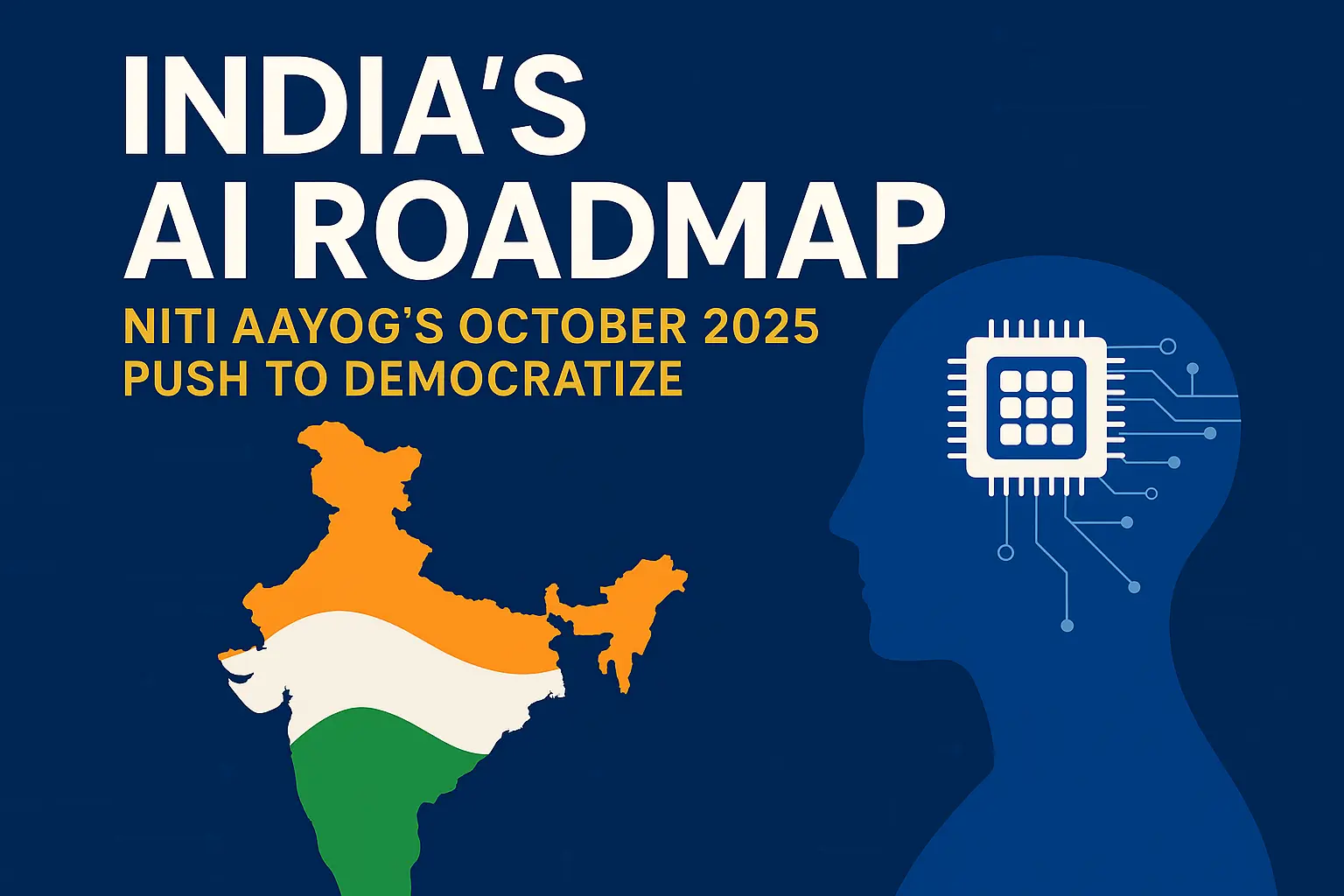
In October 2025, India’s primary policy think-tank, the NITI Aayog, published an ambitious roadmap aiming to make artificial intelligence an inclusive force for development rather than just automation. The documents titled Roadmap for Job Creation in the AI Economy and Roadmap on AI for Inclusive Societal Development set coordinated national missions around skilling, inclusion, and AI-powered productivity.
Key Elements of the Roadmap
- The vision is to empower India’s informal workforce, estimated at ~490 million workers, through AI, digital tools and immersive learning systems. A National AI Talent Mission is proposed to build India into the “AI workforce capital” of the world. The roadmap claims AI could help create up to 4 million new jobs by 2030, especially in the tech-services and CX (customer experience) sectors.
- The approach is inclusive: localized AI tools, regional language support, leveraging low-bandwidth digital systems and micro-entrepreneur access.
- Public–private partnerships, industry supply-chains and state-level rollout plans are emphasised — not just urban elite ecosystems.
What the Data Says — Jobs, Workforce Impact & Scale
According to the roadmap, India’s tech services and CX segment (worth ~USD 245 billion) is both at risk of disruption (routine roles) and at opportunity for creation. The figure of 4 million new jobs by 2030 is cited, if reskilling and inclusive access are effectively delivered.
From a startup / SME perspective, this means there will be demand for AI-based tools addressing: informal-worker marketplaces, credit-matching, language-first interfaces, micro-vendor digital platforms, and gig-economy orchestration.
Opportunity for Indian Startups and SMEs
For you as a content-creator, educator, innovator or startup founder in India (including North East India), this roadmap opens several practical lanes:
- Build AI tools for micro-entrepreneurs, gig-workers, regional-language platforms — i.e., “AI for the many” rather than “AI for the few.”
- Use the roadmap’s framing to access government grants, pilot schemes, state-level backing.
- Focus on low-compute, high-impact solutions (edge, mobile, offline) rather than replicate global mega-models which have capital barriers.
- Collaborate with local institutions, NGOs and vocational training centres to merge AI-skilling with real-world delivery.
Challenges and Risk Areas
- Implementation capacity is the main bottleneck: India’s states, districts and workforce infrastructure vary hugely in digital readiness.
- Data governance, privacy, regional language coverage, and digital divide issues risk excluding large segments if not addressed.
- The ambition of job-creation depends heavily on deployment, not just policy papers — success will depend on execution at district/municipality level.
- There is the risk of hype: if AI tools don’t deliver productivity or real benefit to informal workers, then the social contract could fracture.
Strategic Recommendations for Stakeholders
- Start with proof-of-concept pilots in localized zones (perhaps in the North East or Bhutan cross-border), building real outcomes, then scale.
- Align your startup/initiative with the national branding (“AI for All India”) and seek state or district partnerships.
- Prioritize usability over novelty: accessible UI/UX in regional languages, low bandwidth, offline readiness.
- Invest in ethical, inclusive design: local data sets, audit bias, ensure the gig-worker benefit rather than displacement.
- Monitor and report outcomes (jobs created, gig-worker incomes improved, vendor uptake) to build the evidence base and credibility.
India’s October 2025 AI roadmap signals an important shift: AI is no longer just a top-tier technology play, but a national social and economic development strategy. For innovators in India — especially in underserved regions — the message is clear: focus on inclusion, regionalised solutions and real-world impact. Those who build at the intersection of AI and everyday livelihoods will be the long-term winners.