
The Green Skin Economy: How Northeast India’s Pineapple Leaves and Banana Stems Could Clothe the World
“The next leather revolution will not come from a tannery. It will come from a pineapple field in Meghalaya.”
What This Article Covers
This is a story about a market that is forming faster than most regions are prepared for.
As global supply chains move away from animal and synthetic leather toward plant-based bio-materials, a new industrial category is taking shape—one that sits at the intersection of agriculture, material science, and export manufacturing.
Northeast India, with its abundance of pineapple leaves, banana fibre, bamboo, and other biomass, is not adjacent to this shift. It is positioned at its center.
The question is not whether the opportunity exists.
The question is whether the region will recognize it in time—and build the capability to capture it.
The Global Market Shift — From Ethical Niche to ESG Imperative
For most of the last decade, vegan leather was framed as a moral choice. That framing has now collapsed under the weight of economics and regulation.
The global vegan leather market, valued between $10.61 billion and $11.07 billion in 2024, is projected to reach $27.80 billion by 2034, expanding at a CAGR of 10.8%. These numbers are not driven by sentiment. They are being shaped by ESG disclosure mandates, regulatory tightening in the European Union, and mounting liability risks associated with conventional leather supply chains.
The inflection point is not consumer preference alone—it is procurement behavior. Global brands across fashion and automotive sectors are actively redesigning their material stacks. Companies such as LVMH, Kering, H&M Group, BMW, and Mercedes-Benz are no longer experimenting—they are transitioning.
They are not waiting for plant-based leather to become cheaper. They are paying a premium today to de-risk tomorrow.
The technological landscape, meanwhile, is splitting into two clear trajectories. First-generation alternatives—primarily PU and PVC-coated fabrics—still dominate volumes but are rapidly losing credibility due to their petrochemical base. In parallel, second-generation plant composites are emerging as the long-term frontier, where cellulose-rich raw materials are processed into high-performance bio-composites using low-chemical or enzymatic methods.
That is where the science is heading.
And that is precisely where Northeast India becomes relevant.
The India Scenario — Tannery Heritage Meets Bio-Material Opportunity
India enters this transition with an unusual advantage—a deep legacy in leather manufacturing combined with emerging competence in bio-material innovation.
The country’s traditional leather industry remains a $5+ billion export engine, supported by institutional strength such as the CSIR-Central Leather Research Institute. But the direction of movement is unmistakable.
India’s vegan leather market, currently valued at approximately $2.24 billion, is growing faster than the conventional leather sector. More importantly, the composition of that growth is shifting—from synthetic substitutes toward plant-based, circular materials.
A small but credible cohort of Indian startups has already demonstrated that this transition is not theoretical.
Companies like Phool have shown how waste streams can be converted into export-grade materials with traceable supply chains. Banofi Leather has built a model around banana pseudostem waste with significant carbon footprint reduction. Malai Eco has taken bacterial cellulose into global design markets. Green Hermitage has positioned itself within the premium certification-driven segment.
What binds these companies is not just innovation. It is architecture—the ability to organize waste, process it at scale, and meet the documentation standards that global buyers now demand.
That architecture, in almost every dimension, is more naturally aligned with Northeast India than with the geographies where these companies currently operate.
Northeast India — The Raw Material Bank That Has Not Yet Opened for Business
It is important to state this without hesitation.
Northeast India is not a peripheral player in this emerging industry. It is, structurally and ecologically, one of the most qualified regions in the country to lead it.
And yet, no industry exists.
The region produces nearly 60% of India’s pineapple output, generating vast quantities of leaf biomass that are currently burned or left to decompose. Banana cultivation across Assam and Tripura produces pseudostem waste with high tensile fibre properties. Bamboo, abundant across multiple states, offers reinforcement-grade cellulose. Even water hyacinth—an invasive ecological burden—can be reclassified as a usable industrial input.
What appears fragmented is, in reality, a coherent resource base.
The absence of an industry here is not due to lack of inputs. It is a failure of industrial translation.
The Infrastructure Signal — Technology Is Already Moving In
A decisive shift occurred in June 2025, when CSIR-National Institute for Interdisciplinary Science and Technology entered into a technology transfer agreement with NECTAR.
This was not an academic collaboration. It was an operational signal.
The technology being transferred—based on alkali-microwave irradiation—enables the conversion of agricultural waste such as pineapple leaves and rice straw into bio-leather sheets with significantly reduced chemical input. In cost terms, this is meaningful. In environmental terms, it is transformative.
The chosen deployment model—Common Facility Centers—addresses a critical constraint in the Northeast: access to capital-intensive machinery. By enabling shared infrastructure, it lowers entry barriers for MSMEs and community-level producers.
This is not a concept anymore. It is an industry blueprint waiting to be executed.
The Indigenous Technology Stack — India Does Not Need to Import This Industry
One of the more persistent misconceptions is that plant-based leather technology is locked behind foreign patents.
That window has already closed.
India today possesses a domestically developed, commercially licensable technology stack for plant-based leather. Institutions such as CSIR-NIIST and CSIR-CLRI have developed processes that are not only viable but tailored to Indian raw materials.
These technologies do not require imported reagents, nor do they depend on inaccessible machinery. They are designed for MSME-scale deployment and can be licensed at commercially viable terms.
In parallel, startups have built proprietary process layers that can serve as knowledge bridges.
The implication is direct.
The Northeast does not need to invent this industry. It needs to assemble it.
Capital Architecture — What It Actually Costs to Enter
The question of cost is often where ambition collapses into hesitation. It should not.
At the smallest scale, a fibre extraction and primary processing unit can be established with an investment in the range of ₹5 to ₹7 lakh. At this level, the output is raw fibre—an entry point suited for SHGs and village enterprises.
At the MSME level, where finished sheets begin to emerge, the investment rises to approximately ₹5 to ₹7 crore. This includes sheet formation, drying, and finishing infrastructure.
At the level of export-grade production—where consistency, certification, and scale converge—the capital requirement expands to roughly ₹11 to ₹15 crore for a mid-sized plant.
These numbers are not insignificant. But they are well within the reach of blended capital—public financing, development funds, and private investment aligned with ESG-linked manufacturing.
The barrier, therefore, is not capital scarcity. It is capital organisation.
The Policy Lever — The Window Is Narrowing
While the market is forming globally, policy alignment within the Northeast remains incomplete.
This creates both a risk and an opportunity.
At present, competing geographies such as the Philippines, Indonesia, and parts of Latin America are actively building supply chains around pineapple fibre and similar biomass inputs. They are moving with coordination.
The Northeast, despite its resource advantage, has yet to fully integrate bio-material manufacturing into its industrial policy frameworks.
Time, in this context, is not neutral. Supply chains, once established, tend to harden.
The Strategic Frame — Value Addition or Irrelevance
At its core, this is not a story about materials. It is a story about positioning.
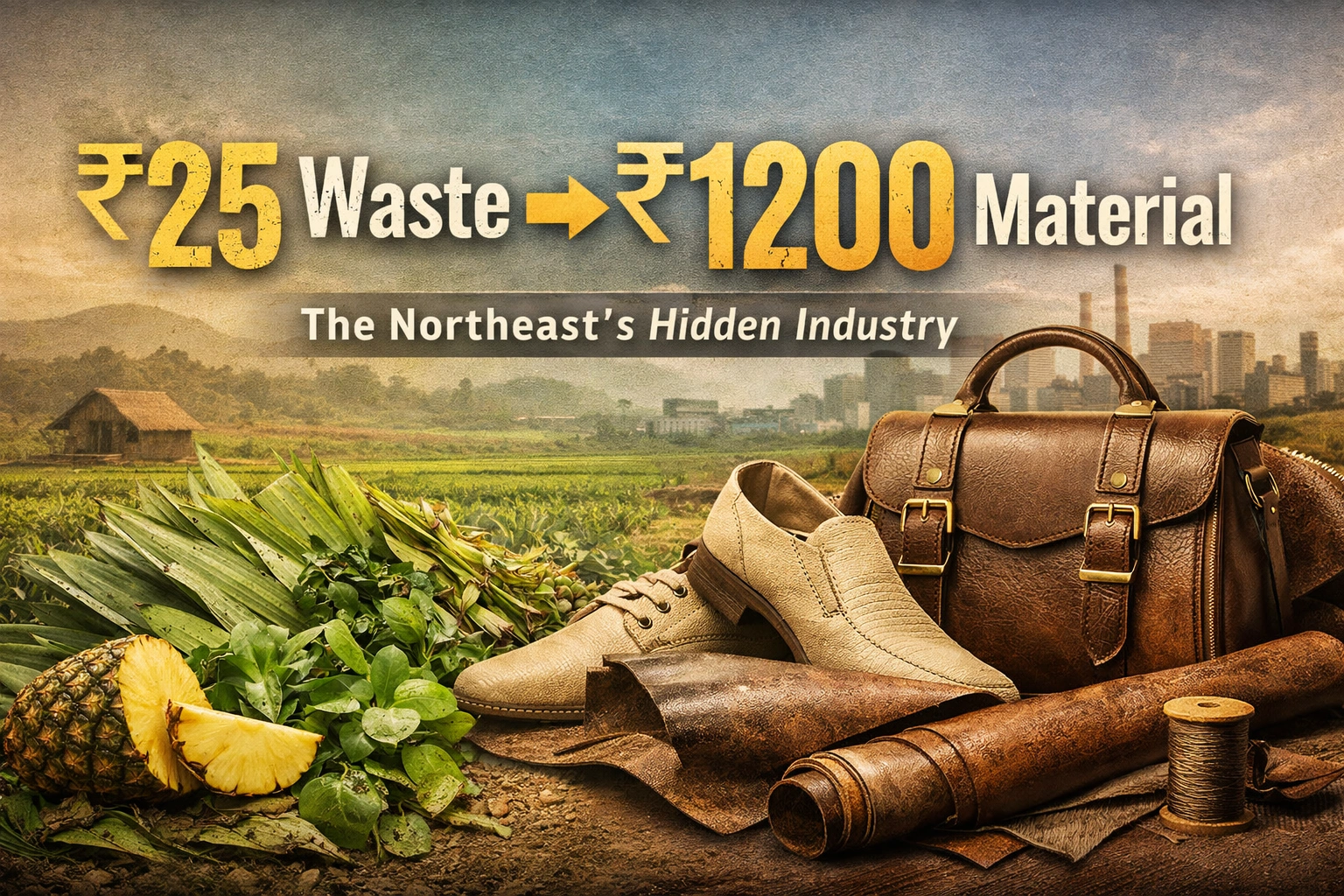
Raw pineapple fibre, exported without processing, commands ₹15 to ₹25 per kilogram. The same material, transformed into finished plant-leather sheets, captures ₹800 to ₹1,200 per kilogram equivalent.
The difference is not scientific. It is structural. It lies in processing, quality control, and the ability to meet global buyer expectations.
Northeast India stands at a familiar crossroads—one it has encountered in multiple commodity cycles before. To remain a supplier of raw inputs. Or to become a producer of finished value.
What to Watch Next
The trajectory of this industry will not be determined by announcements, but by signals.
The operationalisation of NECTAR’s first Common Facility Center will indicate whether institutional intent is translating into industrial action. Procurement signals from global brands will reveal where supply chains are forming. Policy shifts within Assam, Meghalaya, and Tripura will indicate whether governments are aligning with the opportunity. Credit flows into MSMEs will show whether capital is moving. And export registration data will quietly confirm whether the region is transitioning from raw material supply to processed output.
If these signals do not begin to align within the next two to three years, the implication will be clear. The window has closed.
Closing Note
The Northeast does not need discovery. It needs recognition.
Because sometimes, the difference between a missed opportunity and a global industry hub is not innovation, not capital, not even policy. It is a single decision.
Whether a region chooses to process what it already produces.https://thequantiq.com/the-worlds-most-expensive-wood-grows-in-assam-and-most-people-still-dont-know-it/


2 Comments