
India’s Industrial Moment: A US$ 7 Trillion Transition in Motion
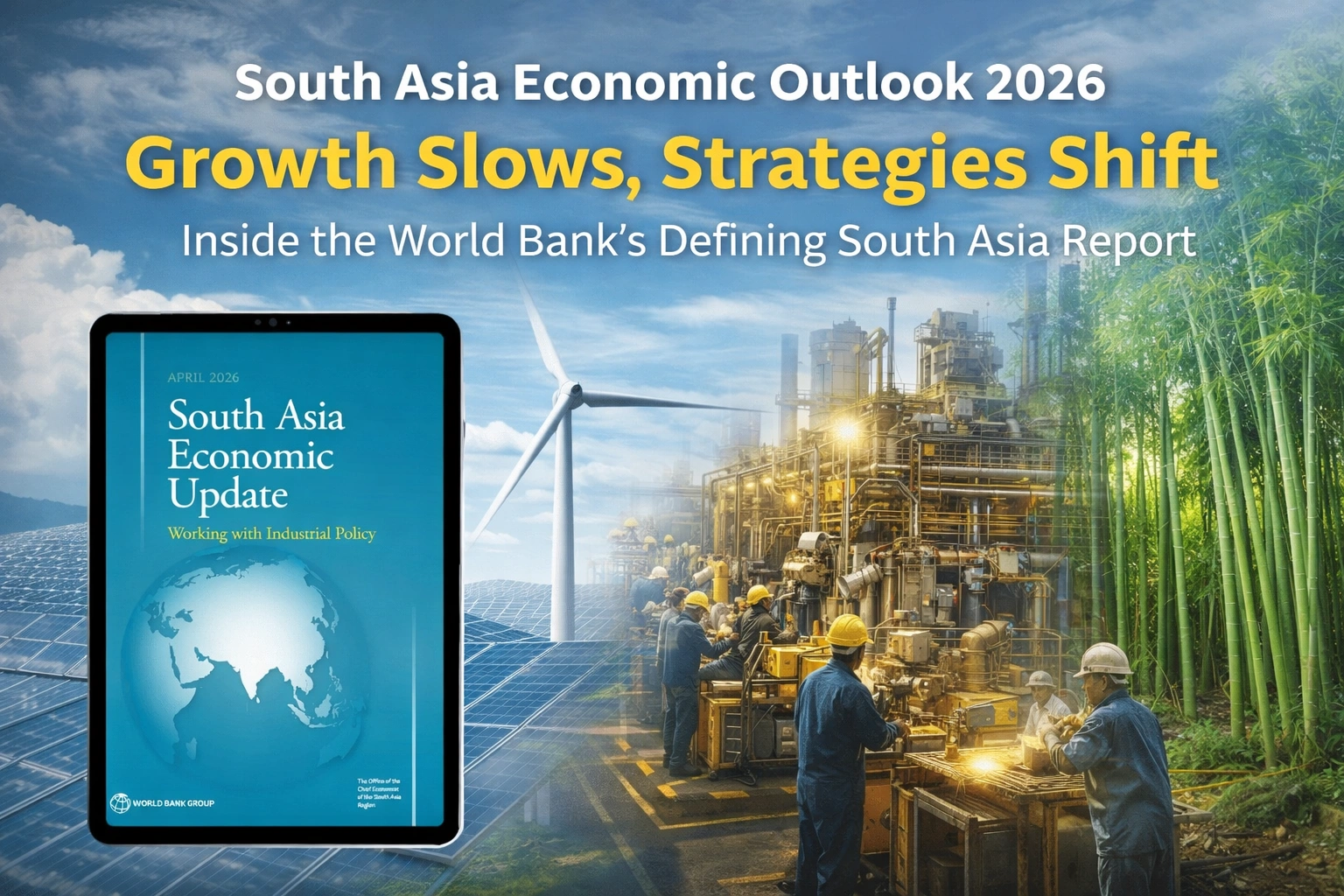
When the World Bank released its latest South Asia Economic Update April 2026, it did not sound an alarm. It marked a turning point.
South Asia is slowing. India is moderating. The easy momentum of the post-pandemic rebound is giving way to a more complex economic reality.
And yet, this is not a story of decline. It is a story of transition.
From Momentum to Calibration
India today stands on the threshold of becoming a US$ 4,000,000 Mn economy, with a credible pathway toward US$ 7,000,000 Mn within the next decade. But the journey from scale to strength will not be automatic.
Growth, which once appeared organic, now needs to be engineered.
The projected expansion of 6.0% to 6.5% over FY26–FY27 still positions India among the fastest-growing large economies. Inflation, expected to remain in the 4.5% to 5.5% range, appears contained on the surface. But beneath these numbers lies a subtle shift—from acceleration to calibration
The External Constraint
The vulnerability does not originate within the domestic economy. It comes from outside.
India continues to depend on imports for nearly 85% of its crude oil requirement. A relatively small increase of US$ 10 per barrel can expand the current account deficit by up to 0.4% of GDP, while simultaneously pushing manufacturing costs higher by close to 10%.
An annual oil import bill fluctuating between US$ 150,000 Mn and US$ 200,000 Mn is not just a number. It is a structural exposure—one that ties India’s growth to global volatility.
Reinventing Industrial Policy
India’s response to this reality has been a renewed engagement with industrial policy.
The Production Linked Incentive framework, with an allocation of nearly US$ 26,000 Mn, aims to generate over US$ 500,000 Mn in incremental manufacturing output. Alongside this, the National Infrastructure Pipeline—estimated at US$ 1,400,000 Mn—seeks to rebuild the country’s logistical foundation.
But investment alone is not transformation.
Logistics costs still account for nearly 13–14% of GDP, compared to a global benchmark of 8–9%. This gap represents an inefficiency that quietly drains more than US$ 150,000 Mn annually from the economy.
India is building capacity. The challenge is to convert it into competitiveness.
The Employment Fault Line
If there is one number that defines India’s structural challenge, it is this:
Each year, 10 to 12 million people enter the workforce. The formal economy absorbs only 3 to 4 million of them.
The resulting gap—potentially 60 to 80 million jobs over a decade—is not merely an economic imbalance. It is a defining test of India’s development model.
Service-led growth, for all its success, cannot carry this burden alone.
The next phase must be more distributed, more labour-absorbing, and more regionally inclusive.
The North East: From Periphery to Possibility
This is where the narrative shifts—quietly, but decisively.
The North East, often viewed through the lens of distance and difficulty, emerges as a potential economic frontier.
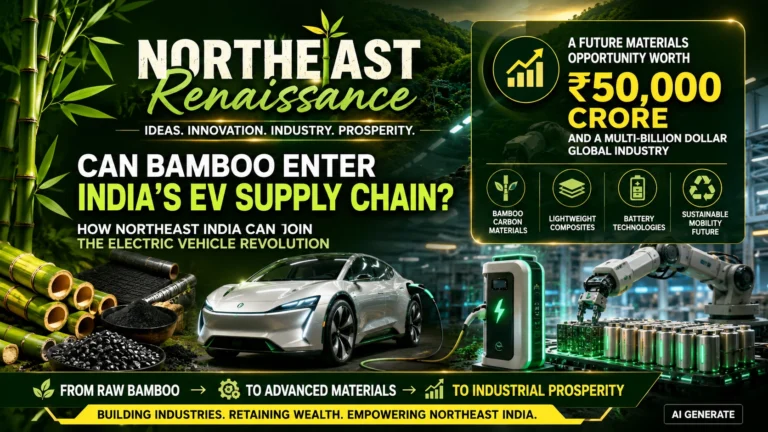
The region holds over 60% of India’s bamboo resources, placing it at the centre of a global market projected to reach US$ 98,000 Mn by 2030. Even limited industrial utilisation could unlock US$ 5,000 Mn to US$ 8,000 Mn annually, alongside significant employment generation.
Beyond bamboo, agroforestry opens another dimension.
With an estimated 25 to 30 million hectares of expansion potential and carbon sequestration rates reaching up to 17 tons of CO₂ per hectare annually, the region is positioned to participate in the emerging carbon economy. At current pricing levels of US$ 10 to US$ 30 per ton, this translates into a long-term revenue potential of US$ 2,000 Mn to US$ 5,000 Mn annually.
What appears peripheral today could become central tomorrow.
The Rise of Distributed Manufacturing
India’s future will not be built solely through large, centralised factories.
It will emerge through networks.
The MSME sector already contributes nearly 30% of GDP and accounts for 45% of exports, with over 63 million enterprises forming its backbone. Yet much of this ecosystem remains fragmented.
Digitisation and supply chain integration could unlock an additional US$ 1,000,000 Mn in economic value over the next decade.
This is not just an economic shift. It is a structural redesign—where rural and semi-urban India become production engines, not just consumption markets.
Sustainability as Strategy
A quiet but powerful realignment is underway in global capital.
ESG-linked investments have crossed US$ 30,000,000 Mn, while carbon markets are projected to exceed US$ 100,000 Mn annually by 2030.
India’s natural alignment with this shift is striking.
Its push toward 500 GW of renewable energy by 2030, combined with strengths in bamboo, agroforestry, and circular materials, creates a unique positioning.
If executed coherently, sustainability alone could unlock more than US$ 500,000 Mn in cumulative economic opportunity over the next decade.
A Decade That Will Decide
The contours of India’s future are becoming visible.
A US$ 7,000,000 Mn economy is within reach. Manufacturing could expand from 16% to nearly 25% of GDP. Exports could approach US$ 1,000,000 Mn. Employment generation could move toward 100 million jobs.
But none of this is guaranteed.
If execution falters, growth may remain consumption-driven, employment gaps may widen, and regional disparities may deepen.
The Final Shift
What the World Bank’s assessment ultimately reveals is not a slowdown, but a selection process.
The global economy is reorganising itself. Capital is becoming more selective. Supply chains are being redefined. Sustainability is no longer optional.
India now stands at a point of choice.
Not between growth and stability—but between scale and structure.
Because the next decade will not reward size alone.
It will reward systems that endure.
And in that quiet shift lies India’s true industrial moment.https://thequantiq.com/the-worlds-most-expensive-wood-grows-in-assam-and-most-people-still-dont-know-it/

One Comment