
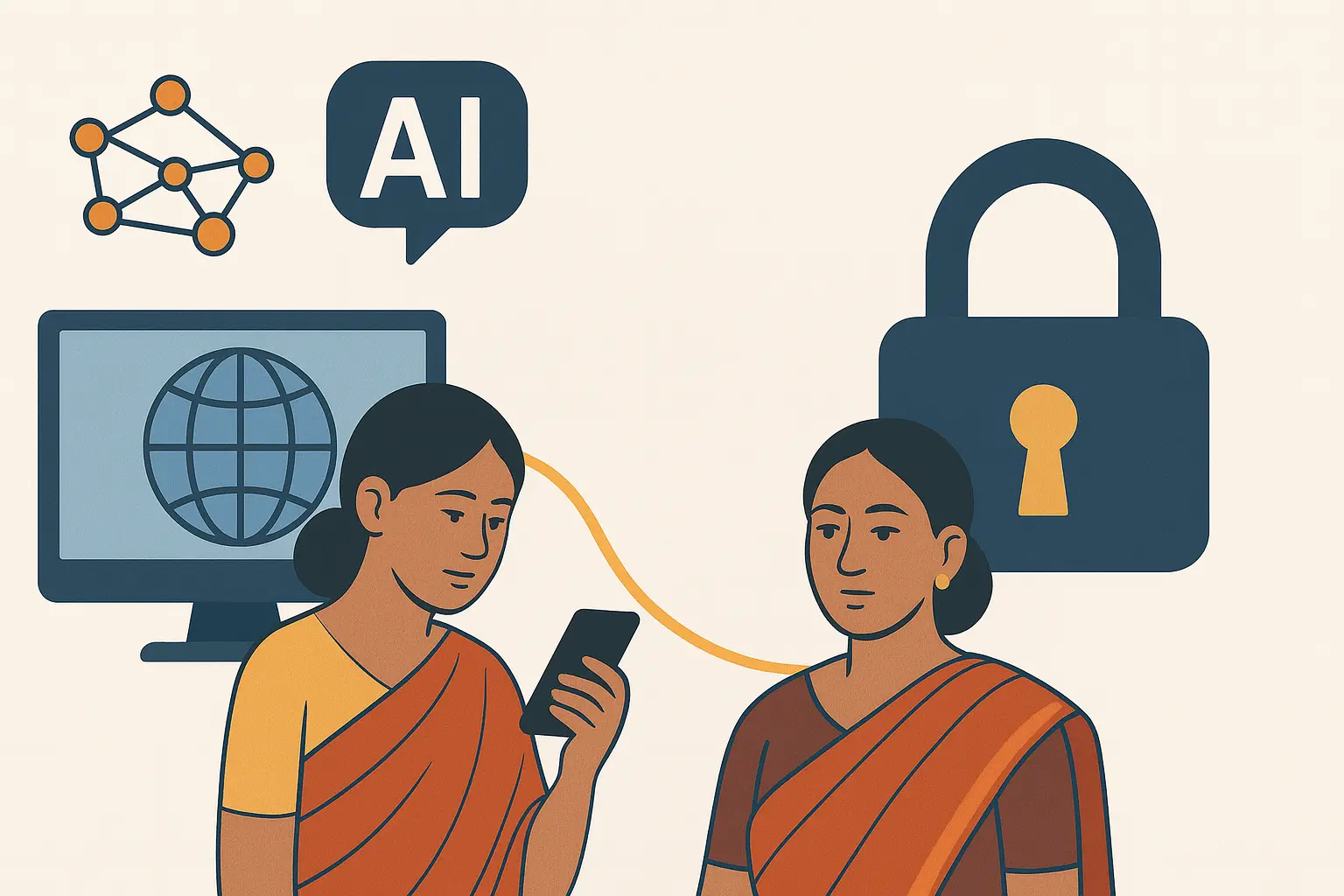
The Digital Divide’s New Frontier: Vernacular Sovereignty and Data Security in Northeast India
Artificial Intelligence (AI) is rapidly reshaping how Indians access information, public services, education, and markets. For a linguistically diverse country like India, this technological shift presents a paradox. On one hand, large language models (LLMs), speech-to-text systems, and machine translation tools have the potential to democratize access for non-English speakers. On the other, they risk deepening digital exclusion for smaller and low-resource languages—particularly those spoken across Northeast India.
Home to one of the world’s richest concentrations of languages and dialects, Northeast India sits at the intersection of vernacular sovereignty, digital inclusion, and data security. As AI systems increasingly mediate communication and knowledge, the region’s linguistic future depends on how these technologies are designed, governed, and adopted.
AI and Vernacular Languages: Opportunity Meets Constraint
AI-powered language technologies offer tangible benefits for speakers of smaller languages. In practical terms, this could mean:
- Farmers receiving weather alerts and advisories in Khasi or Garo
- Students accessing localized educational content in Mizo or Ao
- Artisans using AI-assisted translation to reach wider markets without abandoning their linguistic identity
Such applications can strengthen cultural continuity while improving economic participation.
However, AI systems depend heavily on large, high-quality datasets. While Indian languages such as Hindi, Bengali, Tamil, and Telugu are increasingly represented in digital corpora, many languages spoken in Northeast India—such as Kokborok, Dimasa, Bodo, or several Naga languages—remain data-scarce, inconsistently digitized, or largely oral.
This imbalance is not the result of neglect alone. Smaller speaker bases, limited standardization, and the high cost of dataset creation create structural barriers that commercial AI developers are often reluctant to cross.
Vernacular Sovereignty in the Digital Age
Vernacular sovereignty refers to a community’s ability to shape, govern, and represent its language in digital and algorithmic systems. It goes beyond preservation and addresses who controls linguistic data, how meaning is encoded, and whose worldview is reflected in AI outputs.
For many communities in Northeast India, language is inseparable from identity, customary knowledge, and social organization. If AI systems prioritize dominant languages by default, smaller languages risk becoming digitally peripheral—used in daily life but absent from platforms that increasingly define economic and civic participation.
Safeguarding vernacular sovereignty therefore requires intentional participation by linguistic communities in the AI ecosystem. This includes:
- Community-led data creation: Digitizing texts, recording oral traditions, and annotating language data through local institutions and cultural organizations
- Open-source language models: Supporting collaborative, non-proprietary AI development for low-resource languages
- Respectful standardization: Creating interoperable datasets while preserving linguistic variation and cultural nuance
These efforts ensure that AI systems reflect lived linguistic realities rather than flattening them into simplified representations.
Data Security: Linguistic Data as a Sensitive Asset
The digitization of language data introduces complex data security challenges—particularly for small or indigenous communities.
Linguistic datasets often include personal narratives, oral histories, traditional knowledge, and culturally sensitive material. Once digitized, such data can be vulnerable to misuse, misinterpretation, or unauthorized commercialization.
Key risks include:
- Privacy concerns: AI systems trained on conversational or oral data may inadvertently expose personal or community-sensitive information
- Cultural misappropriation: Traditional knowledge embedded in language data may be reused without consent or context
- Cybersecurity gaps: Smaller institutions often lack the infrastructure and expertise to secure digital linguistic assets
In a region with historical sensitivities around identity and autonomy, trust in data governance becomes essential
Building Trust Through Governance and Ethics
To address these risks, language digitization must be accompanied by strong governance frameworks. Effective approaches include:
- Informed consent and community ownership of linguistic datasets
- Clear data-use policies covering storage, access, and downstream applications
- Local capacity building in cybersecurity and digital stewardship
- Ethical AI guidelines emphasizing transparency, accountability, and cultural respect
Such measures ensure that linguistic empowerment does not come at the cost of community control.
Leveraging India’s AI Initiatives to Protect Vernacular Sovereignty
India’s emerging AI and digital public infrastructure initiatives offer a pathway for small languages to flourish without sacrificing sovereignty.
Programs such as Bhashini, under the Digital India framework, aim to create open, interoperable language datasets and AI tools for Indian languages. Similarly, the IndiaAI Mission emphasizes inclusive AI development and public-good digital infrastructure.
To ensure these initiatives benefit Northeast India meaningfully, the following strategies can be prioritized:
- Dedicated support for low-resource languages within national AI missions
- Public funding for community-driven language datasets, especially oral and multimodal data
- Partnerships between local universities, startups, and national research institutions
- Federated and decentralized AI models, allowing data to remain within community or regional control while contributing to national systems
By embedding vernacular sovereignty into India’s AI architecture, linguistic diversity can become a strength rather than a constraint.
The Road Ahead: Inclusion by Design
The future of AI in India will be defined not only by computational power but by who is represented in its data and design. For Northeast India, the challenge is to ensure that technological progress reinforces linguistic dignity rather than eroding it.
Achieving this balance requires collaboration—between governments, researchers, technologists, and communities themselves. With thoughtful governance, ethical safeguards, and targeted investment, AI can evolve into a tool that amplifies linguistic diversity instead of narrowing it.
A truly inclusive digital India will not be one that merely translates dominant languages, but one that allows every language—no matter how small—to shape its own digital future.




One Comment