India–New Zealand Free Trade Agreement:
Why This Quiet Deal Could Redefine India’s Export Strategy in a Fragmented Global Economy
A Small Partner, A Big Strategic Signal
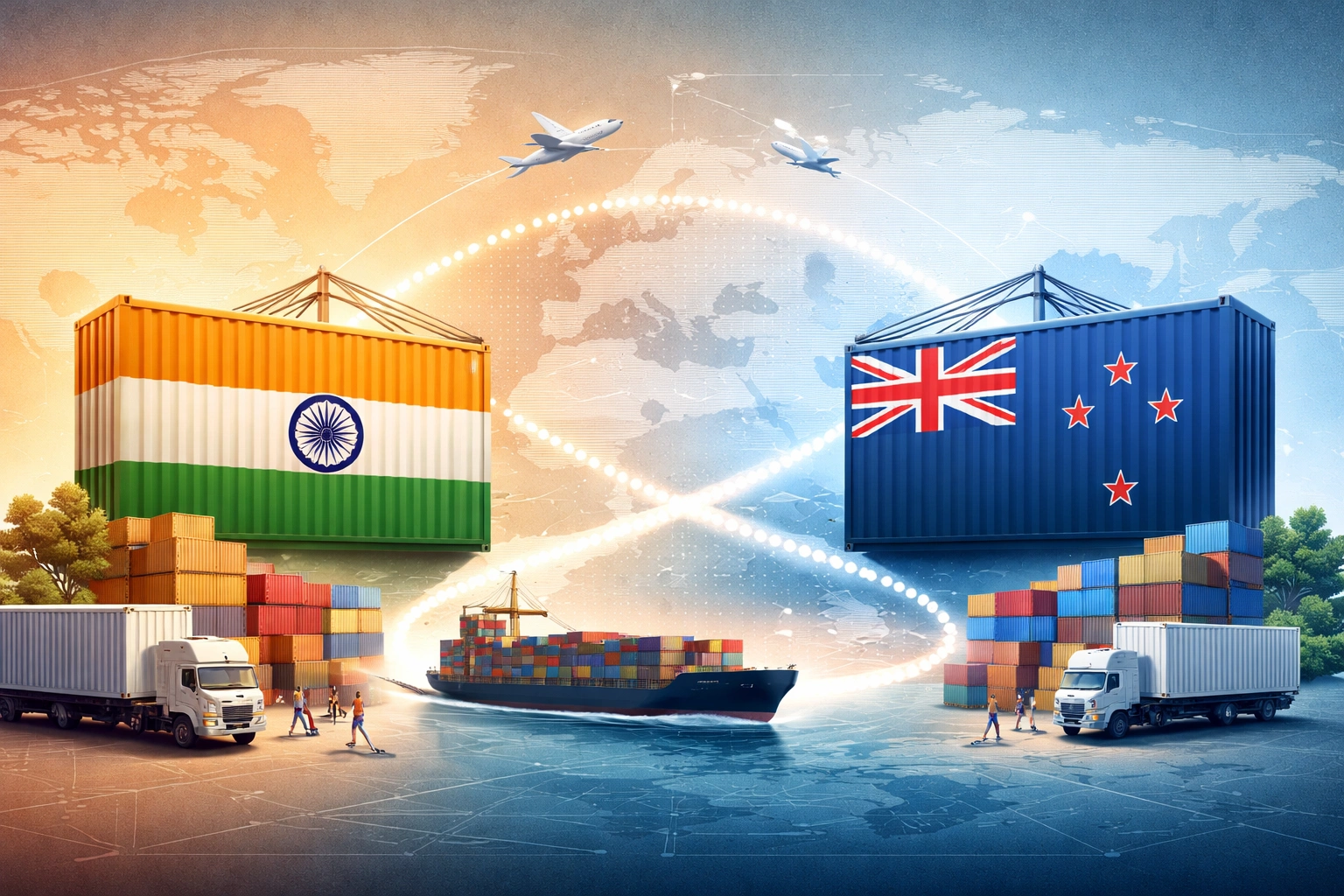
When India concluded a Free Trade Agreement (FTA) with New Zealand on 22 December 2025, the announcement did not dominate headlines the way a trade deal with the United States or the European Union might have. Yet, beneath its low-key unveiling lies a development that could prove strategically significant for India’s long-term economic trajectory.
At a time when global trade is increasingly shaped by geopolitical tensions, rising protectionism, and fragmented supply chains, the India–New Zealand FTA signals a deliberate shift in India’s trade philosophy: towards diversification, trusted partnerships, and calibrated liberalisation.
This agreement is not about headline-grabbing trade volumes alone. It is about resilience, credibility, and future-proofing India’s export economy in an uncertain global environment.
The Agreement at a Glance
India and New Zealand concluded negotiations on a comprehensive Free Trade Agreement after approximately nine months of talks. The agreement, once formally signed and ratified, aims to double bilateral trade within five years.
Key elements include:
- Elimination or substantial reduction of tariffs on a majority of traded goods
- A long-term investment commitment of up to US$20 billion from New Zealand into India over the next 15 years
- Expanded cooperation across goods, services, investment, education, and technology
- Strategic exclusions for sensitive Indian sectors, including dairy, edible oils, onions, spices, rubber, and select agricultural products
The agreement now moves into the ratification and formal signing phase, expected in early 2026
Why This FTA Matters for India’s Economy
India’s merchandise trade has crossed the US$1 trillion mark in recent years, reflecting its growing integration with global markets. However, this growth has also exposed vulnerabilities stemming from over-dependence on a few large export destinations.
With trade tensions escalating in several advanced economies and regulatory barriers rising, India has increasingly prioritised market diversification. New Zealand, though small in absolute trade volume, represents a high-trust, rules-based, and politically stable partner within the Asia-Pacific region.
The FTA strengthens India’s economic footprint in the Pacific supply-chain ecosystem, complementing its broader Indo-Pacific engagement strategy.
Sector-Wise Impact: Who Gains, Who Is Shielded
Textiles and Apparel: Incremental but Strategic Gains
India’s textile and apparel sector stands to gain from improved market access and tariff reductions, particularly in value-added garment segments. New Zealand’s retail market rewards quality, sustainability, and compliance—areas where Indian exporters have been steadily improving.
For Indian MSMEs:
- Reduced tariffs improve competitiveness against Southeast Asian suppliers
- The market offers higher margins rather than high volumes
- Success in New Zealand enhances brand credibility in other developed markets
This makes the FTA strategically valuable despite modest trade volumes.
Engineering Goods and Manufacturing
Engineering goods, including industrial components, fabricated metal products, and light machinery, are expected to see incremental export growth. These gains align with India’s manufacturing push under initiatives such as Make in India and PLI schemes.
The agreement also helps Indian manufacturers integrate into Pacific-oriented value chains, especially in infrastructure development and renewable energy projects.
Pharmaceuticals: Beyond Tariffs
For India’s pharmaceutical sector, the FTA’s significance lies less in tariff reduction and more in regulatory cooperation and mutual recognition of quality standards.
New Zealand’s stringent healthcare regulations make it a credibility market. Expanded access here enhances Indian pharmaceutical firms’ standing in other developed economies with similar regulatory expectations.
Services, Education, and Skill Mobility
The agreement strengthens frameworks for cooperation in:
- Education services
- Professional and technical services
- Skill development and training
Indian service providers and educational institutions gain clearer pathways into the New Zealand market, while New Zealand institutions benefit from structured engagement with India’s talent ecosystem. This represents a form of human-capital-driven economic diplomacy.
Agriculture: Calibrated Liberalisation
India’s decision to exclude dairy and select agricultural products from full liberalisation is a critical feature of the agreement. New Zealand is among the world’s most competitive dairy exporters, and unrestricted access could have disrupted India’s smallholder-dominated dairy sector.
By protecting sensitive sectors while liberalising others, India has adopted a balanced trade strategy that aligns economic openness with social stability.
Investment: The US$20 Billion Signal
One of the most consequential aspects of the agreement is New Zealand’s long-term investment commitment of up to US$20 billion over 15 years.
These investments are expected to target:
- Renewable energy
- Agri-technology and food processing
- Education and skill development
- Sustainable infrastructure
The focus on long-term, sustainability-aligned investments reinforces India’s broader climate and development objectives.
The Broader Context: India’s Evolving Trade Strategy
The India–New Zealand FTA fits into a larger pattern of India’s recent trade engagements. Rather than pursuing sweeping multilateral agreements, India has prioritised targeted bilateral FTAs with strategic partners.
Recent agreements and negotiations with the United Kingdom, Oman, and ongoing talks with the European Union illustrate a disciplined, pragmatic trade doctrine—one that balances openness with domestic safeguards.
India is no longer chasing trade liberalisation as an end in itself. Instead, it is aligning trade policy with industrial growth, investment attraction, and geopolitical positioning.
What This Means for Indian Businesses
For Indian exporters and entrepreneurs, the agreement underscores several realities:
- Smaller, high-trust markets can deliver disproportionate strategic value
- Compliance, sustainability, and quality are becoming competitive advantages
- FTAs reward preparedness more than scale
Businesses that invest early in standards, branding, and long-term partnerships are likely to benefit the most.
A Quiet Deal with Long-Term Consequences
The India–New Zealand Free Trade Agreement may not dominate daily news cycles, but its implications will unfold steadily over the coming years. It represents a carefully calibrated approach to trade—one that values resilience over rhetoric and strategy over speed.
For India, this is not merely another trade agreement. It is a signal of how the country intends to engage the global economy in the decade ahead—selectively, strategically, and on its own terms.