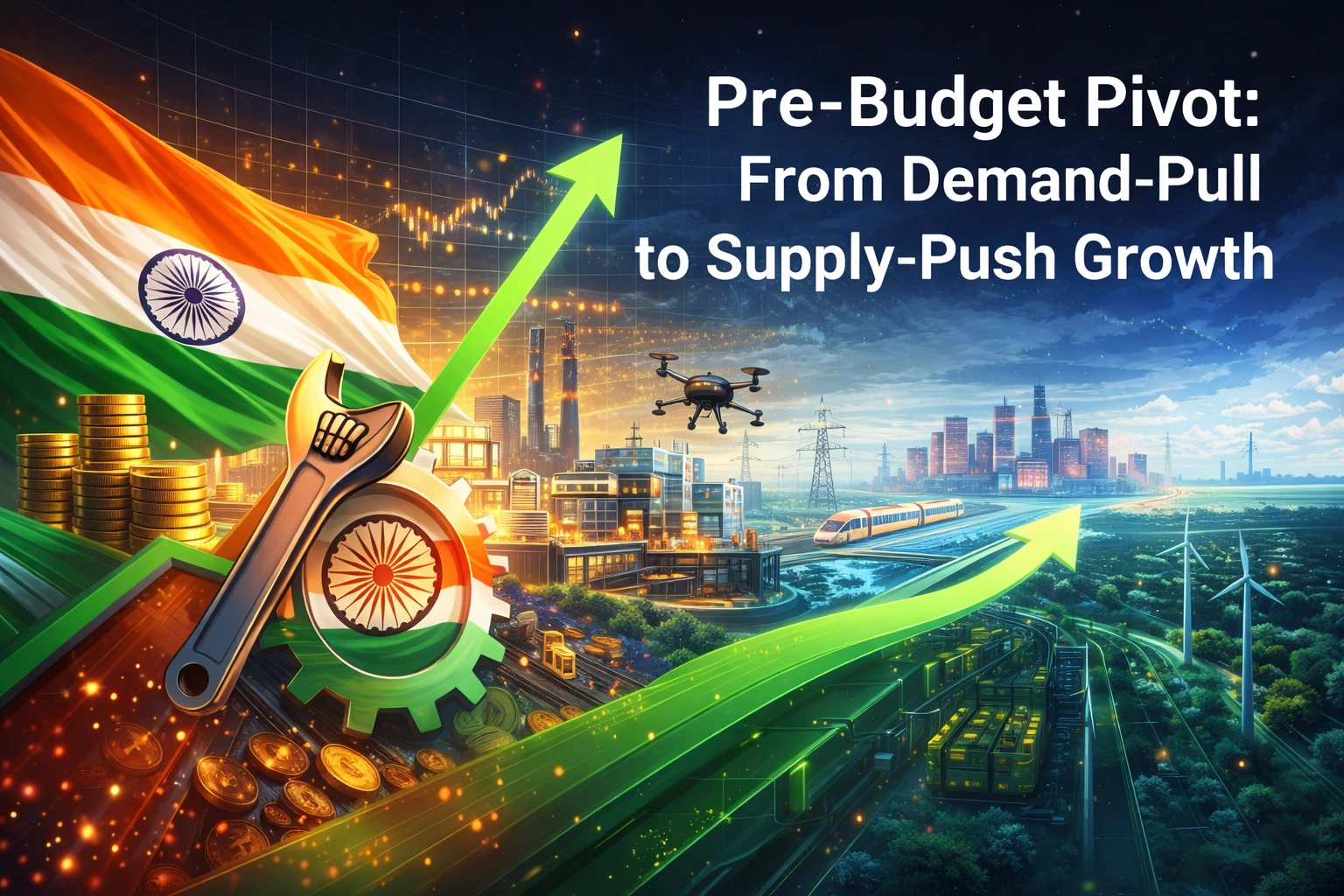
India’s Pre-Budget Pivot: Why the Real Economic Shift Is From Demand-Pull to Supply-Push
As India heads into the Union Budget, a subtle but decisive shift is underway in the country’s economic narrative. Unlike previous years—where tax cuts, consumption boosts, and short-term relief dominated pre-Budget lobbying—industry bodies are now pushing for something far more structural.
The message from business is clear:
India does not need another demand stimulus. It needs a supply-side reset.
This pivot, led by organisations such as FICCI and CII, marks a maturing of India’s economic priorities—from managing growth to manufacturing sovereignty and capital efficiency.
From Consumption Boosts to Capacity Creation
For over a decade, India’s growth playbook leaned heavily on demand-pull strategies:
- Tax relief to spur spending
- Welfare transfers to support consumption
- Credit expansion to keep demand afloat
These measures were necessary during periods of slowdown and crisis. But today, India faces a different challenge: demand exists, but supply competitiveness lags.
Manufacturing depth, technology ownership, and dispute-free capital deployment now matter more than marginal consumption boosts.
The Strategic Focus Areas
1️⃣ Drones and the New-Age Manufacturing Push
One of the most significant signals in pre-Budget discussions is the proposed expansion of Production-Linked Incentives (PLI) for strategic sectors such as drones.
Drones sit at the intersection of:
- Defence and national security
- Agriculture and logistics
- Surveillance, mapping, and disaster response
A targeted PLI outlay—reportedly under active consideration—would signal that India is serious about owning frontier manufacturing, not just assembling imported components.
The question is no longer whether India can consume advanced technology.
It is whether India can control its production stack.
2️⃣ Mega Electronics Industrial Parks: Scale as Strategy
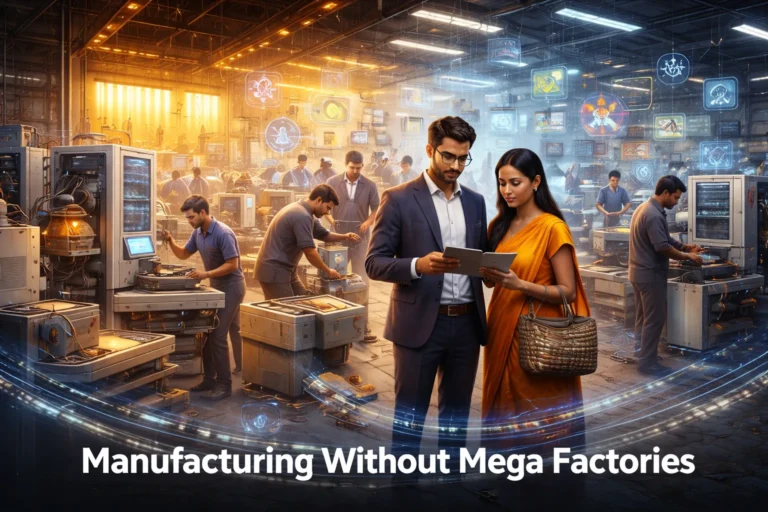
India’s ambition to create Mega Electronics Industrial Parks reflects a deeper understanding of global manufacturing realities.
In electronics, competitiveness is not built factory-by-factory. It is built ecosystem-by-ecosystem:
- Component suppliers
- Design houses
- Logistics hubs
- Skilled labour clusters
Without scale, incentives fail. Without ecosystems, PLIs plateau.
If executed well, these parks could help India move from being a large electronics market to a credible electronics manufacturing base.
The ₹18.16 Lakh Crore Elephant in the Room
Perhaps the most powerful—and least discussed—supply-side constraint is India’s tax dispute overhang.
Industry bodies estimate that ₹18.16 lakh crore is currently locked in tax disputes across forums. This capital is:
- Not being invested
- Not creating jobs
- Not expanding capacity
No subsidy scheme can match the economic impact of unlocking this trapped capital.
A dispute-preventive tax system—clear rules, fewer retrospective interpretations, and faster resolution—could unleash more private investment than any new incentive package.
Why This Matters More Than Tax Cuts
Tax cuts may improve sentiment.
Supply-side reforms improve productive capacity.
India’s next growth phase depends on:
- Faster capital deployment
- Predictable taxation
- Manufacturing depth
- Technology self-reliance
Without these, demand-led growth risks becoming inflationary rather than transformative.
Atmanirbharta 2.0: From Slogan to System
The original phase of Atmanirbhar Bharat focused on resilience—keeping the economy running amid shocks. The next phase must focus on capability.
That means:
- Fewer disputes, more trust
- Fewer imports of critical components
- More domestic value addition
- Fewer policy surprises
This is not protectionism.
It is economic sovereignty.
The Quantiq View
India stands at an inflection point. The choice before policymakers is not between growth and discipline—but between short-term optics and long-term capacity.
A Budget that prioritises supply-side clarity over demand-side comfort will not just boost GDP numbers—it will redefine India’s economic trajectory.
The real question this Budget must answer is simple:
Is India ready to manufacture its future—or only consume it?
Read this alongside our analysihttps://thequantiq.com/the-imfs-resilience-paradox-why-indias-growth-story-is-stronger-than-global-headwinds-suggest/s on why India’s growth remains resilient despite global headwinds: