
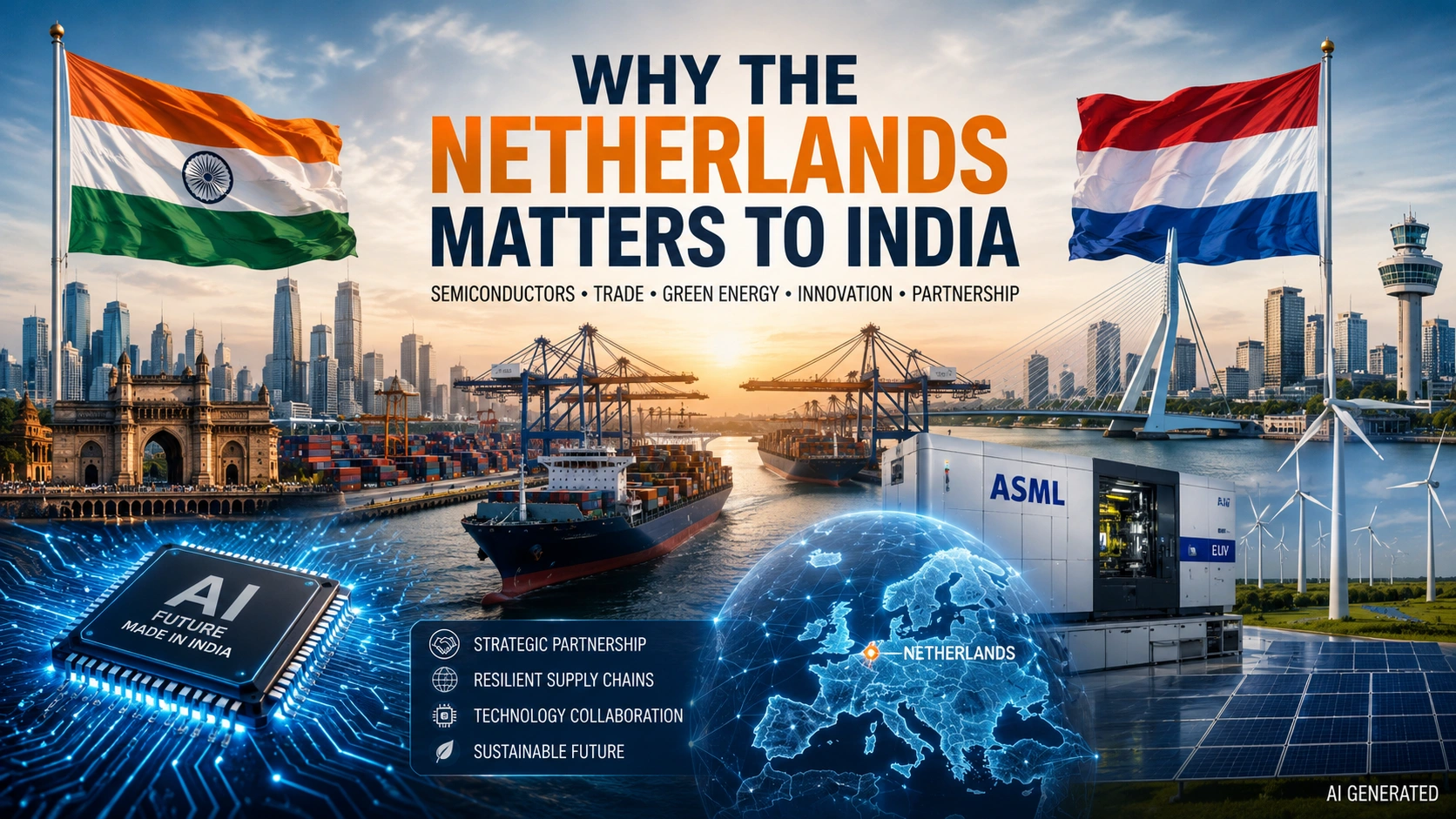
Why the Netherlands Matters More to India Than Most Indians Realise
When we Indians think about Europe, countries like Germany, France, or the United Kingdom usually dominate public conversation.
The Netherlands rarely enters India’s strategic imagination beyond tulips, football, canals, or postcards from Amsterdam.
Yet quietly, and with remarkable strategic importance, the Netherlands is emerging as one of India’s most significant European partners in the evolving global economy.
Recent agreements signed between India and the Netherlands covering semiconductors, green energy, digital technologies, water management, education, and strategic cooperation reflect something much larger than routine diplomacy.
They signal the emergence of a partnership deeply connected to the future architecture of global trade, technology, and supply chains.
To understand why this matters, one must first understand how rapidly the world economy itself is changing.
The era of hyper-globalisation built around concentrated manufacturing ecosystems is gradually fragmenting. Pandemic disruptions, semiconductor shortages, geopolitical tensions, trade conflicts, and concerns over strategic dependency on China have forced governments and corporations worldwide to rethink supply chains that once appeared permanent.
The global economy is now entering an era where resilience matters almost as much as efficiency.
And in this changing environment, India’s importance has risen dramatically.
Multinational corporations increasingly view India not merely as a large consumer market, but as a long-term manufacturing, technology, and strategic partner capable of balancing global supply-chain risks.
This is precisely where the Netherlands becomes critically relevant.
According to recent trade estimates, bilateral trade between India and the Netherlands has crossed approximately US$ 27 billion annually, making the Netherlands one of India’s largest trading partners within the European Union.
The Netherlands has also consistently ranked among the top European investors in India, with Dutch investments flowing into sectors such as logistics, renewable energy, technology, manufacturing, chemicals, ports, and services.
But the true importance of the Netherlands lies not simply in trade numbers.
It lies in the strategic ecosystems the country controls.
Despite having a population of only around 18 million, the Netherlands has built one of the world’s most advanced logistics and innovation infrastructures. Rotterdam Port — Europe’s largest seaport — handles over 430 million tonnes of cargo annually and acts as a major gateway into the European market.
For India, which is aggressively expanding exports into Europe amid global supply-chain realignments, this connectivity is strategically invaluable.
But perhaps the most important dimension of the partnership revolves around semiconductors.
Most people outside the technology sector may never have heard of ASML, a Dutch company headquartered in Veldhoven. Yet ASML may be one of the most strategically important companies in the modern global economy.
ASML manufactures extreme ultraviolet lithography (EUV) systems — highly specialised machines essential for producing advanced semiconductor chips used in artificial intelligence systems, smartphones, electric vehicles, defence technologies, cloud infrastructure, robotics, and modern computing.
Without ASML’s machines, advanced chip manufacturing at scale becomes nearly impossible.
Each EUV machine reportedly costs more than US$ 150 million and contains hundreds of thousands of precision-engineered components. More importantly, ASML effectively dominates this segment globally, giving the Netherlands extraordinary strategic relevance in the semiconductor ecosystem.
This matters enormously for India.
India’s semiconductor market is projected to exceed US$ 100 billion by 2030 as the country expands electronics manufacturing, EV ecosystems, telecom infrastructure, AI computing capacity, and digital systems.
The Indian government has already committed billions of dollars in incentives to attract semiconductor fabrication plants, chip assembly units, and electronics manufacturing ecosystems under its semiconductor mission and industrial policy initiatives.
Global companies are increasingly expanding manufacturing operations in India as part of broader China+1 diversification strategies.
However, semiconductors are among the most technologically complex industries ever created. Building competitive semiconductor ecosystems requires not only capital investment, but also access to precision engineering, specialised supply chains, advanced research ecosystems, and trusted technology partnerships.
The Netherlands therefore becomes far more important to India than most public discussions currently recognise.
The partnership extends beyond semiconductors into green energy and sustainability as well.
India has set ambitious targets of achieving 500 GW of non-fossil fuel energy capacity by 2030, while Europe continues accelerating its energy transition under climate commitments and strategic energy-security pressures.
The Netherlands has emerged as a major player in offshore wind systems, hydrogen ecosystems, sustainable logistics, circular economy models, climate adaptation, and water-management technologies.
India, meanwhile, offers scale, engineering talent, rapidly expanding infrastructure, and one of the world’s fastest-growing energy markets.
Together, the collaboration could become deeply complementary.
Water management is another highly strategic area.
Nearly one-third of the Netherlands lies below sea level, forcing the country to become a global leader in flood management, coastal resilience, drainage systems, and climate-adaptive urban planning.
As Indian cities increasingly face urban flooding, water scarcity, climate stress, and infrastructure vulnerabilities, Dutch expertise may become increasingly valuable.
Agriculture also represents a surprisingly important dimension of the partnership.
Despite its small geographical size, the Netherlands remains one of the world’s largest agricultural exporters, with annual agricultural exports exceeding US$ 100 billion. The country achieved this through precision farming, agri-tech innovation, greenhouse systems, efficient logistics, and advanced agricultural research.
For India, where agriculture still supports millions of livelihoods, technological collaboration in food processing, cold-chain systems, sustainable agriculture, irrigation efficiency, and agri-tech innovation could prove highly beneficial.
The educational and innovation ecosystem adds another strategic layer.
As artificial intelligence, robotics, biotechnology, automation, and advanced manufacturing redefine the future global economy, countries are increasingly competing for talent ecosystems rather than merely industrial capacity.
India possesses one of the world’s youngest populations, while many European economies face demographic ageing.
This creates natural opportunities for deeper collaboration in research, education, startups, deep-tech innovation, and advanced skill development.
India’s startup ecosystem — now among the world’s largest — also aligns strongly with Europe’s growing focus on climate-tech, industrial innovation, AI infrastructure, and sustainability-linked entrepreneurship.https://thequantiq.com/indian-rupee-depreciation-ai-economy/
There is also a wider geopolitical dimension shaping the relationship.
The European Union remains one of India’s largest trading blocs, while India is becoming increasingly important to Europe’s Indo-Pacific strategy and economic diversification goals.
For Europe, India represents not only a major market but also a democratic strategic partner in an increasingly fragmented world order.
For India, deeper engagement with technologically advanced European economies helps accelerate industrial capability, reduce strategic vulnerabilities, and diversify global partnerships.
The implications could eventually extend even to regions like Northeast India.
As Europe intensifies sustainability regulations and green industrial transitions, demand for eco-friendly materials, bamboo-based products, sustainable textiles, organic agriculture, and low-carbon manufacturing solutions may continue growing.
Regions rich in biodiversity and renewable natural resources could therefore acquire new strategic relevance within future sustainability-driven trade ecosystems.
However, India’s ability to fully leverage this opportunity will depend on execution.
Diplomatic agreements alone do not create transformation.
India must continue improving logistics efficiency, manufacturing depth, research capability, infrastructure quality, regulatory systems, and advanced technical skill development if it hopes to become a truly indispensable player in the future global economy.
The next decade will likely be shaped less by traditional geopolitics and more by technological ecosystems, semiconductor capabilities, AI infrastructure, resilient supply chains, renewable energy systems, and climate-linked industrial transformation.
And quietly, almost unnoticed by much of the public, the India–Netherlands partnership is positioning itself at the intersection of all those future-defining trends.
Sometimes the most important strategic relationships are not always the loudest.
They are the ones preparing steadily for the future while the rest of the world is still learning to pay attention.https://thequantiq.com/renewable-energy-india-economic-gatekeeper/




2 Comments