
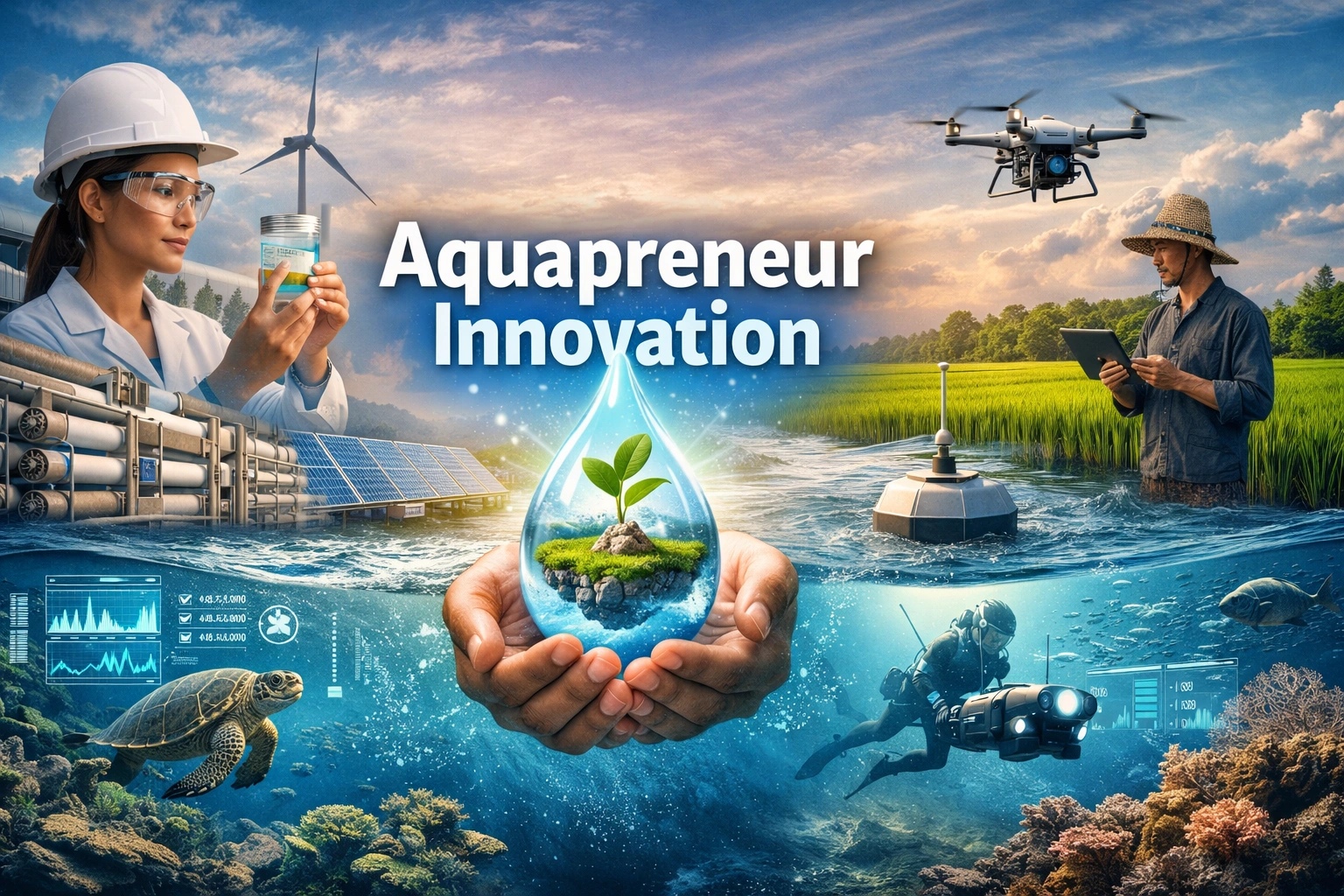
Davos 2026 and the Aquapreneurs: Why These 10 Startups Matter More Than Most Climate Pledges
One of the quieter but more consequential outcomes of the 2026 Annual Meeting of the World Economic Forum was not a speech, a declaration, or a geopolitical headline. It was the selection of ten early-stage startups under the Water Resilience Challenge, run by UpLink in partnership with HCL Group.
Chosen from over 300 global applicants, these ten “Aquapreneurs” are collectively modest in scale. None are unicorns. None dominate headlines. Yet together, they reveal something critical about where climate action has actually arrived in 2026: away from idealism and into the hard terrain of systems, financing, and execution.
This is not climate innovation as symbolism. It is climate innovation as infrastructure.
Why the Aquapreneur cohort matters
For years, climate discussions at global forums were dominated by targets, pledges, and moral urgency. Davos 2026 marked a noticeable shift. The emphasis was no longer on what should be done, but on what can realistically scale—and under what financial and institutional conditions.
The Aquapreneur Innovation Initiative sits precisely at that intersection. Its focus is not on speculative technology, but on deployable solutions for water stress, flooding, industrial pollution, agriculture, and decentralized access—areas where climate impact is immediate and unavoidable.
Water, unlike carbon, does not wait for consensus.
The 10 Aquapreneurs: what they do—and why they were chosen
Rather than treating the winners as a flat list, it is more revealing to group them by problem domain.
1. Industrial water stress and resource recovery
ElectraMet (USA)
ElectraMet focuses on electrochemical systems that extract and recover metals from industrial wastewater, turning pollutants into reusable resources.
Why this matters:
Industrial water pollution is one of the least discussed climate issues, yet one of the most damaging. Technologies that reduce toxic discharge while creating economic value directly align with the new Davos logic: environmental benefit must come with operational incentives.
Signal:
Circular water solutions that reduce regulatory risk and operating costs are becoming financeable climate infrastructure.
Vortech Water Solutions (Ireland)
Vortech develops energy-efficient wastewater treatment systems designed to reduce power consumption and footprint.
Why this matters:
Wastewater treatment is energy-intensive. Any meaningful reduction in energy use directly improves municipal and industrial resilience—especially in energy-constrained regions.
Signal:
Incremental efficiency gains, when applied at scale, now matter more than breakthrough claims.
2. Desalination and unconventional water sources
FLOCEAN (Norway)
Flocean is working on subsea desalination, using natural ocean pressure to reduce the energy cost of producing fresh water.
Why this matters:
Desalination is unavoidable for many regions, but its energy cost has limited adoption. Flocean’s approach targets the economics of desalination rather than its optics.
Signal:
Climate solutions that lower lifecycle costs—not just emissions—are gaining priority.
Desalytics (UAE / Africa)
Desalytics combines digital water diagnostics with local service delivery, targeting African and emerging markets.
Why this matters:
Water scarcity in the Global South is often a systems failure, not a technology failure. Diagnostics plus service models shorten response time and build trust.
Signal:
Service-integrated climate solutions are more scalable than hardware-only plays.
3. Flooding, groundwater and real-time monitoring
Hohonu (USA)
Hohonu provides low-cost, hyperlocal sensors for flood and water-level monitoring.
Why this matters:
Climate adaptation begins with situational awareness. Flood monitoring reduces disaster response costs and insurance losses long before physical infrastructure is built.
Signal:
Data is becoming a first line of climate defence.
iFLUX (Belgium)
iFLUX specialises in measuring groundwater flows and contamination using advanced sensing techniques.
Why this matters:
Groundwater is the invisible backbone of water security. Poor measurement leads to poor policy.
Signal:
Evidence-based water governance is finally becoming investable.
4. Agriculture and Community Resilience
SWAN Systems (Australia)
SWAN Systems offers software and IoT tools for precision irrigation, helping farmers reduce water and input use while maintaining yields.
Why this matters:
Agriculture accounts for the majority of freshwater withdrawals globally. Efficiency here delivers outsized impact.
Signal:
Climate action in agriculture is moving from ideology to farm-level economics.
NoorNation(Egypt)
NoorNation builds solar-powered hubs delivering water, irrigation, and electricity to off-grid communities.
Why this matters:
Bundling water and energy addresses rural resilience holistically, not piecemeal.
Signal:
Decentralised infrastructure is central to adaptation in the Global South.
5. Materials science and purification
Xatoms (Canada)
Xatoms develops photocatalytic materials that use light to remove biological and chemical contaminants from water.
Why this matters:
If durable at scale, such materials could dramatically lower the cost of water purification in remote and resource-poor regions.
Signal:
Deep tech is welcome—but only when paired with realistic deployment pathways.
EarthFokus (India)
EarthFokus focuses on smart fixtures and retrofit solutions that reduce water consumption in buildings and urban environments.
Why this matters:
Urban water efficiency is one of the fastest ways to reduce demand without new supply.
Signal:
Demand-side water management is finally being taken seriously.
What Davos 2026 tells us through these winners
Three larger truths emerge from the Aquapreneur cohort:
1. Climate innovation is no longer about hero technologies
It is about systems compatibility—with finance, regulation, and operations.
2. Water has become the frontline of climate adaptation
Unlike emissions, water stress is local, visible, and politically urgent.
3. Early-stage solutions now need procurement pathways
Grants alone are insufficient. What these startups need next is institutional demand.
Why this matters for India
For India, the relevance is immediate:
- Industrial wastewater regulation is tightening
- Urban water demand is rising
- Agriculture remains water-intensive
- Flood and drought risks are increasing
The Aquapreneur cohort offers ready-to-pilot solutions. What is missing is a structured pathway for adoption—through public procurement, blended finance, and regulatory sandboxes.
Davos has done its part by surfacing the innovators.
The real work now begins at the state and city level.
Final takeaway
The Aquapreneurs of Davos 2026 represent a quiet but decisive turn in climate action. They are not selling hope. They are selling workable systems.
In a year when Davos repeatedly signalled that execution matters more than ambition, these ten startups may end up being more influential than many of the summit’s most publicised announcements.
For policymakers, investors, and institutions, the message is clear:
climate resilience will be built solution by solution, not pledge by pledge.https://thequantiq.com/wef-davos-2026-the-signals-shaping-the-global-economy-and-indias-make-or-break-choices/