Budget Maths vs Ground Reality: What the ₹10,000 Crore MSME Provision Really Means
A reassuring headline, a familiar moment
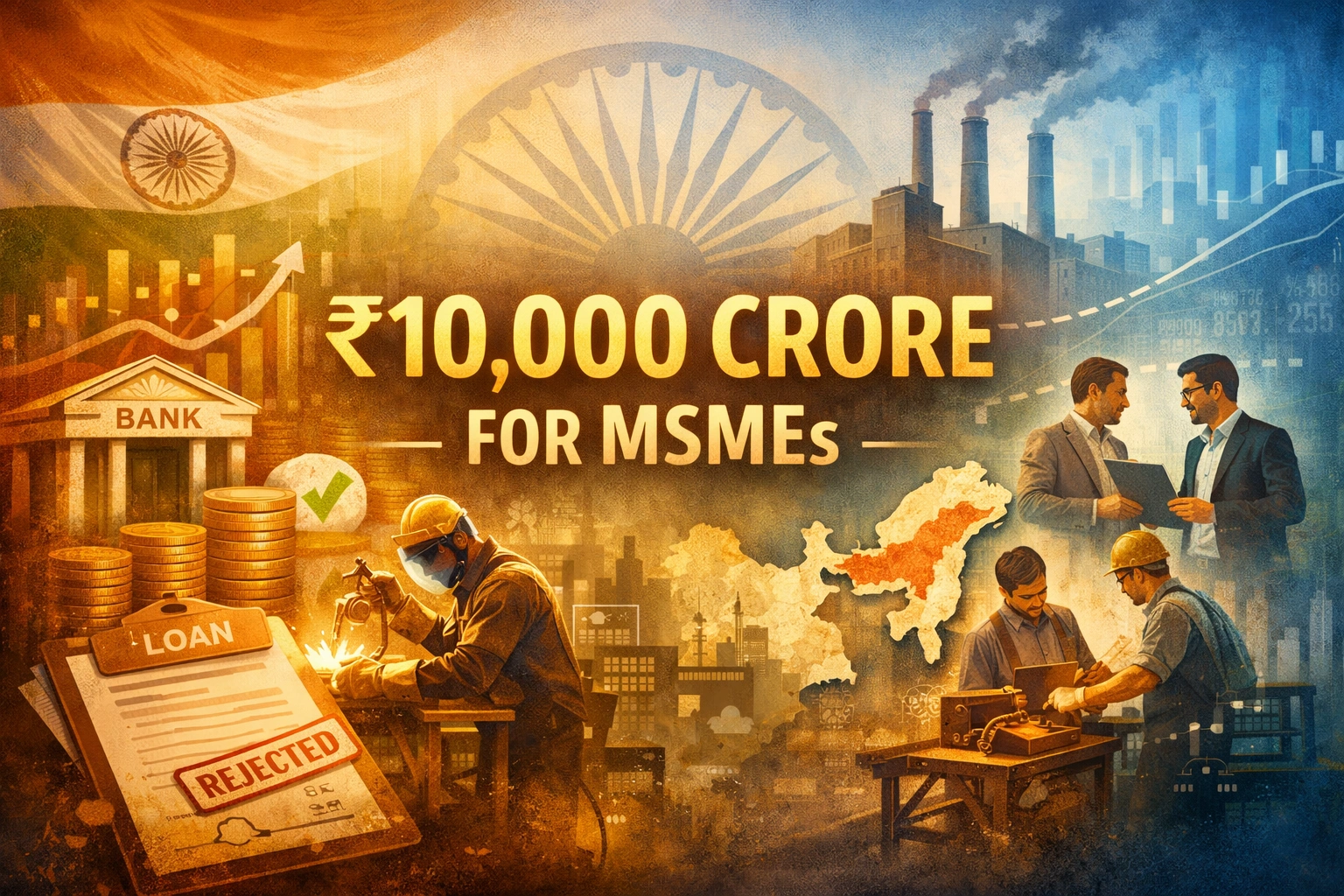
When the Union Budget announced a ₹10,000 crore provision for India’s micro, small and medium enterprises, the headline number offered reassurance. At a time when MSMEs are navigating tight credit cycles, rising costs, delayed receivables and uneven demand, the announcement appeared to reaffirm the sector’s centrality to India’s economic growth story.
Yet, as with most budgetary allocations, the real impact lies not in the number itself but in the mechanics behind it. How the money is structured, who can access it with ease, and whether it meaningfully changes behaviour on the ground are far more important than the headline figure. Viewed through this lens, the ₹10,000 crore MSME provision reflects a careful, system-first policy choice rather than a bold intervention aimed at expanding entrepreneurial risk.
What the provision is designed to do
A closer reading makes it clear that this is not direct financial support flowing into MSME bank accounts. Instead, the allocation is largely designed to strengthen credit guarantee and risk-sharing mechanisms, encouraging banks and financial institutions to lend with greater confidence. In practical terms, the government is absorbing a portion of lender risk, hoping this will unlock more institutional credit for small businesses.
This design choice signals continuity rather than disruption in MSME policy thinking.
Why formal MSMEs stand to gain first
This structure naturally favours enterprises that are already part of the formal financial ecosystem. MSMEs with consistent GST compliance, established banking relationships, stable cash flows and clean credit histories are best positioned to benefit. For them, the provision can translate into smoother access to working capital, quicker approvals and marginally improved lending terms. In such cases, the policy acts as a catalyst within an already functioning system.
The persistent gap at the informal end
However, the picture changes when viewed from the other end of the MSME spectrum. A significant share of India’s enterprises continue to operate in semi-formal or informal settings, often by necessity rather than choice. First-generation entrepreneurs, micro enterprises, rural businesses and innovation-led ventures with limited balance-sheet strength frequently find themselves excluded from institutional credit despite being economically viable. For these businesses, the distance between eligibility on paper and approval in practice remains substantial.
The North-East reality policymakers rarely factor in
This gap is particularly pronounced in the North-East. MSMEs in the region face a combination of structural challenges that national policy frameworks rarely factor in adequately. Smaller local markets, higher logistics costs, limited banking penetration and thin credit histories make it difficult for otherwise viable enterprises to appear “bank-ready”. Many businesses operate with discipline and intent but lack the formal documentation and scale that lenders look for. As a result, a credit-guarantee-led approach offers limited immediate relief, reinforcing a long-standing perception that MSME policy is shaped around established manufacturing clusters, while peripheral regions are expected to adapt to systems not designed for their realities.
How banks view the ₹10,000 crore push
From the banking perspective, the design of the provision is logical. Financial institutions prioritise predictability, compliance and risk mitigation. Government-backed guarantees help reduce exposure, but they do not fundamentally alter lending behaviour. Screening remains conservative, documentation requirements often increase, and enterprises that fall outside standard risk models continue to struggle. The outcome is a system that becomes more stable without necessarily becoming more inclusive.
What the signal means for MSME founders
For MSME founders, the announcement should be read less as a windfall and more as a directional signal. The message is clear: access to capital will increasingly favour businesses that align themselves with formal systems. Financial hygiene, credible records and transparent operations are no longer optional but essential. Those who invest early in building this credibility will find it easier to benefit as institutional credit flows deepen.
A familiar policy tension
At a broader level, the ₹10,000 crore provision highlights a recurring policy tension. India expects its MSMEs to drive employment, exports and innovation, yet public support continues to be routed primarily through risk-averse financial channels. Stabilising the credit system is necessary, but long-term competitiveness demands mechanisms that also accommodate entrepreneurial uncertainty and regional diversity.
The bottom line
The allocation is not insignificant, and it does reinforce the government’s stated commitment to the MSME sector. Its impact, however, will be uneven. Enterprises already inside the formal ecosystem are likely to experience incremental relief. For many others, especially in regions like the North-East, the ground reality remains unchanged: access to finance still depends on credibility, compliance and clarity.
Budgets can open doors. Whether India’s MSMEs are able to walk through them depends less on the size of the allocation and more on how prepared they are to meet the system halfway.https://thequantiq.com/union-budget-2026-what-it-really-means-for-north-east-india/