
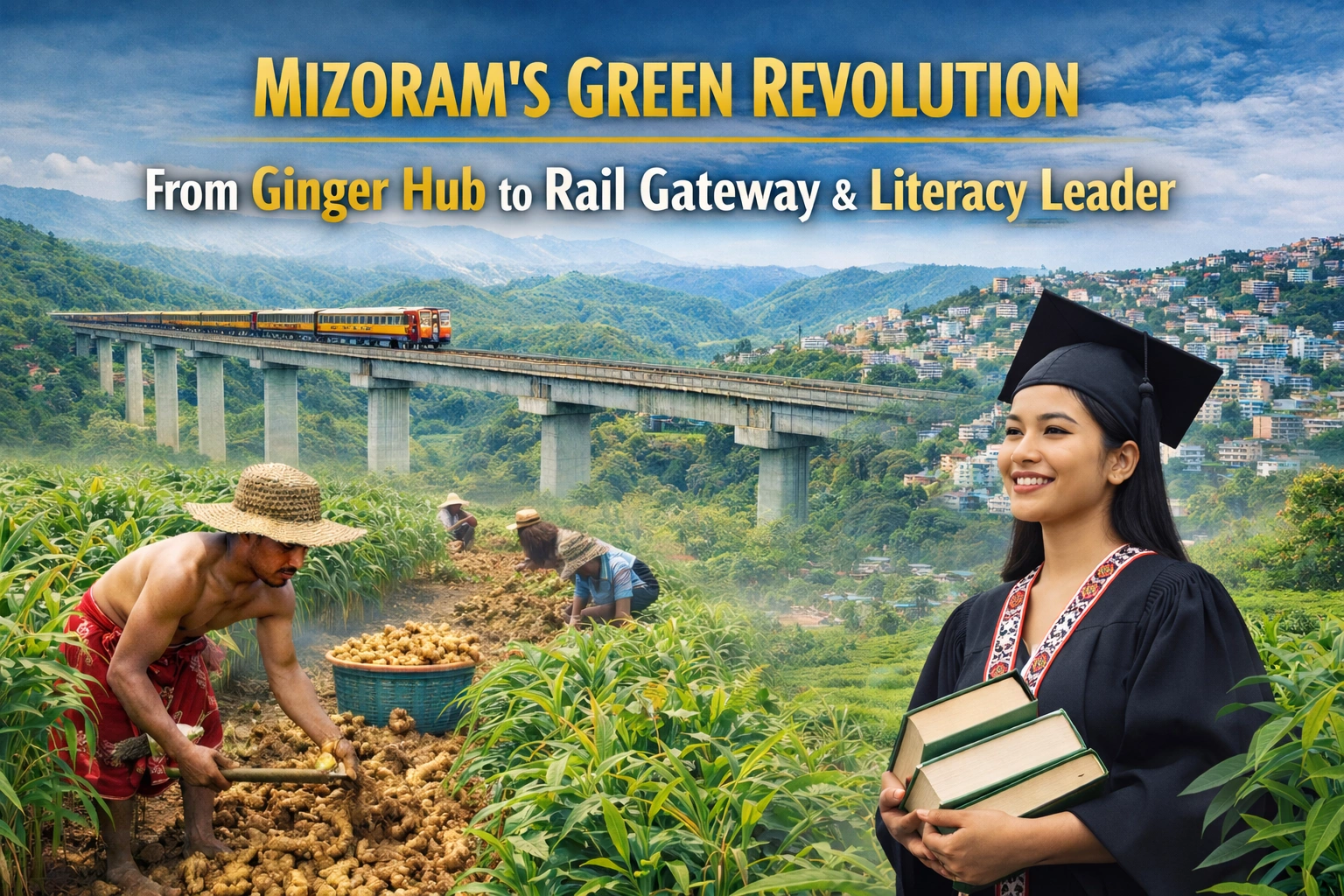
Mizoram’s Green Revolution: From Quiet Frontier to Ginger Hub and Northeast Connectivity Powerhouse
As Mizoram marks 40 years of statehood, the state’s story is evolving from that of a peaceful hill frontier into one of India’s most promising examples of organic agriculture-led growth, rising connectivity, and human-capital-driven development.
From expanding ginger cultivation and food processing to the long-awaited arrival of railway connectivity near Aizawl, Mizoram is gradually positioning itself as a green economy hub in the Northeast and an important node in India’s Act East strategic vision.
Ginger Economy: Mizoram’s Organic Advantage
Agriculture remains central to Mizoram’s rural economy, and ginger has emerged as one of its most visible success stories.
The state is among India’s major ginger producers, known particularly for locally grown varieties such as Thingpui ginger, valued for its strong aroma, fibre content, and suitability for organic cultivation. Much of Mizoram’s farming continues to be low-chemical or naturally organic by practice, giving it a market advantage as demand rises for clean-label produce.
Production and Market Momentum
While exact yearly figures vary across departments and seasons, government estimates indicate that Mizoram produces well over one lakh tonnes of ginger annually, placing it among the significant contributors in the Northeast.
Rather than a sudden surge, the growth has been steady over recent years, driven by:
- expansion of ginger acreage
- improved farmer training and cooperative marketing
- better road connectivity for transport
- support under central horticulture missions
The “Ginger Capital” narrative, promoted in policy and development circles, reflects this expanding production base and Mizoram’s reputation for quality organic ginger, though it should be seen as a strategic branding effort rather than a single official title issued through one notification.
Moving Up the Value Chain
Recognizing that raw ginger alone brings limited income, the state has increasingly focused on processing and value addition.
With support from agencies such as NABARD and horticulture development programs, Mizoram has been encouraging:
- ginger drying and powder units
- paste and preserved ginger production
- essential oil extraction
- packaging for export markets
Investments in processing infrastructure — including units in districts such as Champhai, Kolasib, and Lunglei — aim to increase the share of value-added ginger products over the coming years. If successful, this shift could significantly raise farmer incomes while positioning Mizoram as a specialized organic spice exporter from the Northeast.
Railway Connectivity: A Structural Turning Point
For decades, Mizoram’s biggest economic constraint was physical isolation. That is beginning to change.
The Bairabi–Sairang railway project, a 51-km broad-gauge line connecting Mizoram to the national rail network, represents one of the most transformative infrastructure projects in the state’s history. Built at a cost exceeding ₹6,500 crore, the line will bring rail access to Sairang, just outside Aizawl.
While construction timelines have shifted multiple times due to difficult terrain, bridges, and tunnels, the project is nearing completion and trial operations have been progressing. Once fully operational, the railway is expected to:
- dramatically reduce freight transport time and cost
- improve access to mainland markets
- lower logistics costs for agricultural produce
- strengthen supply chains for construction and consumer goods
- boost tourism inflows
Even before full passenger-scale operations, improved connectivity narratives have already begun influencing hotel development, homestays, and logistics planning in the region.
Logistics and Trade Implications
Better rail connectivity could significantly reduce transport costs compared to road-only routes, particularly for bulky agricultural goods like ginger, turmeric, bamboo, and horticulture produce.
Strategically, the line also enhances Mizoram’s potential role in India’s Act East Policy, given the state’s proximity to:
- Myanmar through the Kaladan corridor region
- Bangladesh, via potential trade routes linked to river and road networks
Over time, integration of rail, road, and border infrastructure could turn Mizoram into a multi-modal gateway for cross-border commerce, especially for agricultural and light industrial goods.
Literacy and Human Capital: Mizoram’s Quiet Strength
Mizoram has long ranked among India’s most literate states, with literacy rates consistently above 90%, among the highest in the country.
In 2025, the state celebrated achieving near-universal literacy, a milestone reflecting decades of strong community participation in education, church-led schooling traditions, and high social emphasis on learning.
This literacy advantage has tangible economic implications.
Skills and Workforce Development
A highly literate youth population enables Mizoram to expand beyond agriculture into:
- food processing and packaging
- tourism and hospitality services
- digital and administrative jobs
- small-scale entrepreneurship
Under national and state skill initiatives, Mizoram has been promoting training in:
- hospitality and eco-tourism
- agro-processing and cold chain management
- digital services and IT-enabled work
Enrollment in skill programs and entrepreneurship initiatives has grown in recent years, reflecting a shift toward employment diversification.
Startup and Local Enterprise Push
Through initiatives like Startup Mizoram, the government has provided support to emerging enterprises, particularly in:
- agro-based businesses
- tourism services
- handicrafts and bamboo products
- food processing ventures
Such programs aim to create local value chains, reducing dependence on government jobs — historically a major employer in the state.
Tourism and the Green Economy Opportunity
Mizoram’s rolling hills, cultural richness, and relatively low tourist density make it one of India’s most underexplored destinations.
Improved connectivity — especially rail access and better highways — could unlock:
- eco-tourism circuits
- cultural tourism experiences
- adventure tourism in hill and forest regions
- homestay-based rural tourism
Combined with its organic agriculture branding, Mizoram has the potential to market itself as a green destination blending sustainable farming, clean landscapes, and community-driven tourism.
A Small State with a Strategic Future
Mizoram’s transformation may be quieter than that of larger Indian states, but its trajectory is increasingly clear.
With:
- a strong organic agriculture base led by ginger
- improving rail and logistics connectivity
- strategic relevance in India’s Act East framework
- one of the country’s most literate populations
the state is gradually shifting from geographic isolation to economic integration and green growth leadership.
As Mizoram completes 40 years of statehood, the next decade could determine whether it evolves from a peaceful frontier into one of Northeast India’s most sustainable and connected economies.



One Comment