
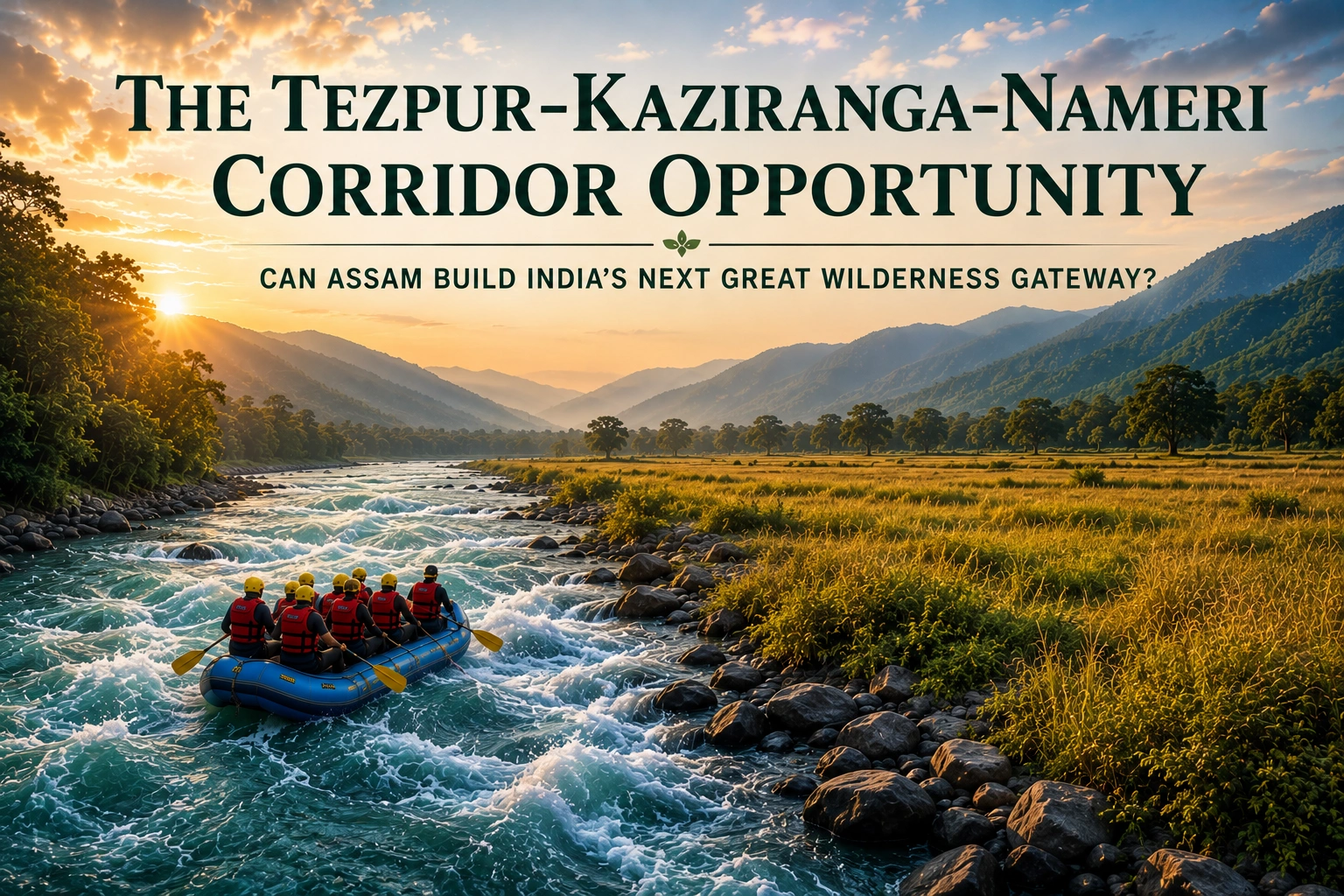
The Tezpur–Kaziranga–Nameri Corridor Opportunity: Can Assam Build India’s Next Great Wilderness Gateway?
For decades, Assam’s tourism story has largely revolved around isolated destinations.
Visit Kaziranga. Take a safari. Click the rhino. Leave.
But what if the real opportunity was never a single destination at all?
What if Assam’s greatest tourism potential lies in connecting landscapes, experiences, cultures, and journeys into one seamless wilderness ecosystem?
Hidden quietly in plain sight is a corridor that could fundamentally reshape how travellers experience not only Assam, but the entire Northeast region of India.
That corridor stretches across Tezpur Airport, Kaziranga National Park, and Nameri National Park — with enormous future potential to integrate Orang National Park and even the Himalayan foothills of Arunachal Pradesh into a larger “Eastern Wilderness Belt.”
And yet, despite possessing many of the ingredients required for a world-class tourism circuit, this opportunity remains largely under-imagined.
Not underdeveloped. Under-imagined.
The Geography of Opportunity
Globally successful tourism regions are rarely built around a single attraction.
The world’s most iconic travel ecosystems thrive because they combine multiple experiences within manageable geographic proximity.
The Serengeti circuit in East Africa is not just about wildlife. It is about movement across landscapes.
The Alps are not merely mountains, but interconnected cultural and adventure corridors.
The wine valleys of Europe thrive not because of one vineyard, but because of clustered experiences.
Assam may already possess a similar possibility.
Within a relatively compact travel radius from Tezpur lie three dramatically different ecological experiences.
The floodplain megafauna landscapes of Kaziranga.
The riverine forests and adventure ecology of Nameri.
The intimate grassland wilderness of Orang.
Each destination offers a distinct ecological personality. Together, they create something much more powerful: diversity of experience without fragmentation of travel.
This is where the real opportunity begins.
Why Tezpur Matters More Than It Appears
For years, most travellers heading toward Kaziranga have instinctively viewed Guwahati as the default entry point. It is understandable. Guwahati is Assam’s largest urban centre and its primary aviation hub.
But premium tourism does not always favour the largest city.
Increasingly, global travellers prefer smaller, quieter, emotionally immersive gateways that gradually transition them into the destination experience.
That is where Tezpur possesses extraordinary strategic potential.
Unlike crowded metropolitan arrival experiences, Tezpur offers something psychologically important: a softer transition into the wilderness.
The Brahmaputra landscape begins to unfold differently here. The pace changes. The visual rhythm changes. The emotional relationship with the landscape changes.
From Tezpur, travellers can potentially access multiple wilderness experiences while avoiding the fatigue of repeatedly changing hotels or undertaking exhausting road journeys from Guwahati.
This creates the foundation for what modern tourism increasingly values — slow, immersive, experience-rich travel.
The Shift From Destination Tourism to Corridor Tourism
The future of premium tourism may not belong to standalone attractions.
It may belong to curated corridors.
A traveller visiting Kaziranga today often spends one or two nights before moving elsewhere. Economically, this creates limited local value despite the global importance of the park.
But imagine a different model. A traveller lands in Tezpur.
The first evening is spent overlooking the Brahmaputra or amidst tea garden landscapes. The following days unfold gradually through the rhythm of the corridor itself — a dawn safari through Kaziranga’s elephant grasslands, a riverside experience in Nameri, slow Assamese culinary immersion, birding and photography trails, cultural storytelling evenings, and soft adventure along the Jia Bhoroli river.
Suddenly, the tourist is no longer consuming a park. The tourist is inhabiting an ecosystem. That changes everything.
Longer stays create deeper economic impact. Spending spreads across local communities, guides, transport providers, food entrepreneurs, artisans, nature interpreters, and hospitality ventures. More importantly, travellers carry back emotional memory rather than transactional tourism.
And emotional memory is the true currency of premium travel.
The Missing Layer in Assam Tourism
Assam has never lacked natural beauty. What it has lacked is layered tourism architecture.
Many destinations in the region continue to operate in silos. Wildlife exists separately from tea heritage. River systems remain disconnected from tourism narratives. Culture is showcased independently of landscape.
But globally competitive tourism ecosystems thrive on integration.
The Tezpur–Kaziranga–Nameri corridor has the potential to combine wildlife, river systems, tea heritage, soft adventure, rural experiences, Assamese cuisine, cultural storytelling, and Himalayan gateway access into one coherent journey.
Very few regions in India can offer such ecological and experiential diversity within a connected travel geography.
Yet the corridor remains largely absent from mainstream tourism imagination.
Why This Matters Economically
This conversation is not merely about tourism branding.
It is about regional economic transformation.
Premium tourism functions differently from mass tourism. Its value does not depend only on visitor numbers, but on the depth and quality of experience.
A traveller spending four nights across a corridor contributes far more economically than a rushed one-night safari visitor. The benefits ripple outward through transport services, boutique stays, local cuisine, handicrafts, guiding, river activities, and community experiences.
At a time when employment generation remains one of the Northeast’s biggest developmental challenges, experience-led tourism could emerge as a serious economic engine if approached strategically.
Particularly for the youth of Assam.
The Untapped Power of Community-Led Hospitality
One of the corridor’s greatest future opportunities may lie not in giant resorts, but in curated, high-quality community-driven stays around Tezpur and nearby landscapes.
Globally, travellers increasingly seek authenticity, intimacy, local connection, and environmentally conscious hospitality.
This opens the possibility for a new generation of youth-led hospitality entrepreneurs in Assam.
Small but aesthetically designed nature residences, eco-retreats, river-facing stays, tea landscape lodges, and curated homestay networks could gradually transform Tezpur into a meaningful wilderness gateway.
If done carefully, this would not merely create rooms. It would create identity.
A Chance to Build India’s Next Great Wilderness Narrative
India possesses globally recognised tourism brands. Rajasthan evokes heritage. Kerala evokes backwaters. Goa evokes beaches. Himachal evokes mountains.
But India still lacks a globally dominant wilderness corridor narrative comparable to parts of Africa or South America.
The Eastern Himalayas and Brahmaputra floodplains may offer that possibility.
The Tezpur–Kaziranga–Nameri corridor could become the nucleus of such a vision.
Not as a mass-tourism destination.
But as a premium, slow, immersive wilderness region built around ecology, culture, and discovery.
That would require smarter branding, stronger storytelling, conservation-sensitive infrastructure, community participation, and a long-term vision that sees tourism not merely as visitor movement, but as regional transformation.
Most importantly, it would require belief.
Because before destinations become globally iconic, they are first imagined differently.
And perhaps Assam’s next great tourism opportunity is waiting not in building something entirely new — but in finally connecting what already exists.https://thequantiq.com/from-hidden-valleys-to-hospitality-capital-the-dirang-signal-that-redraws-northeast-indias-tourism-mapdirang-tourism-ihcl-northeast-india-growth/






2 Comments