The Great Indian Numbers Game
Beyond GDP, Growth and the Government Job Dream
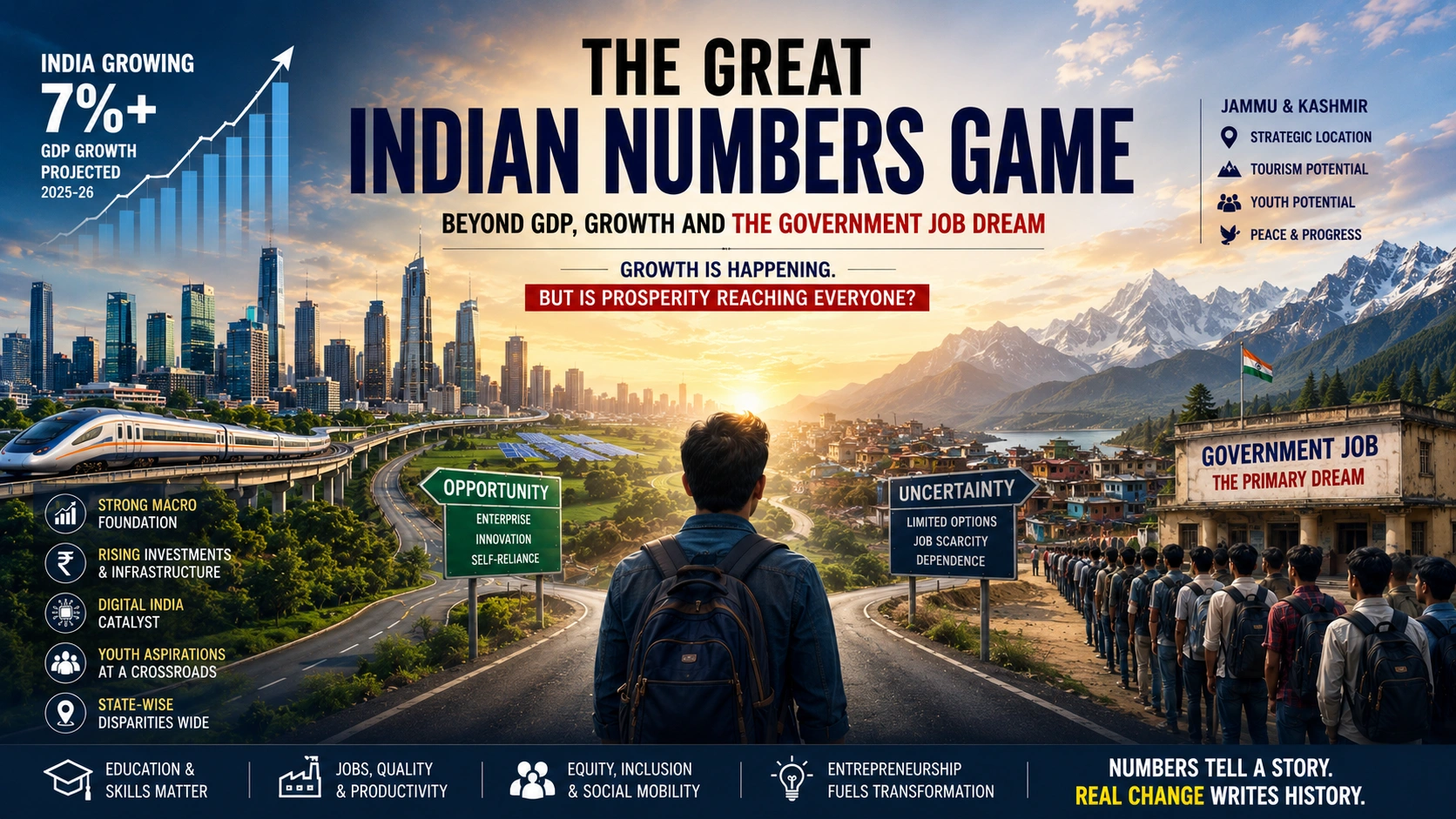
India today stands at a fascinating economic crossroads. On one hand, the country is celebrated as one of the world’s fastest-growing major economies. Growth projections remain robust. Policymakers speak of trillion-dollar ambitions, investment summits dominate headlines, airports rise, highways expand, and digital infrastructure deepens across the country.
And yet, beneath this optimism lies a question that refuses to go away.
If growth is accelerating, why do economic anxieties remain stubbornly visible? Why do millions of young people still queue desperately for a handful of government vacancies? Why do migration, underemployment and household insecurity continue to shape everyday decisions? Why do some states record enviable growth rates and still struggle with poverty, weak entrepreneurship and limited quality employment?
The answers are neither simple nor ideological. They lie inside what may be called India’s numbers paradox. Because economies are not judged by applause alone. Economies are judged by lived reality.
India’s Growth Story Is Real — But It Is Not the Entire Story
Let us begin with honesty. India’s macroeconomic progress is real and deserves recognition. The country has maintained strong momentum despite global uncertainty, geopolitical tensions and post-pandemic disruptions. Recent official assessments estimate medium-term growth potential around 7 percent, and India continues to rank among the fastest-growing major economies. This matters. A weak India helps nobody.
Growth generates fiscal resources, creates investment confidence, and supports poverty reduction. But this is where public conversation often stops — and perhaps where the real discussion should begin. Because there is a critical difference between growth and prosperity. The two are related. They are not identical.
” Growth headlines often create celebration. But economies are not judged by applause. They are judged by lived reality. “
The Percentage Illusion
One of the most misunderstood ideas in economics is the growth percentage. Suppose one economy worth ₹100 grows by 20 percent. It becomes ₹120. Another economy worth ₹1,000 grows by 8 percent. It becomes ₹1,080. The first economy grew faster. The second became far wealthier.
This simple arithmetic explains why some states celebrated as ‘fastest growing’ may still remain among the poorest. Growth percentages can inspire optimism. But prosperity depends on the base, the quality, and the distribution of that growth — and this is where India’s state-level story becomes far more complex than national headlines suggest.
India’s Internal Divergence
India does not have one economy. It has many. A state with strong manufacturing ecosystems operates very differently from one dependent on remittances. A tourism-driven economy behaves differently from a mineral-rich one. An entrepreneurial ecosystem differs dramatically from one dependent on public expenditure.
This diversity is both India’s strength and its policy challenge. The disparity becomes visible when one examines per-capita income — a more grounded indicator than total GDP alone. While India ranks among the world’s largest economies in aggregate size, its per-capita income remains far below many advanced economies. State-level differences are even sharper. States such as Goa, Sikkim, Haryana, Tamil Nadu and Maharashtra perform substantially above national averages, while poorer states continue to lag despite periods of impressive growth.
This raises an uncomfortable but necessary question: Are we celebrating speed while ignoring distance? A poorer state may run faster and still remain far behind.
State GSDP rankings and growth percentages, taken alone, can mislead as much as they inform. Per-capita income, employment quality and capability depth tell a fuller story of whether growth is translating into prosperity.
The Fastest-Growing Yet Still Struggling Contradiction
Consider the irony. A state may report strong GSDP growth. Investment announcements may dominate news cycles. Economic surveys may celebrate expansion. Yet ordinary households may still struggle with fragile incomes, migration pressures, insecure jobs, weak local enterprise ecosystems, and limited private-sector opportunity. This is not a contradiction. It is an economic reality.
Even relatively successful states reveal this paradox. Maharashtra’s economy remains among India’s largest, and its growth projections remain strong — yet district-level inequality persists, agricultural vulnerabilities remain visible, and many districts fall below the state average in prosperity. Himachal Pradesh has seen growth and tourism recovery supports income expansion, yet youth unemployment and fiscal pressures continue. These examples are not failures. They simply remind us of an important truth: GDP growth alone does not guarantee social and economic transformation. A state can grow — and still remain economically anxious.
Beyond GDP: The Missing Indicators
When people discuss economic success, GDP usually dominates. But serious analysis demands broader questions. What kind of jobs are being created? Who benefits? Are young people finding meaningful opportunities? Are women participating fully? Is prosperity geographically concentrated? How resilient is the state economy?
Economists increasingly rely on complementary indicators: per-capita income, labour participation, employment quality, enterprise creation, fiscal health, education, health outcomes, productivity, and capability depth. This broader approach matters because people do not live inside GDP charts. They live inside households. And households judge economies differently.
A family asks: Can we earn with dignity? Can our children find work? Can we build a future here? Those questions rarely fit inside celebratory statistics.
The Employment Puzzle Nobody Wants to Simplify
India’s labour story is equally complex. Official data indicate improvement in employment indicators and labour participation in recent years. Unemployment has moderated from earlier peaks, and workforce participation has strengthened. These trends deserve acknowledgment.
But another truth exists alongside them. The employment debate increasingly revolves not merely around unemployment, but around job quality and opportunity structure. Globally and domestically, youth employment remains a persistent challenge. India faces a special demographic moment. A young nation cannot rely only on growth. It must also generate aspiration-compatible opportunity — and here emerges one of the most sensitive economic questions of our time.
The Government Job Aspiration and Its Hidden Cost
Across large parts of India, government employment carries a powerful emotional and social meaning: security, prestige, predictability, respect. For millions of families, a government job is not merely employment. It is insurance against uncertainty. That aspiration is understandable and it deserves respect.
But difficult questions cannot be avoided. What happens when large sections of educated youth focus overwhelmingly on a narrow employment pipeline? What happens when coaching economies expand faster than entrepreneurial ecosystems? What happens when risk-taking becomes socially secondary to job security?
This is not an argument against government jobs. Healthy states require competent public servants. The question is about aspirational concentration — and whether economies can unlock their full potential when one dream becomes overwhelmingly dominant.
” When security becomes the only respected dream, risk-taking quietly retreats from society. “
Most young people are responding rationally. Families seek certainty because uncertainty is expensive. Weak private ecosystems, unstable jobs, and limited local industry naturally increase the appeal of government employment. The real question, therefore, is systemic: Can economies experience entrepreneurial transformation when opportunity itself appears socially narrow?
The Resource-Rich Yet Opportunity-Poor Puzzle
How can regions blessed with fertile land, rivers, minerals, biodiversity, tourism potential, strategic geography or cultural capital still struggle to generate broad-based prosperity? Why do some resource-rich regions continue to witness migration, unemployment and economic frustration?
The answer may be uncomfortable. Resources alone do not create economic revolutions. Capabilities do. History repeatedly teaches this lesson. Oil does not automatically create innovation. Minerals do not automatically create entrepreneurship. Tourism potential does not automatically create thriving economies. Prosperity emerges when resources meet institutions, skills, enterprise and productive imagination — and this is where many state economies encounter invisible barriers.
” Resources may lie beneath the soil. But revolutions begin in the imagination, and the capability of people. “
The Capability Question: What Can Your Economy Actually Build?
For decades, development debates focused heavily on physical resources — land, coal, ports, water, roads. Important, certainly. But modern economics increasingly points toward another idea: economic complexity. Prosperous economies are not merely those producing more. They are those capable of producing more sophisticated and diversified products and services.
Recent research examining Indian states through economic complexity frameworks found significant differences in productive sophistication across regions. States such as Maharashtra, Karnataka and Delhi displayed stronger capability depth and industrial diversity, while others remained concentrated in low-value or less diversified activities. A strong relationship between economic complexity and per-capita prosperity was also confirmed. This shifts the debate profoundly. The question is no longer merely ‘What resources does a state possess?’ but ‘What can its people and enterprises actually build?’
The Myth of Automatic Prosperity
There is a seductive belief in development politics: that prosperity will naturally follow investment summits, industrial announcements or infrastructure projects. Reality is more demanding. Economic transformation is rarely automatic.
Consider the contrasts across Indian states. Some states lacking large mineral wealth have built strong industrial, manufacturing or service ecosystems. Others, despite natural endowments, continue to struggle with low industrial diversification and limited enterprise depth. Punjab remains economically significant and agriculturally influential, yet recent projections indicate slower growth compared to national averages and continuing structural challenges. Meanwhile, Telangana demonstrates another reality — strong growth and rising per-capita income coexisting with substantial district-level disparities. Growth may be real. But prosperity is rarely uniform. And therefore, serious journalism must move beyond celebratory averages, because averages often hide geography, and geography hides inequality.https://thequantiq.com/beyond-the-resource-economy-the-capital-pivot-in-nagaland-tripura-manipur/
Manufactured Optimism vs Informed Confidence
Modern politics and media often reward optimism. And optimism has value — societies cannot progress through despair alone. But optimism becomes dangerous when detached from reality. Sometimes numbers are selectively narrated. Growth becomes headline. Debt becomes footnote. Investment announcements dominate discussion while employment quality receives less attention.
Nationally, India’s macroeconomic resilience remains strong and widely acknowledged. Yet economic surveys and policy discussions increasingly warn about fiscal sustainability and the importance of productive investment. This is where citizens require nuance — not cynicism, not blind celebration, but informed optimism. Because manufactured optimism and informed confidence are not the same thing. One avoids difficult questions. The other asks them courageously.
Measuring What Truly Matters
Examining Indian states seriously means asking harder questions than GDP alone can answer. It means asking whether aggregate growth is translating into per-capita prosperity — whether the size of an economy reflects what people actually earn and keep. It means asking about the quality of work being created: not simply whether people are employed, but whether those jobs are formal or informal, fairly paid, productive, and open to the young. It means asking whether a state’s economy has genuine depth — whether its enterprises are diversified and capable of producing goods and services of real sophistication, or whether they remain locked in low-value extraction and commodity dependence. It means asking whether public finances are sustainable, because growth built on fragile fiscal foundations eventually stalls. It means asking about the condition of people themselves — their health, their education, the skills they carry, and the social mobility available to their children, because people are not secondary to growth; they are growth. And finally, perhaps most importantly, it means asking what young people in a state are daring to dream. An economy where imagination is expanding, where multiple futures feel possible and where ambition takes many forms, may ultimately outperform one where aspiration has quietly narrowed to a single, crowded door.
Beyond Investment Summits: The Imagination Economy
India does not suffer from lack of potential. It suffers, at times, from the uneven conversion of potential into opportunity. That is a different problem — and perhaps a more solvable one.
The real economic revolution will not emerge merely from investment summits, policy slogans or growth headlines. It will emerge when capabilities deepen, enterprise expands, institutions strengthen, and young minds begin to believe that dignity has many doors.
The challenge before Indian states is therefore larger than attracting investment. It is about building ecosystems. Encouraging entrepreneurship. Expanding dignity beyond narrow employment pipelines. Strengthening human capability. And creating economies where young people imagine multiple futures.
Because prosperity is not merely produced in factories. It is also produced in imagination. And that may be the most important number India has yet to measure.https://thequantiq.com/industrial-hemp-northeast-india-slow-fashion/