The Number India Can’t Agree On: Inside the Great GDP Rebase — and Why It Matters More Than You Think
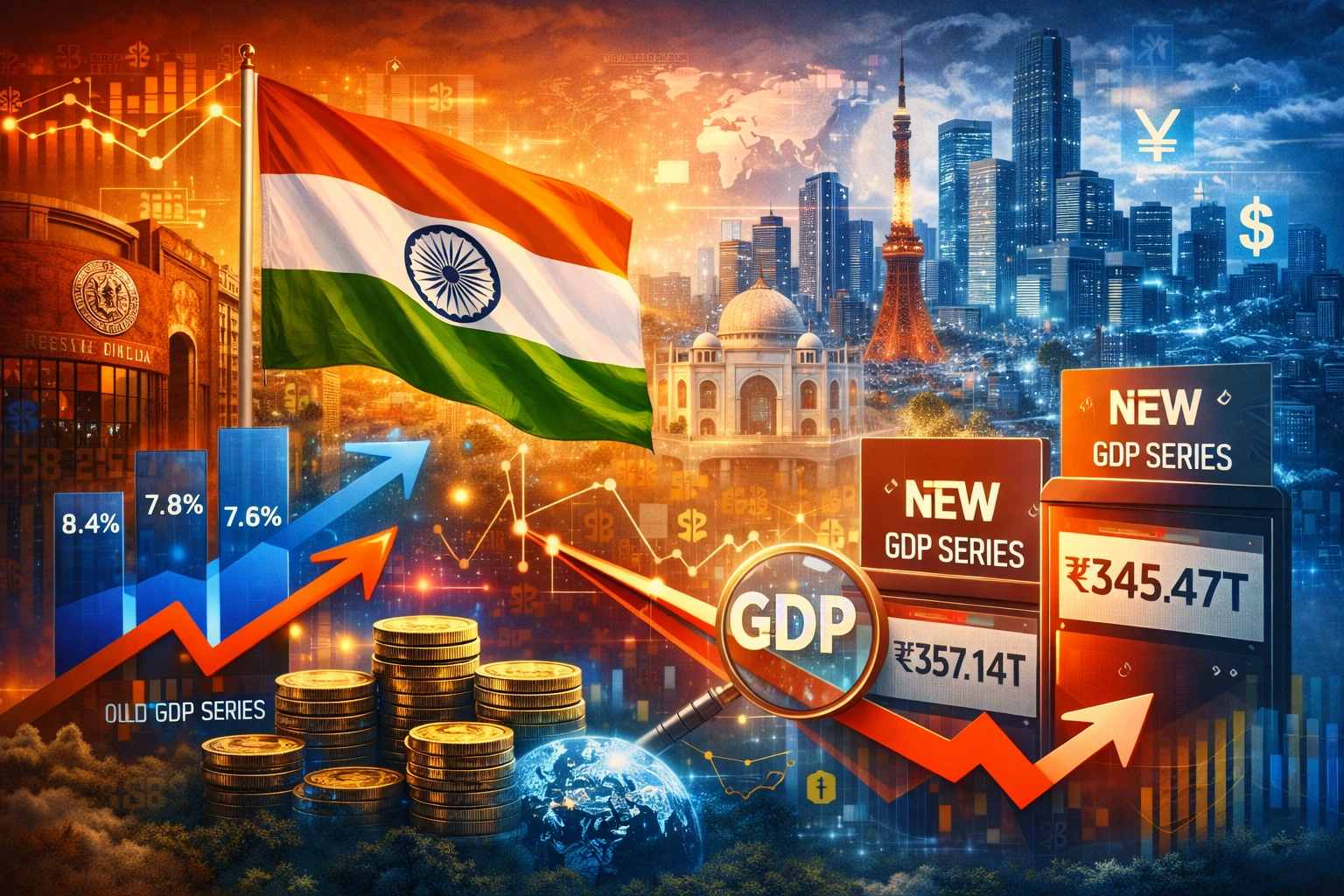
India’s latest GDP release delivered a headline that most newsrooms treated as straightforward good news: Q3 FY26 growth printed at 7.8%, beating expectations, with the full-year estimate revised up to 7.6%.
But beneath that optimism lies a statistical twist few are unpacking properly.
Using a newly revised base year and methodology, the government now estimates India’s nominal GDP for the fiscal year at ₹345.47 trillion — lower than the ₹357.14 trillion estimate under the previous series.
Growth rate up.
Absolute size down.
For a country publicly celebrating its ascent toward becoming the world’s fourth-largest economy, that is not a trivial recalibration.
This is not merely a technical adjustment. It is a reminder that GDP is not a natural fact like gravity. It is a constructed measure — and when you change the construction, the narrative changes with it.
What Is GDP Rebasing — And Why It Happens
Every economy evolves. When it does, statistical frameworks must evolve too.
GDP rebasing updates:
- The base year used for price comparisons
- The weights assigned to sectors
- The data sources and survey methodologies
- The way informal activity is estimated
India periodically revises its GDP series to reflect structural change — the last major rebasing shifted the base year to 2011–12. The latest revision incorporates new data on services, digital activity, and formalisation trends.
Rebasing is not manipulation by default. It is routine statistical housekeeping.
But it is not neutral either.
When you change the weights on the scale, the outcome changes — even if the economy itself has not.
Fast-growing sectors such as:
- Digital services
- Platform-based work
- Financial intermediation
- Formal manufacturing
… tend to gain weight in new series.
Sectors such as:
- Informal manufacturing
- Traditional agriculture
- Small-scale unregistered activity
… may lose relative prominence.
That shift reflects real structural change. But it also reshapes perception.
The Japan Question: Fourth Largest — Or Not Yet?
India’s nominal GDP is now estimated at roughly $4 trillion for FY26.
Japan’s GDP, by comparison, stood around $4.4 trillion in 2025, according to international estimates.
The difference is not vast — but it is material.
Currency movements matter here.
The Indian rupee weakened by roughly 5% against the US dollar last year. The Japanese yen strengthened. Since global GDP rankings are calculated in dollar terms, exchange rates directly influence league tables.
This is why aggregate GDP rankings are often misleading.
Consider per capita income:
- India: just above $3,000
- Japan: roughly $36,000+
Even if India surpasses Japan in aggregate GDP, the comparison reflects population scale, not prosperity.
On a purchasing power parity (PPP) basis, India is already the world’s third-largest economy — a position it has held for years. PPP adjusts for domestic price levels and better captures internal consumption power.
But global geopolitical influence, capital flows, and sovereign credit perception are often anchored to nominal dollar GDP, not PPP.
Which is why this rebasing matters politically.
Growth Is Strong — But Context Matters
Let us be clear: 7.8% quarterly growth is impressive by global standards.
It follows a previous quarter of 8.4%.
India remains one of the fastest-growing large economies in the world.
But macroeconomic conditions are mixed:
- The current account deficit widened to roughly 2.8% of GDP in late 2025.
- Currency depreciation offsets some growth gains in global comparisons.
- External demand remains uneven.
GDP growth is a velocity measure.
Nominal GDP size is a scale measure.
Rebasing affects both — but in different ways.
The IMF Critique — And The Credibility Question
The International Monetary Fund has previously rated India’s data quality in lower tiers of its statistical adequacy framework, citing:
- Outdated base years
- Wholesale price index distortions
- Measurement challenges in the informal economy
The government argues that the new GDP series addresses many of these concerns by incorporating improved datasets and broader coverage.
Independent economists are more cautious.
Their concern is not that rebasing is wrong — but that data transitions create uncertainty precisely when policy decisions depend on clarity.
When:
- The Reserve Bank of India sets interest rates
- The Finance Ministry projects fiscal deficit targets
- Global investors price sovereign bonds
… they are calibrating against numbers that are themselves in methodological transition.
Credibility in economic data is not built through press conferences. It is built through consistency, transparency, and peer validation over time.
What It Means for Monetary Policy
GDP revisions alter output gap calculations — the difference between actual and potential growth.
If growth appears stronger under the new series, the central bank may face:
- Reduced pressure to cut rates
- Greater focus on inflation management
- Recalibrated credit projections
At a time when inflation remains a persistent risk and global liquidity is tightening, even small shifts in GDP interpretation can influence bond yields, credit expansion, and investment cycles.
The rebasing does not automatically change policy.
But it changes the data foundation on which policy rests.
The Politics of Measurement
GDP is more than economics. It is national narrative.
When leadership publicly claims that India has become the world’s fourth-largest economy, that claim becomes symbolic capital.
If a statistical revision shifts the milestone further away — even temporarily — it complicates the story.
But here is the deeper point:
Mature economies do not fear statistical transparency.
They institutionalise it.
The credibility of India’s growth story depends less on headline ranking and more on the robustness of its measurement architecture.
The Northeast Blind Spot
For The Quantiq, this story is not abstract.
Rebasing increases the weight of services and digital activity — precisely the sectors where Northeast India is undercounted and under-analysed.
Questions worth asking:
- Are gig workers in Guwahati accurately reflected in service GDP?
- Is informal digital entrepreneurship being captured?
- Are regional service exports measured effectively?
- Does the new methodology better account for emerging tech ecosystems in the Northeast?
If GDP increasingly reflects digital services, then regions that lack digital penetration risk statistical invisibility.
But the reverse is also possible.
If informal and gig work measurement improves, the Northeast’s contribution could rise more sharply than many expect.
The region’s growing:
- Youth workforce
- Digital literacy
- Startup experiments
- Platform-based service activity
… deserve better measurement than legacy economic frameworks typically provide.
This is where national methodology meets regional ambition.
Scale Versus Prosperity
There is a psychological temptation in GDP league tables.
Fourth-largest economy. Third-largest economy. $5 trillion economy.
These milestones matter for investor confidence.
But prosperity is measured differently:
- Per capita income
- Productivity
- Employment quality
- Wage growth
- Social mobility
India’s per capita income remains a fraction of advanced economies. The country’s economic challenge is not just expanding GDP — it is translating GDP into widespread prosperity.
Rebasing does not change that challenge.
It merely changes how we quantify progress.
The Bottom Line
India’s GDP rebasing has created a fascinating paradox:
- Growth looks stronger.
- Absolute size looks smaller.
- Global ranking appears slightly further away.
None of this invalidates India’s growth momentum.
But it reminds us that economic measurement is complex — and politically consequential.
For investors, the takeaway is not panic or celebration.
It is scrutiny.
For policymakers, the task is not narrative management.
It is statistical credibility.
And for citizens, the real question is not whether India is fourth or fifth in the world.
It is whether growth translates into:
- Better jobs
- Higher incomes
- Stronger institutions
- Greater regional inclusion — including the Northeast
GDP is a number.
But the story behind the number shapes national ambition.
And right now, India is recalibrating both.https://thequantiq.com/the-carbon-economy-the-new-oil-of-the-21st-century/