
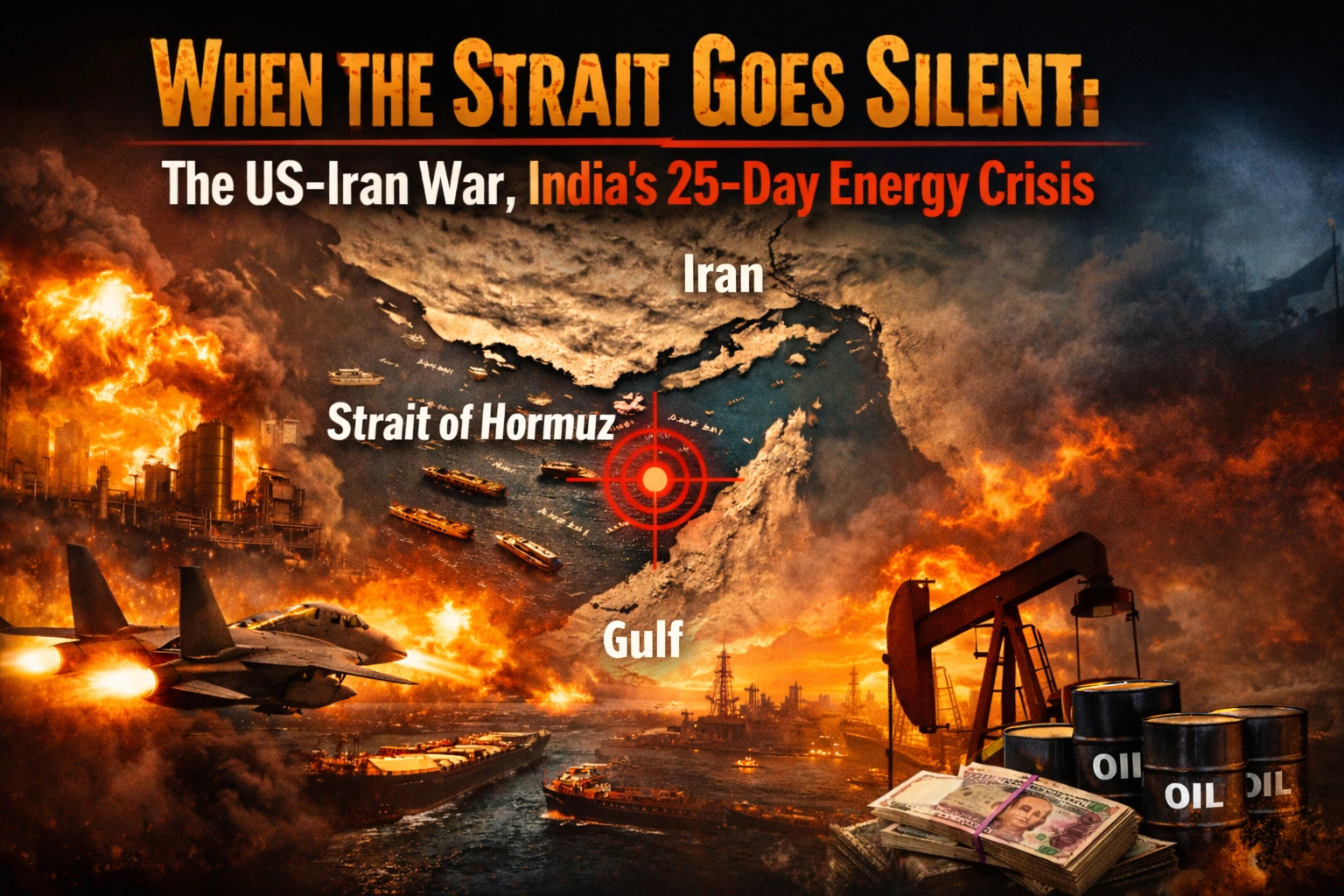
When the Strait Goes Silent: The US–Iran War, the World Economy, and the 25-Day Clock India Cannot Afford to Ignore
For decades, the possibility existed mostly inside war-game simulations, think-tank reports, and oil market contingency models.
But on the morning of February 28, 2026, the hypothetical finally crossed into reality.
In coordinated military operations widely reported as Operation Roaring Lion and Operation Epic Fury, Israeli and US forces launched a series of strikes targeting Iranian military installations, nuclear infrastructure, and command centres across multiple cities including Tehran, Isfahan, Qom, Karaj, and Kermanshah.
The escalation was immediate.
Iran responded within hours with Operation True Promise IV, launching ballistic missiles and drones targeting Israeli territory and several US-aligned military installations across the Gulf region.
Six days into the conflict, the military front lines remain fluid. But the deeper shockwave is not only military.
It is economic.
And nowhere are the implications more immediate than in India, where a strategic vulnerability—long known but politically postponed—is now staring policymakers in the face
The Military Escalation: Tactical Success, Strategic Uncertainty
The stated objective of the US-Israel strikes appears to have been twofold: significantly degrade Iran’s military and nuclear capabilities and disrupt the command architecture of the Islamic Republic.
Early battlefield assessments from Western and regional security analysts suggest several Iranian military facilities have suffered significant damage. Iran’s retaliatory capabilities remain active but appear more limited compared with the first days of the conflict.
Yet military success does not automatically translate into strategic resolution.
Iran has already demonstrated its ability to retaliate through ballistic missile barrages, drone swarms, and proxy actors across the region. Militant groups aligned with Tehran—including elements operating in Iraq, Yemen, and Lebanon—have signaled readiness to widen the theatre of conflict.
The most worrying scenario for global markets is not simply prolonged air warfare.
It is the possibility of maritime escalation in the Persian Gulf, specifically around the world’s most critical energy chokepoint.
The Strait of Hormuz.
The Strait of Hormuz: The Artery of the Global Energy System
At its narrowest point, the Strait of Hormuz is only about 33 kilometres wide.
Yet through this narrow maritime corridor flows roughly one-fifth of the world’s oil supply.
In 2024 alone:
- Nearly 20 million barrels of oil per day transited the strait
- Around 84% of these shipments were destined for Asian markets
- China, India, Japan, and South Korea together accounted for roughly 69% of the demand
The Strait is not just another shipping lane.
It is the central artery of the global energy system.
Since the outbreak of hostilities, shipping companies, insurers, and energy traders have reacted swiftly.
Several tanker operators have reduced or paused voyages through the Strait, citing escalating war-risk premiums and security concerns. Insurance providers have dramatically raised war-risk coverage costs, sometimes exceeding $250,000 per voyage for very large crude carriers (VLCCs).
Meanwhile, disruptions in the Red Sea corridor, driven by renewed Houthi activity, have compounded the stress on global shipping routes.
The result: energy markets have begun to reprice geopolitical risk.
Oil Markets React: The Price Shock Begins
Global energy markets are already responding.
Since the outbreak of hostilities:
- Brent crude has risen from roughly $66–67 per barrel in January to around $82–84
- Asian LNG spot prices have surged from roughly $10 per MMBtu to over $24
Major financial institutions are now modelling several scenarios:
| Scenario | Oil Price Projection |
|---|---|
| Short disruption | $90–100 |
| Prolonged tension | $100–120 |
| Hormuz blockade scenario | Up to $150 |
Some analysts caution that global oil supply conditions entering 2026 were relatively comfortable, with supply growth exceeding demand growth.
But that buffer evaporates quickly if physical flows through Hormuz are significantly disrupted for several weeks.
And that is precisely where the pressure begins to build for India.
India’s 25-Day Energy Clock
India imports roughly 85 percent of its crude oil and about half of its natural gas consumption.
A large share of that energy traditionally comes from Gulf producers such as Saudi Arabia, Iraq, UAE, and Qatar.
Much of it passes through the Strait of Hormuz.
Government data and industry estimates indicate India currently holds roughly 25 days of crude oil and petroleum product reserves across commercial inventories and strategic reserves.
Under normal conditions, this buffer is manageable.
Under wartime shipping disruptions, it becomes a strategic countdown clock.
If Gulf shipments slow or stall, several economic pressure points appear quickly:
- Rising oil import bills
- Pressure on the rupee
- A widening current account deficit
- Higher inflation
- Stress on fuel-sensitive industries such as aviation, fertilisers, logistics, and petrochemicals
India’s current account deficit had already widened to about 2.8% of GDP in late 2025.
A prolonged oil price spike could widen that gap further.
And currency depreciation would amplify the pain.
Every weaker rupee means every barrel becomes more expensive in domestic terms.
Trump’s 30-Day Waiver: A Strategic Lifeline for India
Amid the escalating crisis, one policy decision from Washington has quietly reshaped the short-term equation.
The Trump administration has announced a temporary 30-day waiver allowing India to continue procuring crude oil from Russia, despite broader sanctions pressure linked to geopolitical tensions.
The waiver is not symbolic.
It is strategically significant.
Since the Russia-Ukraine war reshaped global energy flows, India has emerged as one of the largest buyers of discounted Russian crude, often accounting for more than 35–40% of India’s crude imports.
Crucially, Russian shipments:
- Do not depend on the Strait of Hormuz
- Travel primarily via longer but secure maritime routes
- Are supported by an established shadow tanker fleet and alternative insurance mechanisms
The 30-day waiver therefore gives India a temporary buffer against Gulf supply disruptions.
But it is exactly that — temporary.
Thirty days in geopolitical time can pass quickly.
If the conflict persists beyond that window, the diplomatic and logistical calculus becomes far more complicated.
Global Trade Faces a New Shockwave
Beyond oil markets, the conflict is already beginning to ripple through the broader global economy.
Airlines are confronting a double shock:
- Rising jet fuel prices
- Disrupted airspace and Middle Eastern hub operations
Shipping costs are also rising as vessels reroute around longer maritime corridors.
Insurance premiums across the Indian Ocean and Gulf region are climbing sharply.
These costs eventually cascade through supply chains.
Not just oil.
But also:
- Food commodities
- Fertilisers
- Pharmaceuticals
- Manufactured goods
The result is a familiar but dangerous transmission mechanism.
Geopolitical conflict → energy shock → logistics inflation → global price pressure.
India’s Strategic Energy Question
The deeper lesson for India goes beyond this crisis.
Energy security has long been discussed as an economic issue.
But moments like this reveal it for what it really is:
A national security issue.
India’s Strategic Petroleum Reserve currently targets around 36–37 million barrels of storage capacity, spread across underground caverns in Visakhapatnam, Mangaluru, and Padur.
In global comparison, that is modest.
The United States historically maintained hundreds of millions of barrels in reserve. China has steadily built one of the world’s largest strategic reserves.
For a country with 1.4 billion people and a $3.7 trillion economy, India’s buffer remains thin.
If anything, the current crisis may accelerate several long-term shifts already underway:
- Expansion of strategic petroleum reserves
- Greater reliance on Russian and African crude
- Faster deployment of renewable energy
- Investments in green hydrogen
- Diversification of maritime supply routes
The Bottom Line
They spread through financial markets, energy systems, supply chains, and currencies.
The US–Iran conflict is now beginning to do exactly that.
The Strait of Hormuz will eventually reopen, because a permanent closure harms Iran almost as much as it harms the world.
But even temporary disruptions carry enormous economic consequences.
For India, the numbers are stark:
- 25 days of energy reserves
- 85% import dependence
- Rising oil prices
- A fragile current account balance
The 30-day Russian oil waiver from Washington offers breathing space.
But breathing space is not a solution.
The real question confronting India is larger:
Can a nation aspiring to become the world’s third-largest economy afford to remain this vulnerable to a single maritime chokepoint it does not control?
That is the strategic debate this war has forced into the open.
And it is one India can no longer postpone.https://thequantiq.com/the-2-kg-race-can-india-become-the-global-green-hydrogen-price-maker/





One Comment