
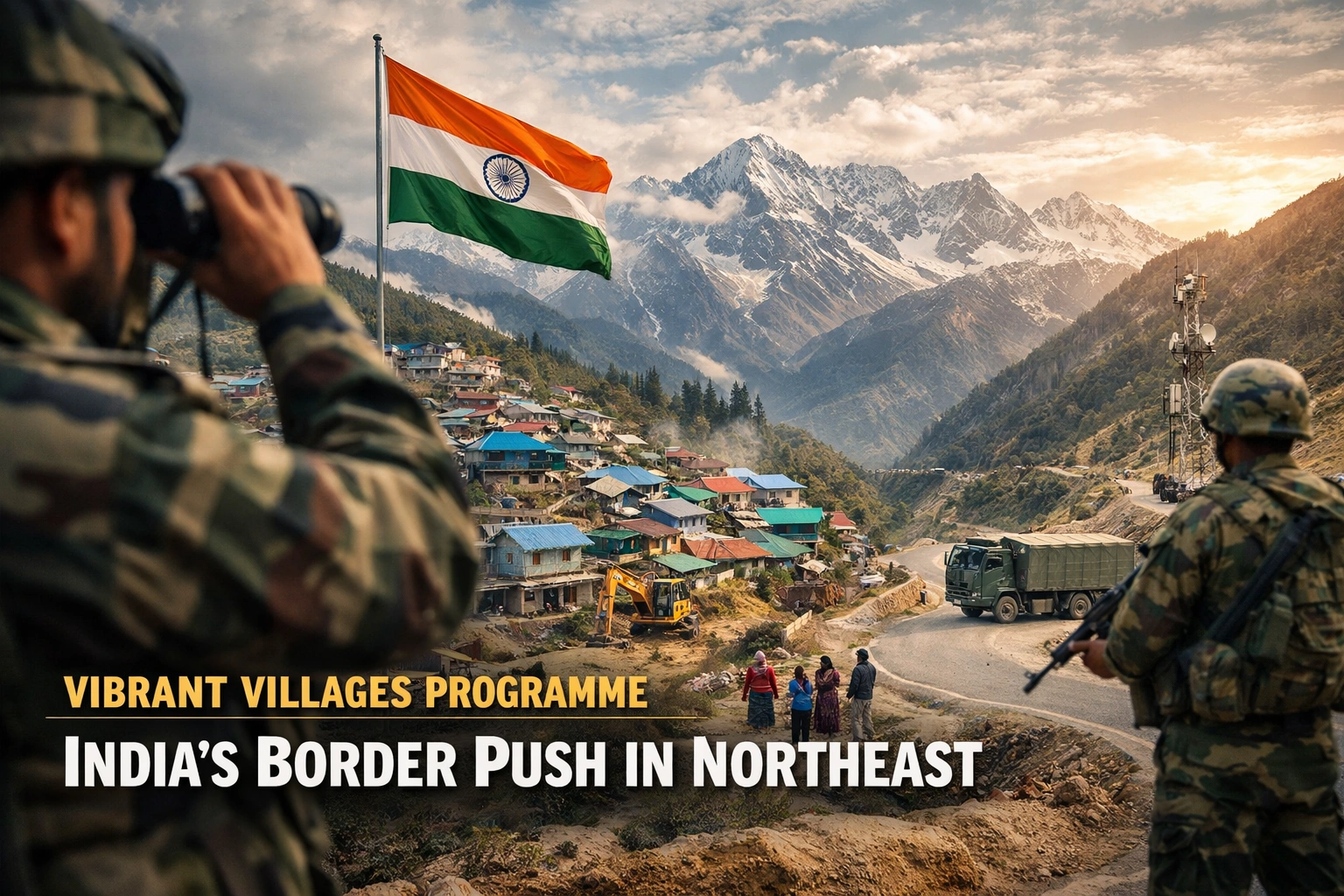
The Border Boom: Inside India’s ₹11,000+ Crore Bet on Frontier Villages
Where Development Ends and Strategy Begins
Some government schemes arrive with noise.
Others arrive quietly—and change the map.
India’s Vibrant Villages Programme (VVP) belongs to the second category. Approved in February 2023 with a modest ₹4,800 crore outlay, it did not command prime-time debates or headline wars. But three years on, the numbers—and more importantly, the intent—have shifted dramatically.
What now stands is not just a development scheme. It is a frontier doctrine.
The Geography of Priority
The early design of VVP reveals where India’s concerns truly lie.
Of the 662 villages identified in Phase I, a staggering majority sits in Arunachal Pradesh, with Sikkim forming another critical cluster. This concentration is not administrative—it is geopolitical. Arunachal’s long, contested boundary with China and Sikkim’s proximity to Doklam make them not just states, but strategic corridors.
The programme’s early execution—over ₹1,161 crore sanctioned across thousands of projects—signals urgency. But urgency alone does not build roads in the Himalayas. Terrain resists ambition.
The Terrain That Shapes Policy
In most parts of India, a road is a line on a map.
In the Northeast, it is an act of persistence.
The cost per kilometre crossing ₹2 crore is not inefficiency—it is geography asserting itself. Rivers shift, mountains fracture, landslides erase months of work overnight. That over a hundred roads have been sanctioned, with the overwhelming share in Arunachal Pradesh, is therefore not just progress—it is engineering against nature.
There are discrepancies in public reporting—figures around bridges and village connectivity vary between central and state data—but the larger truth remains intact: connectivity is expanding, slowly but decisively.
Phase II: When the Centre Takes Control
The real shift came with Phase II.
Approved in April 2025 and launched by Amit Shah, the programme did something unusual. It moved from a shared funding model to a fully centralised one. One hundred percent funding by the Union government.
This is not a technical change. It is a declaration.
Delhi is no longer enabling border development—it is directly underwriting it.
With an outlay of ₹6,839 crore and expanded coverage across nearly two thousand villages, Phase II transforms VVP from a pilot into a national security instrument dressed as development policy.
Arunachal: The Core Theatre
If there is a single geography where this transformation becomes visible, it is Arunachal Pradesh.
New allocations, deeper penetration into border villages, and a clear push toward all-weather roads, electrification, and telecom connectivity mark a coordinated attempt to stabilise habitation in areas that have long been defined by out-migration.
Because that is the real story here—not infrastructure, but absence.
For years, people have been leaving these villages. Not because they wanted to, but because opportunity demanded it. Empty villages create empty frontiers. And empty frontiers create strategic vulnerabilities.
The Attempt to Reverse an Exodus
VVP is, at its heart, an attempt to reverse that silent exodus.
Livelihood interventions—tourism, cooperatives, local agriculture—are not side projects. They are the core strategy. The logic is simple and powerful: if people stay, borders hold.
The government’s own language reflects this shift. Border residents are no longer passive beneficiaries; they are being positioned as participants in national security.
The Numbers—and the Narrative Beneath Them
By mid-2025, more than a thousand villages had entered active development cycles. Roads had begun to cut through previously inaccessible terrain. Health outreach had reached tens of thousands. Youth training programmes had begun to seed local economies.
These numbers matter. But they are not the story.
The story is that India is redefining what a border village means.
Not a remote settlement at the edge of the map—but a living, strategic presence.
The Quantiq View
The Vibrant Villages Programme is not just about roads, electricity, or connectivity. It is about continuity of civilisation at the frontier.
Its success will not be measured in kilometres built, but in people who choose not to leave.
Because in the end, infrastructure can extend a nation’s reach.
But only people can hold it.https://thequantiq.com/industrial-hemp-northeast-india-slow-fashion/




One Comment