From Weed to Wealth: How Water Hyacinth Could Trigger Northeast India’s Next Green Economy Revolution
What if the plant choking Assam’s rivers is not a liability, but one of its most underpriced economic assets?
Across Southeast Asia, water hyacinth has quietly moved from nuisance to industry. Vietnam has built export-scale furniture ecosystems around it. Bangladesh has integrated it into global handicraft supply chains. The Philippines is experimenting with fibre-level processing.
In Northeast India, the same plant grows in overwhelming abundance—often at zero cost—yet remains trapped in a low-value craft economy.
This is not a story about lack of resources. It is a story about a value chain that never scaled.
The Problem Everyone Sees—But Misreads
Water hyacinth (Eichhornia crassipes), locally known as pani meteka, is widely recognised as one of the world’s most aggressive invasive aquatic species. Introduced in India in the early 20th century as an ornamental plant, it now spreads across rivers, wetlands, and lakes with remarkable speed.
Under favourable conditions, it can double its coverage within 10 to 15 days. In water bodies like Loktak Lake and the floodplains of the Brahmaputra, it forms dense floating mats that reduce dissolved oxygen, disrupt aquatic ecosystems, and interfere with fishing and navigation.
Governments spend significant public funds every year on removal drives. Yet the plant returns, often within weeks.
Because the system treats it as waste.
Not as inventory.
The Market That Already Exists
While Northeast India continues to remove water hyacinth, global markets are beginning to absorb it.
The broader eco-fibre and sustainable materials market is expanding steadily, driven by regulatory pressure, consumer demand, and corporate sustainability commitments. Natural fibres—especially those derived from waste or invasive biomass—are gaining attention as alternatives to synthetic materials.
Water hyacinth sits at an interesting intersection. It is biodegradable, abundant, and visually aligned with contemporary design trends that favour natural textures and organic forms.
Vietnam, currently one of the most advanced water hyacinth economies, exports large volumes of furniture and home décor products made from the material. Wholesale raw material prices in such ecosystems can range from roughly $0.50 to $1 per kilogram at scale, while finished products—especially furniture—capture significantly higher value in international markets.
In contrast, Northeast India’s raw material cost is effectively zero.
That gap between cost and potential value is where the opportunity lives.
What Northeast India Has Already Built
It would be inaccurate to suggest that Northeast India has ignored water hyacinth.
Since around 2008, institutions such as NEDFi and state livelihood missions have invested in building a craft ecosystem around the material. Today, more than 5,000 artisans—predominantly women—are engaged in producing water hyacinth-based products across Assam and neighbouring states.
Common Facility Centres, training programs, and market linkages have been established. Products from the region have even reached international trade platforms, including exhibitions in Japan.
This is not a weak foundation. It is, in fact, stronger than what many emerging regions possess.
And yet, when evaluated through a market lens, a critical limitation becomes visible.
The product portfolio—baskets, mats, bags, storage items—has remained largely unchanged for over a decade.
The Value Trap: When Craft Does Not Become Industry
The stagnation is not due to lack of skill. Northeast India’s artisans possess deep material understanding and weaving expertise.
The constraint lies elsewhere.
It lies in the absence of design-led evolution.
Most products emerging from the region are variations of existing forms. They compete in crowded, price-sensitive segments where differentiation is minimal and margins are thin. Artisan earnings in such models often remain in the range of ₹200 to ₹300 per day, limiting both income growth and sector expansion.
Meanwhile, in markets like Vietnam, the same material has moved into furniture, architectural applications, and large-scale interior solutions—categories where a single product can command prices equivalent to hundreds of small craft items.
The difference is not the material. It is how the material is imagined.
What Others Understood Early
Vietnam’s shift into water hyacinth furniture did not happen accidentally. It aligned the material with global home furnishing demand, integrated it with metal and wood frameworks, and built supply chains capable of fulfilling container-scale orders.
Bangladesh, while operating closer to the craft model, has successfully linked its products to European buyers, incorporating design feedback and compliance requirements. Its handicraft exports, including natural fibre products, contribute millions of dollars annually to the economy.
The Philippines has taken a different route, investing in research to explore water hyacinth as a fibre. Institutions there have developed processing techniques aimed at improving consistency and reducing drying time—an important step toward industrial scalability.
Each of these approaches reflects a shift from working with the material to building systems around the material.
The Gaps That Still Define Northeast India
Seen through this lens, Northeast India’s water hyacinth sector reveals a set of clearly identifiable gaps.
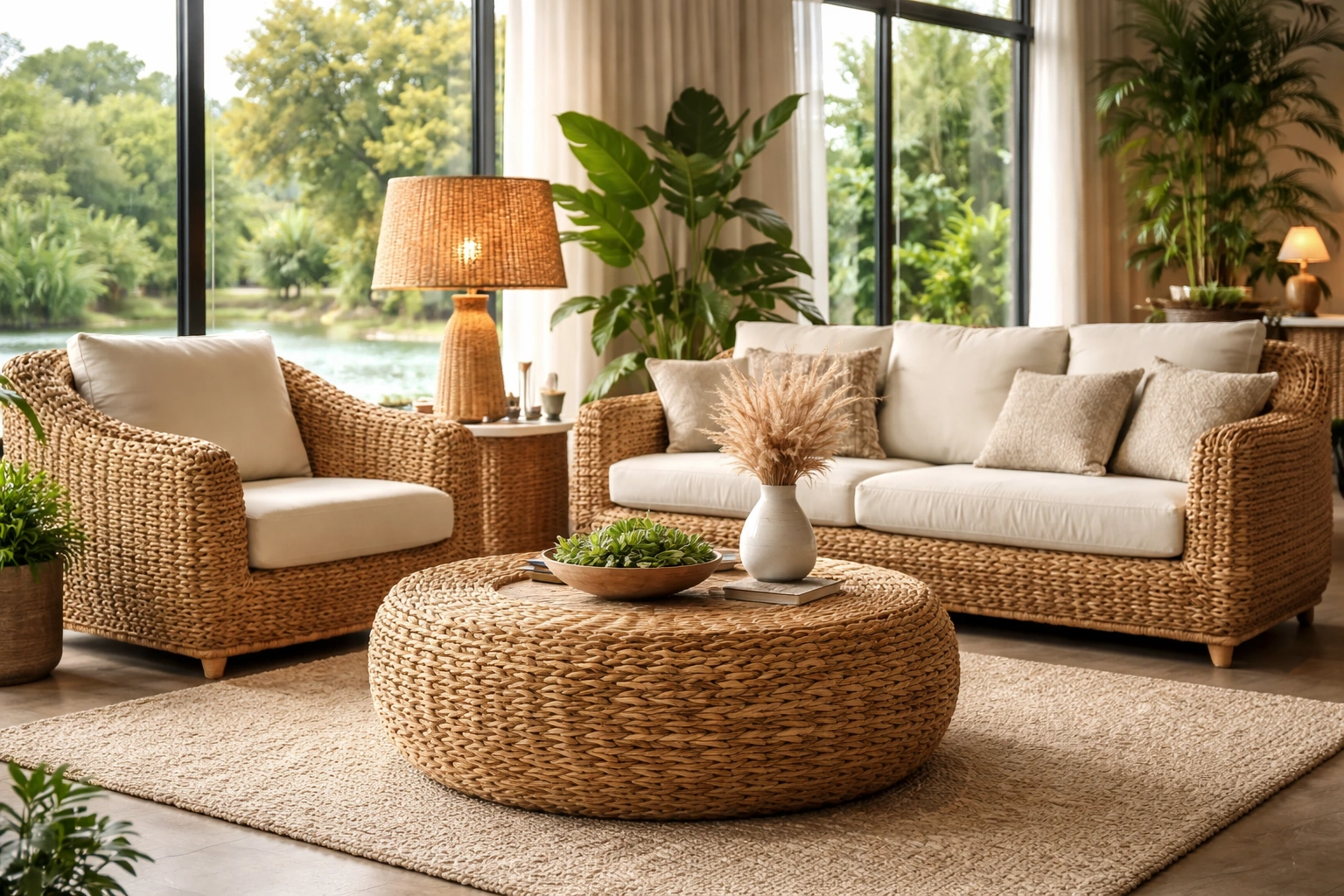
The most visible is the absence of a furniture segment. Despite having both the raw material and a strong bamboo and cane tradition, the region has not yet developed water hyacinth furniture for domestic or export markets.
Equally significant is the lack of movement toward fibre extraction and textile applications. While still emerging globally, this category represents a higher-value pathway that remains largely unexplored in the region.
Paper and packaging offer another missed opportunity. With increasing demand for sustainable packaging solutions, water hyacinth-based paper could position itself as both an eco-friendly and narrative-rich material.
Closer to home, the hospitality sector presents an immediate market. Northeast India’s growing network of eco-resorts and boutique stays represents a ready buyer segment for design-led products. Yet, structured engagement between producers and hospitality buyers remains limited.
Finally, there is the question of processing technology. Much of the current production still depends on sun-drying, making it weather-dependent and volume-constrained. Mechanised interventions—even at a modest scale—could significantly improve productivity and consistency.
The Economics Beneath the Surface
When viewed as a business rather than a craft, the economics of water hyacinth become compelling.
The raw material is abundant and, in most cases, free. Harvesting it contributes to ecological restoration, which opens possibilities for public-private collaboration or even subsidy-linked models.
The artisan base already exists, reducing the need for large-scale skill development investments.
What changes the equation is design and market access.
A single well-designed product, positioned correctly, can command multiples of the price realised by traditional craft items. At scale, even moderate order volumes can translate into meaningful revenue.
A design-led enterprise operating across furniture, hospitality supply, and eco-friendly products can realistically target annual revenues in the range of ₹3 to ₹5 crore within a few years of operation, assuming consistent quality and market linkage.
The constraint is not viability.
It is intent.
Where It All Begins
The transformation of Northeast India’s water hyacinth sector will not begin with machinery. It will not begin with funding.
It will begin with design.
With someone asking a different question—not “how do we make better baskets,” but “what does this material want to become in today’s market?”
From there, the path becomes clearer. Production systems can evolve. Market linkages can be built. Technology can be introduced where it creates the most impact.
The first customers do not need to be global. They are already present within the region—in resorts, homestays, and hospitality spaces that are actively seeking locally grounded, sustainable products.
Scale, in this case, does not begin with export.
It begins with relevance.
The Quantiq’s Assessment
Water hyacinth is perhaps the most strategically misunderstood resource in Northeast India.
It is invasive, yes. It is disruptive, certainly. But it is also abundant, renewable, and economically viable.
The region has already invested nearly two decades in building a base around it. What remains incomplete is the transition from craft to industry.
That transition will not be driven by more training or more production of existing products. It will be driven by a shift in thinking—from decoration to design, from activity to value, from removal to utilisation.
The plant is already here, spreading faster than any policy response.
The market is already forming, driven by forces far beyond the region.
The only variable left is whether Northeast India chooses to participate in that market as a supplier of ideas—or merely as a source of raw material.https://thequantiq.com/industrial-hemp-northeast-india-slow-fashion/