The Sovereign Spine: How Assam’s NDC-NER Is Rewiring India’s Digital Future from the Edge
There are moments in a region’s history that arrive quietly—without spectacle, without noise—but with the power to redraw its future.
The inauguration of the National Data Centre for the North East Region (NDC-NER) in Assam is one such moment.
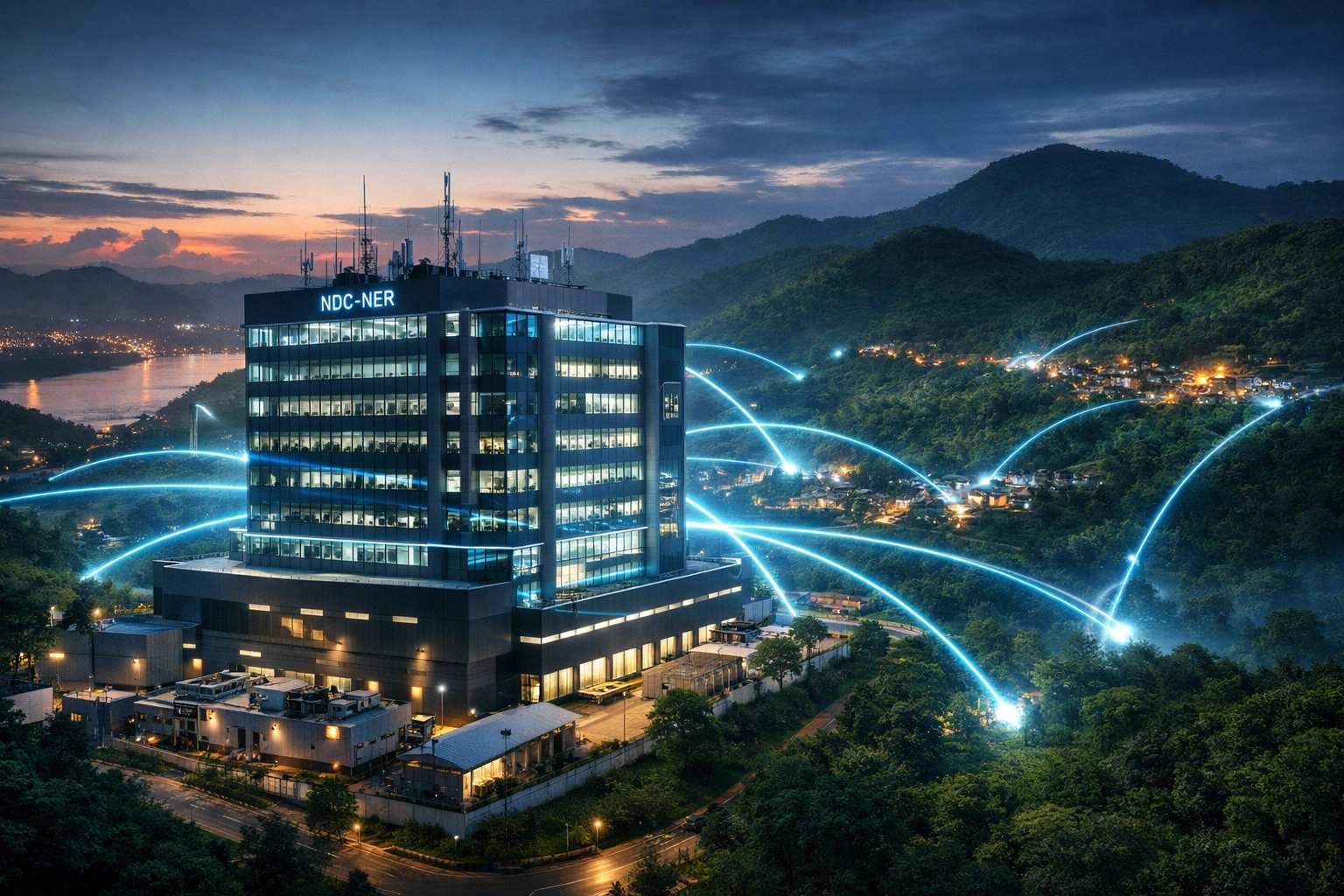
At first glance, it is a structure of steel, cables, and cooling systems—a G+5 building with an 8 MW power capacity, certified Tier III, and designed to meet green building standards. But to see it merely as infrastructure is to miss the point entirely.
This is not a building.
This is a spine.
And it may well become the sovereign backbone of India’s digital future—rising not from Delhi or Mumbai, but from Guwahati.
From Distance to Proximity: Why Location Changes Everything
For decades, the North East has existed at the far edge of India’s digital map.
Data generated in districts like Mon, Ziro, or Karbi Anglong would often travel thousands of kilometers to centralized servers before returning as a service—whether for land records, health systems, or education platforms.
Latency was not just a technical issue.
It was a governance issue.
With the NDC-NER—developed under the stewardship of National Informatics Centre—that geography begins to collapse.
- Reduced latency means faster delivery of e-governance services
- Localized data processing improves system reliability
- Edge infrastructure enables real-time applications
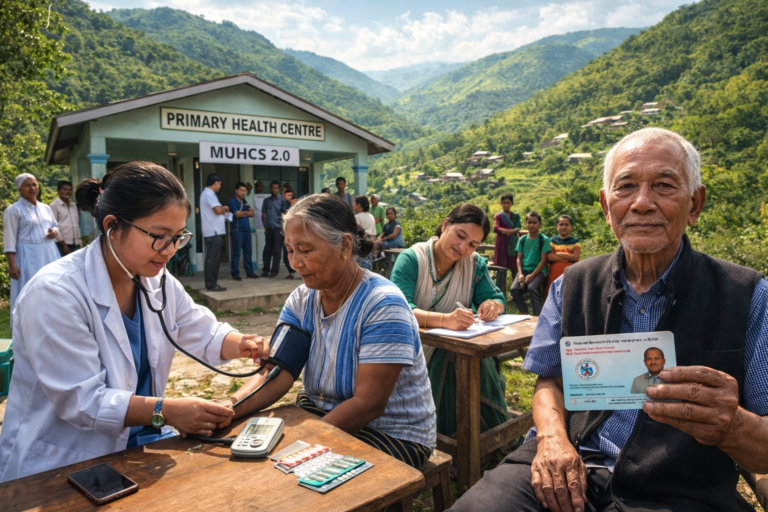
For a farmer accessing subsidy records or a student logging into a digital classroom, the change may feel subtle.
But it is foundational.
The Rise of Edge Sovereignty
Globally, the cloud revolution has been dominated by centralized giants like Amazon Web Services and Microsoft Azure.
India’s approach, however, is beginning to diverge.
Instead of relying solely on centralized hyperscale regions, the country is quietly building a distributed digital architecture—where data is processed closer to where it is generated.
This is where NDC-NER becomes significant.
It represents a shift from:
- Centralized cloud dependency
to - Federated, sovereign, edge-based infrastructure
In strategic terms, this is not just digital expansion.
It is digital federalism.
Inside the Machine: What Makes NDC-NER Different
The technical specifications tell only part of the story, but they matter.
- Tier III Certification ensures high availability (99.982% uptime)
- 8 MW Power Capacity supports scalable workloads
- IGBC Gold Rating reflects energy-efficient design
- Humidity-Optimized Cooling Systems address North East India’s climatic realities
That last detail is often overlooked.
Running a data center in a high-humidity region like Assam is not trivial. Cooling efficiency, corrosion resistance, and energy optimization require specialized engineering.
Which means NDC-NER is not just an extension of India’s digital grid—it is adapted infrastructure, built for the region rather than imposed upon it.
The Hidden Multiplier: AI in Governance
Perhaps the most transformative impact of NDC-NER will not be visible immediately.
It will emerge quietly, through data.
As public datasets—from agriculture to health to education—begin to accumulate locally, the region unlocks something far more powerful than storage:
The ability to build AI-driven governance systems.
Imagine:
- Crop prediction models tailored to Arunachal’s micro-climates
- Early warning systems for floods and landslides
- Real-time health analytics for remote districts
These are not futuristic ideas.
They are data problems.
And data problems require proximity, compute power, and reliability.
NDC-NER provides all three.
From Infrastructure to Inclusion
There is a tendency to view digital infrastructure through the lens of economics—cost, efficiency, scalability.
But in regions like the North East, the impact is also deeply human.
When latency drops:
- A scholarship application loads faster
- A telemedicine consultation becomes smoother
- A local entrepreneur accesses digital marketplaces without friction
The distance between citizen and state shrinks.
And in that shrinking distance lies a quiet form of empowerment.
A Strategic Signal to the World
There is also a geopolitical layer to this development.
As nations increasingly debate data sovereignty, digital borders, and AI control, infrastructure becomes strategy.
By investing in regional data centers like NDC-NER, India is signaling that:
- Data will not be entirely outsourced
- Digital capability will not remain metro-centric
- The next phase of growth will be distributed, resilient, and sovereign
And importantly, that growth will include regions long considered peripheral.
The Ziro–Mon Imagination
Perhaps the true measure of NDC-NER will not be found in uptime metrics or power efficiency charts, but in something far less tangible—imagination.
In Ziro, for instance, a farmer checks a crop advisory generated by an AI model trained on local soil data, while in Mon, a student attends a virtual classroom without buffering interruptions. Meanwhile, in Guwahati, a startup builds a governance tool that quietly scales across the region.
None of them will think about server racks or cooling systems; instead, they will simply experience a system that works.
The Spine That Changes the Story
The story of India’s digital rise has often been told through its metros—Bengaluru, Hyderabad, and Pune.
However, the next chapter may be written elsewhere, in places where infrastructure meets intent, policy meets geography, and data meets people.
The NDC-NER is not just a facility; it is a statement—that the future of India’s digital power will not only be built at the center, but increasingly at the edges, where it matters most.https://thequantiq.com/sunday-brief-5-lesser-known-ai-tools-quietly-redefining-knowledge-and-creation/