
The $500 Billion AI Question: Can India Build Its Own AI Future?
Artificial intelligence may become India’s biggest economic opportunity since liberalisation. But the road ahead could be far more complex than the headlines suggest.
Artificial intelligence is no longer merely a technology trend discussed in corporate boardrooms or Silicon Valley conferences. Across the world, AI is rapidly evolving into the foundational layer shaping economies, governance, national security, education, healthcare and the future of work itself.
For India, the stakes may be extraordinarily high.
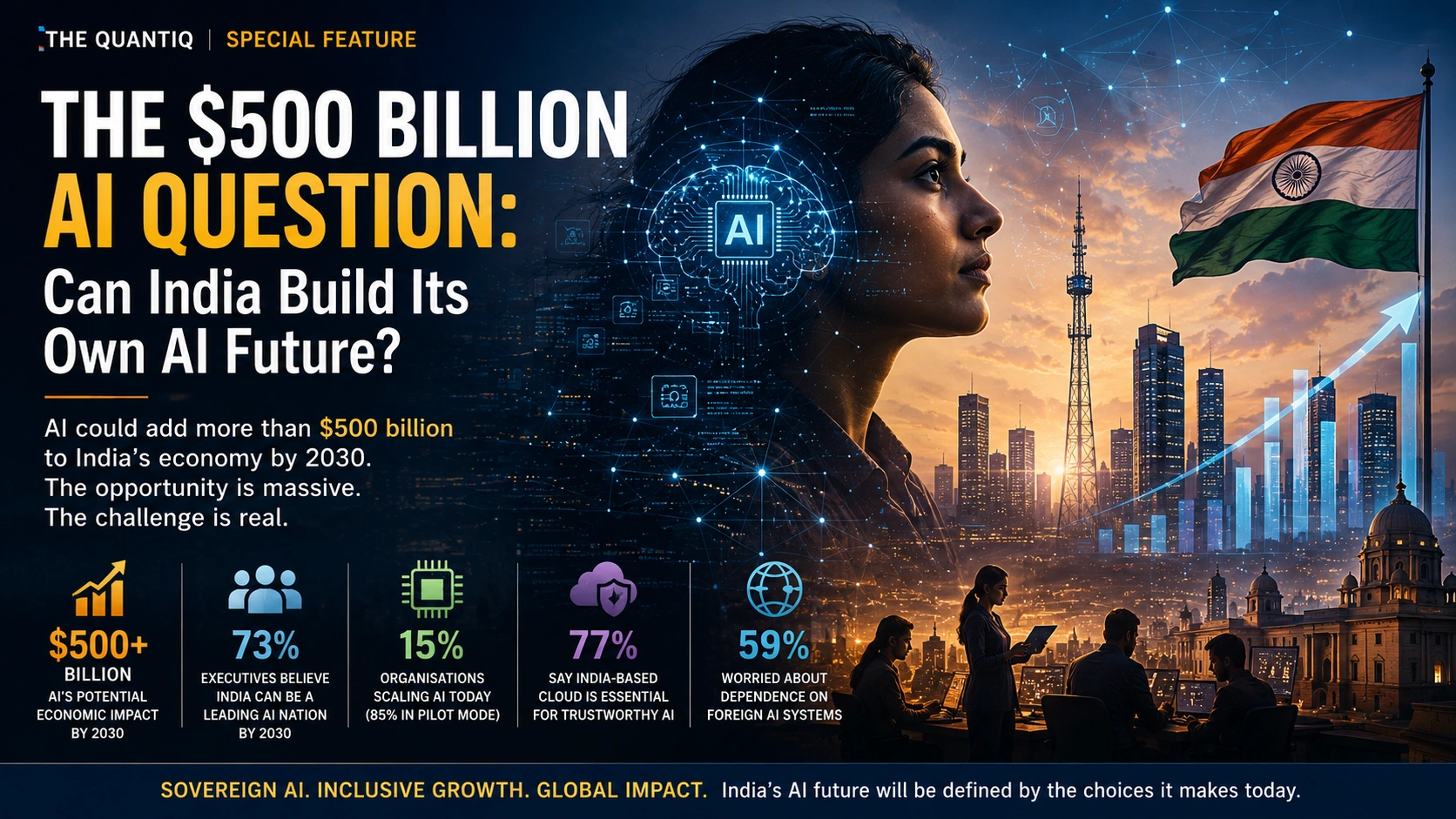
According to a recent report by IBM India, artificial intelligence could contribute more than US$500 billion to India’s economy by 2030. That number alone is large enough to reshape the country’s economic trajectory for decades.
Yet beneath the optimism lies a deeper and more uncomfortable question:
Can India truly build its own AI future, or will it remain dependent on technologies, infrastructure and platforms controlled elsewhere?
That question may ultimately define not only India’s technological future, but also its economic sovereignty in the decades ahead.
India’s AI Moment Has Arrived
For years, India’s global technology story was closely linked to software services and IT outsourcing. The country built one of the world’s largest pools of engineering talent and emerged as a digital powerhouse serving global corporations.
But artificial intelligence represents something different.
Unlike earlier technology waves, AI has the potential to penetrate nearly every sector of society simultaneously. It can influence agriculture as much as banking, education as much as defence, and healthcare as much as manufacturing.
The scale of India itself creates a unique opportunity. With a population exceeding 1.4 billion, one of the world’s youngest workforces and an increasingly sophisticated digital public infrastructure, India possesses conditions that few countries can replicate easily.
Initiatives like Aadhaar, UPI and digital governance platforms have already demonstrated India’s ability to deploy technology at population scale. AI could become the next layer built on top of that digital foundation.
Perhaps that explains why optimism around India’s AI future is rising rapidly. According to the IBM report, nearly 73 percent of executives believe India can emerge as a leading global AI nation by 2030. But optimism alone does not build ecosystems.https://thequantiq.com/mid-week-ai-brief-google-openai-palantir-ai-race/
India’s AI Ambition Is Running Ahead of Its Readiness
One of the most revealing aspects of the report is the enormous gap between India’s AI aspirations and its current preparedness.
Despite growing excitement around artificial intelligence, only about 15 percent of Indian organisations are currently scaling AI deployments at an enterprise level. The overwhelming majority remain stuck in pilot projects, experimentation phases or fragmented adoption strategies.
In fact, nearly 85 percent of organisations continue operating in what experts often describe as “pilot mode,” unable to move from experimentation to large-scale implementation.
Even more striking is the sense of global competition emerging within Indian industry itself. Around 72 percent of surveyed organisations believe they currently lag behind global peers in AI maturity.
This reveals a critical paradox.
India believes deeply in the transformative potential of artificial intelligence. Yet structurally, much of the country is still not fully prepared for the scale of transformation AI may demand.
The challenge is not merely technological. It involves infrastructure, compute power, quality datasets, regulation, cloud ecosystems, energy availability, cybersecurity readiness and human capital development.
Artificial intelligence is not just software. It is infrastructure. And infrastructure takes time, investment, and strategic clarity to build.
Why Sovereign AI Is Becoming a Strategic Issue
As AI systems become increasingly embedded into economies and governance systems, concerns around technological dependence are beginning to intensify worldwide. India is no exception.
The IBM report indicates that 77 percent of respondents believe India-based cloud infrastructure will be essential for building trustworthy and secure AI systems. At the same time, nearly 59 percent expressed concern over excessive dependence on foreign AI technologies and infrastructure.
This marks an important shift in how nations are beginning to view artificial intelligence.
AI is no longer seen merely as a commercial technology sector. Increasingly, it is being viewed as strategic infrastructure comparable to energy systems, telecommunications networks or semiconductor manufacturing.
Countries that depend entirely on foreign AI ecosystems may eventually face vulnerabilities related to data sovereignty, cybersecurity, economic control and technological autonomy.
That is why terms like “sovereign AI” are now entering policy discussions globally.
For India, sovereign AI could mean building domestic cloud capacity, strengthening local AI research ecosystems, investing in indigenous language models and ensuring that critical digital infrastructure remains resilient and locally governed.
The AI race is no longer just about innovation. It is also about control.
India’s Greatest AI Strength May Be Human Adaptability
Despite the infrastructure challenges, India possesses one major advantage that could become decisive in the AI era — human adaptability.
India’s workforce has repeatedly demonstrated an ability to adapt rapidly to technological shifts, from software services to mobile internet and digital payments. The country’s startup ecosystem has also matured dramatically over the past decade, creating a culture increasingly open to experimentation and innovation.
Unlike many ageing economies, India’s demographic profile may work strongly in its favour. Millions of young Indians are entering a world where AI literacy could become as fundamental as digital literacy itself.
This matters because the future AI economy may not reward only technical expertise. It may increasingly reward adaptability, creativity, problem-solving and interdisciplinary thinking.
India’s diversity could also become an advantage. Building AI systems capable of functioning effectively across languages, cultures and socio-economic realities may prepare Indian innovators for global markets far beyond India itself.
In many ways, India’s complexity may become its training ground.
Can North East India Leapfrog Into the AI Economy?
For North East India, the rise of artificial intelligence presents a particularly interesting opportunity.
Historically, geographical distance from India’s industrial and financial centres created structural disadvantages for the region. Traditional industrialisation often depended heavily on physical proximity to ports, manufacturing corridors and major urban markets.
But the AI economy may operate differently.
Digital infrastructure and AI-enabled entrepreneurship could reduce the importance of geography in ways earlier economic revolutions never fully achieved. A skilled AI creator, designer, educator or entrepreneur working from Guwahati, Shillong, Imphal or Agartala may increasingly compete in national or even global markets without relocating permanently to metropolitan cities.
The emergence of multilingual AI systems could also prove significant for the region’s linguistic diversity. India’s growing investments in language technologies and platforms such as BHASHINI may eventually create opportunities for indigenous language preservation, regional content creation and culturally relevant AI applications.
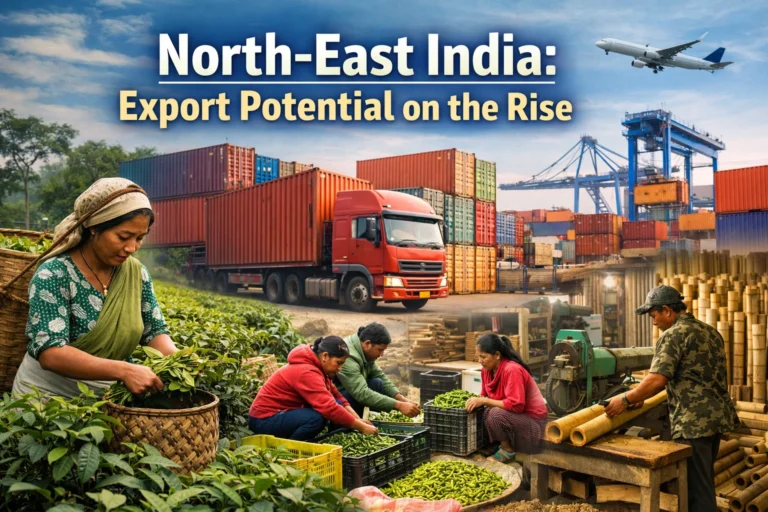
The North East could also find opportunities in sectors where it already possesses natural strengths — tourism, handicrafts, bamboo, organic agriculture and cultural industries. AI-driven market access, logistics optimisation and digital storytelling could help local entrepreneurs reach audiences far beyond the region.
In many ways, artificial intelligence may offer North East India something previous industrial revolutions rarely did:
the possibility of participating meaningfully in the digital economy without first becoming a traditional industrial hub.
The Next Decade May Define India’s Technological Identity
The most important question facing India today may not be whether artificial intelligence will transform the economy. That transformation is already underway globally.
The deeper question is whether India can shape that transformation on its own terms.
Can the country build trusted AI infrastructure?
Can it create world-class AI talent at scale?
Can it balance innovation with regulation?
Can it ensure AI benefits extend beyond large corporations and metropolitan centres?
Can it create a model of AI development rooted in inclusion, multilingualism and democratic values?
The answers to those questions may shape India’s position in the global order of the twenty-first century.
Because the AI revolution is not merely another technology cycle.
It may become one of the defining economic and civilisational transitions of our time.https://thequantiq.com/indias-younger-generation-is-redesigning-the-meaning-of-work-risk-and-ambition/



One Comment