
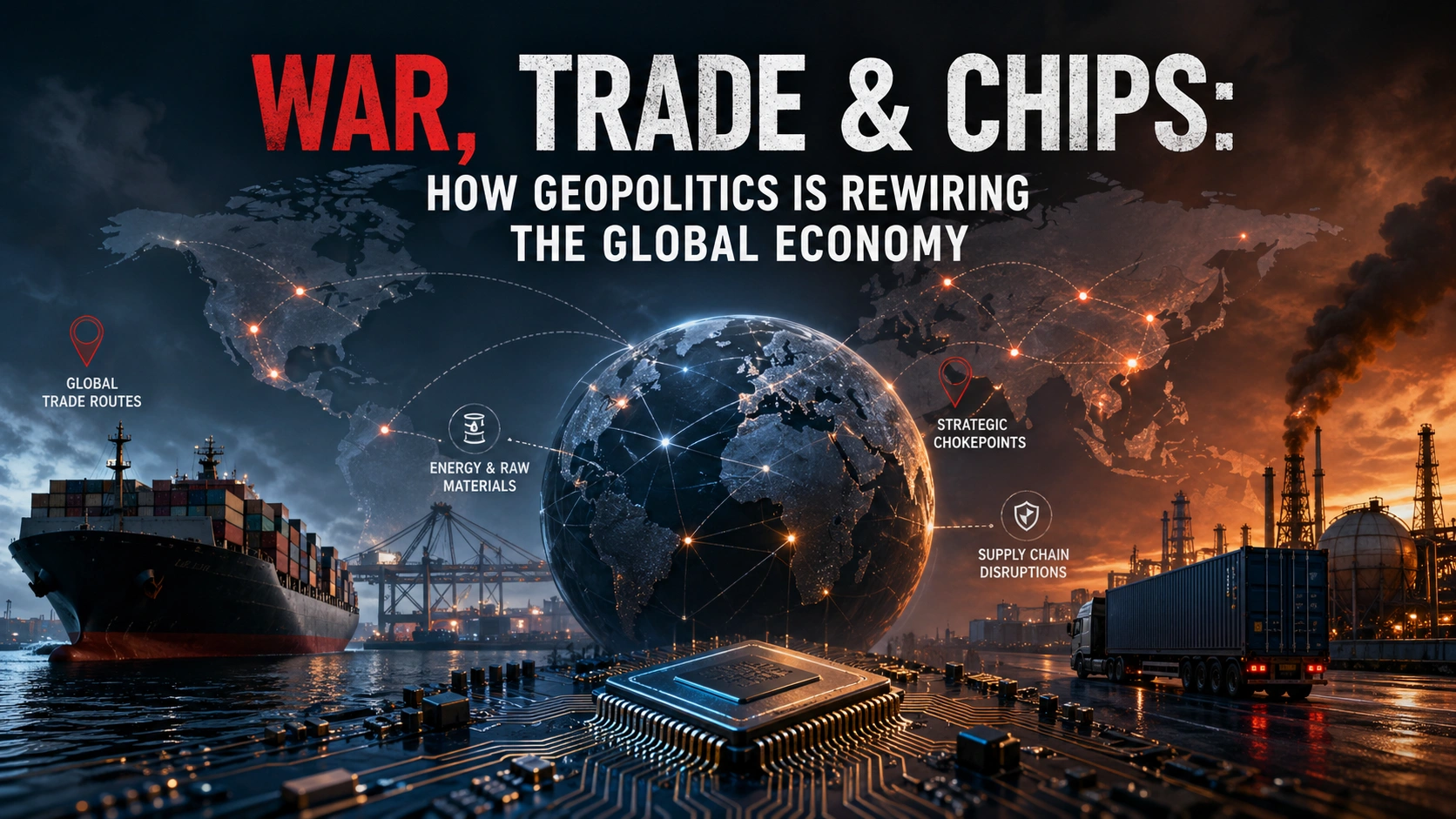
War, Trade & Chips: How Geopolitics is Rewiring the Global Economy
When Conflict Travels Without Noise
There was a time when wars were visible.
They arrived with the sound of boots, the movement of tanks, the fall of cities. You could point to a map and say—this is where history is being rewritten.
That clarity is gone.
Today, a conflict can begin in the waters of the Strait of Hormuz and quietly travel across continents, entering your life not as breaking news, but as a price rise, a delay, a shortage. No sirens. No spectacle. Just disruption.
And yet, its impact is far deeper than most wars we have known.
What is unfolding in West Asia is not merely a geopolitical standoff. It is something more systemic, more consequential. It is the slow, deliberate rewiring of the global economy.
The Invisible Journey of a Shock
A single strike on a petrochemical facility does not stay where it happens.
It moves.
Not across borders in the traditional sense, but through systems—industrial, logistical, technological. Materials that quietly power printed circuit boards begin to thin out. The foundations of modern electronics—so often taken for granted—start to feel pressure.
The change is subtle at first. Manufacturers hesitate. Costs begin to inch upward. Delivery timelines stretch just enough to be noticed, but not enough to alarm.
And then, somewhere down the line, a device becomes more expensive. A project is delayed. A consumer pays more, without ever knowing why.
This is how modern conflict behaves. It doesn’t announce itself. It embeds itself.
The Strait That Moves the World
There are places on the map that carry disproportionate weight. The Strait of Hormuz is one of them.
It is not just a passage of water. It is an economic nerve.
When tension rises there, the first reaction is not always visible. Ships slow down. Insurance costs rise. Routes are reconsidered. The smooth rhythm of global trade begins to falter.
A significant share of the world’s energy passes through this corridor, but energy is only part of the story. Beneath it lies a dense network of industrial dependencies—chemicals, gases, inputs that keep factories running and technologies evolving.
Interrupt that flow, even briefly, and the world does not stop. It stumbles.
A Fragile Technological Age
What makes this moment distinct is not just the conflict itself, but the kind of world it is disrupting.
We are no longer anchored in a purely industrial economy. We are living in a system where technology sits at the core of everything—communication, healthcare, mobility, intelligence.
And that system, for all its sophistication, is surprisingly fragile.
A disruption in one input can ripple across industries. A shortage of a gas can delay semiconductor production. A delay in semiconductors can slow down entire sectors—from consumer electronics to artificial intelligence infrastructure.
The future, it turns out, is not as robust as it appears.
It is delicately interconnected.
From Efficiency to Resilience
For decades, the global economy was built on a simple belief: efficiency above all.
Production moved to wherever it was cheapest. Supply chains stretched across continents. Inventory was minimized. Everything arrived just in time.
It was a system of precision.
And it worked—until disruption exposed its vulnerabilities.
What we are witnessing now is not the end of that system, but its transformation. Supply chains are becoming shorter, more regional, more deliberate. Nations are beginning to think less about cost and more about control.
The language is changing.
Efficiency is no longer enough. Resilience has entered the conversation.
A War Without a Battlefield
It is tempting to describe this phase as a new Cold War. But that comparison only captures part of the picture.
This is not a conflict defined by borders or blocs.
It is a conflict of systems.
Energy systems, technology systems, logistics systems—each intertwined, each capable of disruption, each vulnerable in ways we are only beginning to understand.
The battlefield is no longer confined to geography. It stretches into ports, factories, shipping lanes, and data centres. The weapons are not always visible. Sometimes, they are simply interruptions—delays, shortages, constraints.
And yet, their impact is no less profound.
India in the Middle of the Shift
In this evolving landscape, India occupies a position that is both promising and precarious.
It is not at the centre of these conflicts, yet it is deeply connected to their outcomes. It is both a participant in global systems and an emerging anchor in new ones.
This creates an opening.
A fragmented world looks for stability. Disrupted supply chains look for reliable alternatives. There is space here for India to step in—not just as a market, but as a node of trust.
But the same interconnectedness that creates opportunity also brings exposure. External shocks do not remain external for long.
The challenge, then, is not just growth. It is navigation.
The World is Not Breaking. It is Rewiring.
It is easy to assume that what we are witnessing is temporary. Another cycle of tension that will eventually settle.
But something deeper is taking shape.
The architecture of the global economy is being redesigned—not through deliberate planning, but through accumulated disruption. The old system assumed stability. The new one is being built for uncertainty.
This is not a breakdown. It is a rewiring.
The Quiet Presence of Geopolitics
The next time a distant conflict makes the news, it may seem far removed from everyday life.
But distance has lost its meaning.
Because the effects of that conflict may already be moving through supply chains, through industries, through decisions that shape what gets built, what gets delayed, and what gets priced differently.
Geopolitics no longer stays at the borders. It lives quietly inside the products we use and the futures we imagine. And that may be the most profound shift of all.https://thequantiq.com/the-economics-of-garbage-why-waste-is-now-a-400-billion-industry/
How does geopolitics affect global supply chains?
Geopolitical conflicts disrupt critical trade routes, raw material supplies, and logistics networks, causing delays, price increases, and shortages in industries like electronics and energy.