AI Literacy Is the New Economic Divide
There is a quiet scene unfolding across India today. Classrooms, co-working spaces, WhatsApp groups, YouTube tutorials—everywhere, people are “learning AI.” They are attending workshops, copying prompts, experimenting with chatbots, generating images, writing posts.
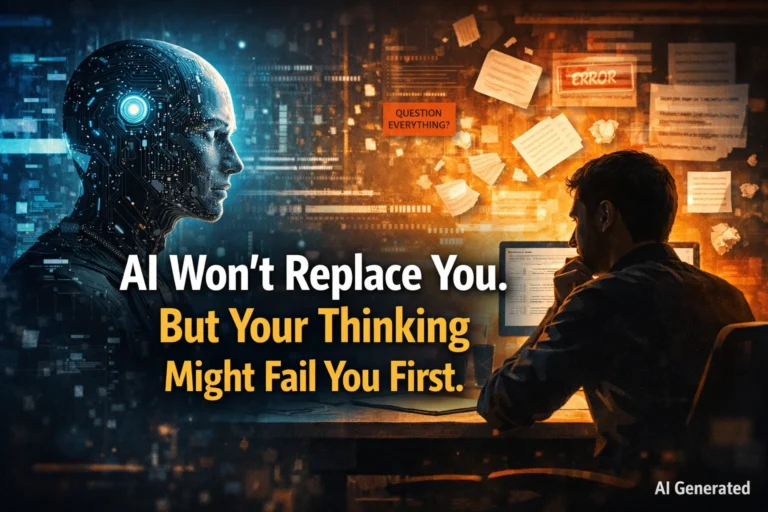
On the surface, it feels like a revolution. Look closer, and a different reality emerges. Most people are not learning artificial intelligence. They are learning interfaces.
The rise of tools like ChatGPT has created an illusion of competence. Type a sentence, get an answer. Ask a question, receive a structured response. It feels powerful, almost magical. But beneath that convenience lies a deeper question—one that will define the next decade:
Do we understand what we are using, or are we merely reacting to it?
The Illusion of Learning
The early internet rewarded access. The smartphone era rewarded adoption. The AI age will reward understanding.
Today, millions are using ChatGPT and similar systems across the world. Students, professionals, entrepreneurs, creators—everyone is experimenting. Yet, meaningful understanding remains rare.
Ask a typical user how AI arrives at an answer, and the response often dissolves into guesswork. Ask them how to verify outputs, where the risks lie, or how to integrate AI into a real workflow, and the confidence fades.
What we are witnessing is not widespread AI literacy. It is widespread AI exposure. And the gap between the two is where the next inequality forms.
Adoption Without Comprehension
Every technological shift creates two classes of participants: those who use, and those who understand.
The printing press created readers and thinkers. The internet created users and builders. Artificial intelligence is now creating a similar divide—between those who merely interact with systems and those who can think with them.
Mass adoption without comprehension is a dangerous comfort. It creates the feeling of progress without the substance of capability.
You can generate an article in seconds. But can you judge its accuracy?
You can automate a task. But do you understand what has been automated—and what has been lost?
This is not a technical gap. It is a cognitive one.
What It Means to Be AI Literate
AI literacy is often misunderstood as the ability to use tools effectively. In reality, it is something deeper, more foundational.
It begins with understanding what AI can and cannot do. Not as a list of features, but as a way of thinking. It involves recognising that AI systems do not “know” in the human sense—they predict, they approximate, they assemble patterns from data.
It extends to the ability to ask better questions. Prompting, in this sense, is not about syntax or tricks. It is about clarity of thought. The sharper the thinking, the sharper the output.
It demands critical evaluation. AI-generated content can sound confident while being flawed. Without the ability to question and verify, users risk becoming passive recipients of polished misinformation.
And finally, AI literacy requires integration. The real value of AI does not lie in isolated usage, but in embedding it into workflows—business decisions, creative processes, farming practices, supply chains, education systems.
In essence, AI literacy is not about learning a tool. It is about learning how to think in an age where machines can think alongside you.
The Tool Trap
There is a temptation, especially in fast-moving technological cycles, to chase tools.
Today, it is ChatGPT. Tomorrow, it will be something faster, cheaper, more powerful. Interfaces will evolve. Features will change. Entire platforms may disappear.
If your learning is anchored to tools, you are condemned to start over again and again.
But if your learning is anchored to understanding, every new tool becomes easier to master. You are no longer adapting to technology. You are absorbing it.
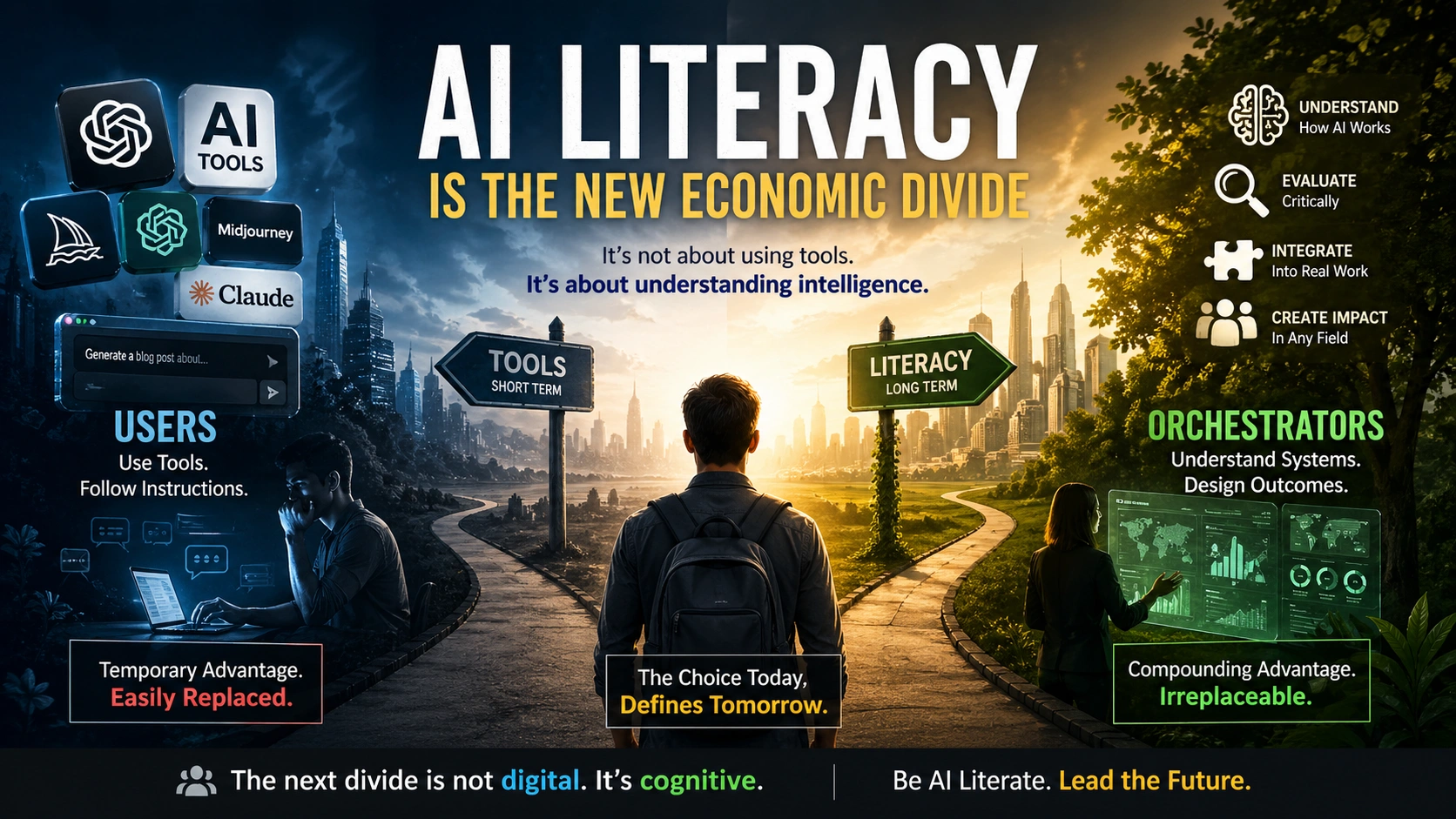
This is the difference between users and orchestrators. Users follow instructions. Orchestrators design outcomes.
Beyond ChatGPT
Reducing artificial intelligence to chatbots is like reducing the internet to email.
AI is already reshaping sectors far beyond text generation. In agriculture, it is influencing crop prediction, soil analysis, and climate resilience—areas deeply relevant to regions like Northeast India. In healthcare, it is assisting diagnostics and accelerating research. In logistics and supply chains, it is optimising efficiency at scales previously unimaginable.
For entrepreneurs, AI is not just a productivity tool. It is an infrastructure layer. For farmers, it is not just an app. It is a decision-support system.
For media platforms, it is not just content generation. It is a new way of storytelling, distribution, and engagement.
To remain confined to a single tool in such a landscape is to misunderstand the magnitude of the shift.
The New Divide
For years, we spoke about the digital divide—the gap between those who had access to technology and those who did not.
That divide is narrowing.
A new divide is emerging in its place. It is not about access. It is about awareness. It is not about devices. It is about direction.
Those who are AI-literate will move into roles that define, manage, and guide intelligent systems. They will make decisions faster, experiment more effectively, and create value at scale.
Those who remain at the level of tool usage will find themselves executing tasks—often faster than before, but not necessarily more meaningfully.
In regions like Assam and the broader Northeast, this distinction carries even greater weight. At a time when aspirations are often channelled towards limited pathways, AI literacy offers a chance to leapfrog—to participate not just in the consumption of technology, but in its application and adaptation.
The risk is not that people will be left behind.
The risk is that they will believe they are moving ahead, while standing on a fragile understanding.
Rethinking the Way We Learn AI
If AI literacy is the goal, then the way we approach learning must change.
It cannot be reduced to crash courses on tools or lists of prompts. It must begin with curiosity—an interest in how systems work, where they fail, and how they can be applied meaningfully.
It must encourage structured thinking, because AI amplifies clarity and exposes confusion.
It must connect with real-world problems. Whether in business, agriculture, education, or media, AI must be experienced as a problem-solving partner, not a novelty.
And above all, it must be continuous. In a landscape that evolves this quickly, learning cannot be an event. It has to become a habit.
A Defining Question
We are at an inflection point.
Artificial intelligence is no longer a distant concept. It is embedded in everyday life, shaping decisions, influencing outcomes, and redefining what it means to be skilled.
The question is no longer whether people will use AI. That phase has already begun.
The real question is whether they will understand it.
Because in the age of AI, the difference between using a tool and understanding intelligence is not academic.
It is economic. It is structural. And it may well determine who leads—and who follows—in the decade to come.https://thequantiq.com/indias-banks-face-their-first-ai-shock-and-this-time-its-not-about-efficiency/
FAQS
What is AI literacy?
AI literacy is the ability to understand, evaluate, and effectively use artificial intelligence in real-world contexts beyond just operating tools.
Why is AI literacy important?
It enables individuals to think critically, adapt to new technologies, and make informed decisions in an AI-driven world.
Is learning AI tools enough?
No. Tools change rapidly, but understanding AI principles creates long-term value and adaptability.
How is AI literacy different from digital literacy?
Digital literacy focuses on using technology, while AI literacy focuses on understanding intelligent systems and their impact.

2 Comments