
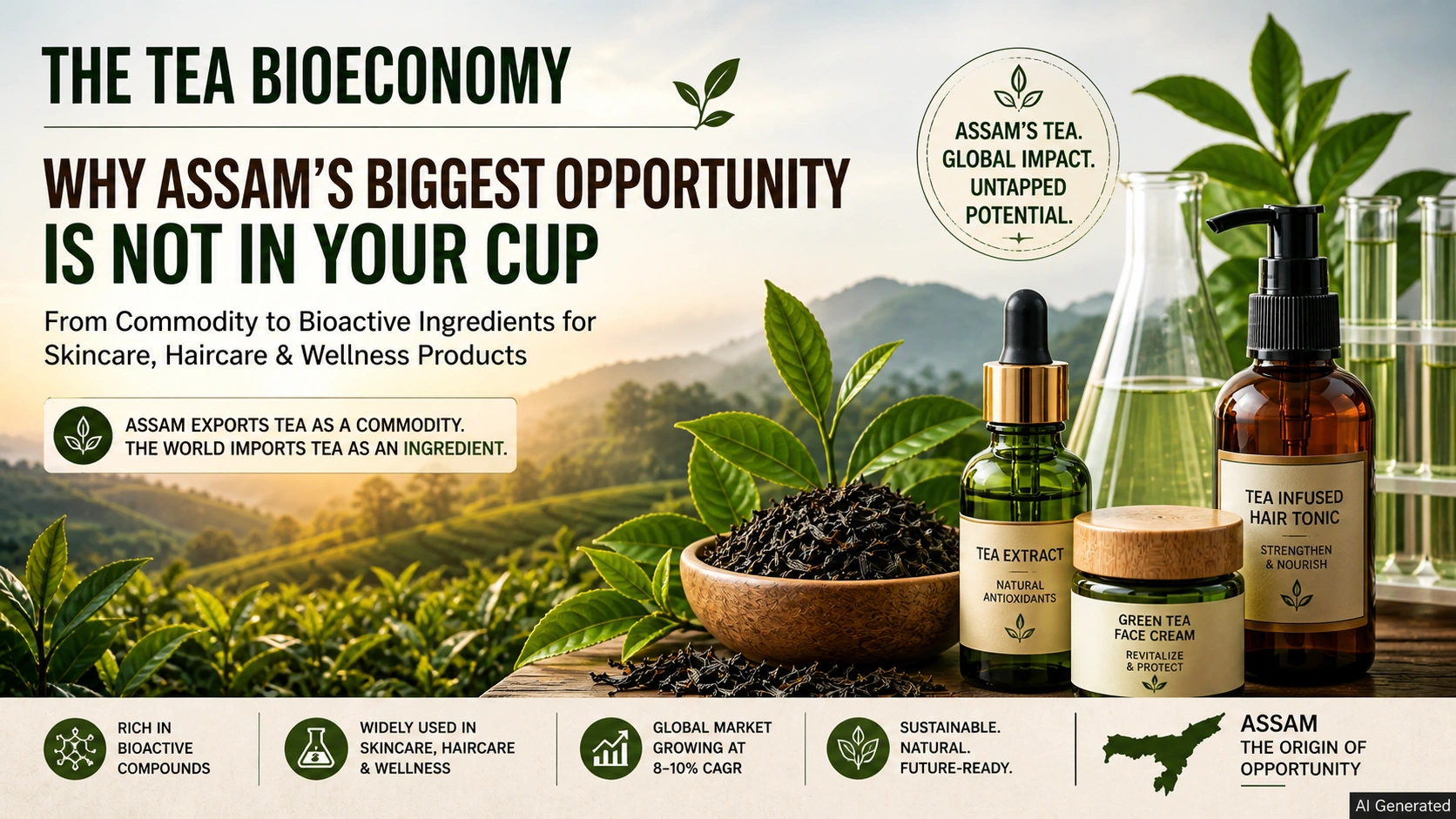
The Tea Bioeconomy: Why Assam’s Biggest Opportunity Is Not in Your Cup
Assam exports tea as a commodity. The world imports tea as an ingredient
What This Article Covers
A quiet shift is taking place in global markets.
Tea is no longer just a beverage. It is becoming a raw material for a new category of products—skincare, haircare, nutraceuticals, and functional wellness formulations.
This article examines how that shift is unfolding, and why Assam—one of the world’s most recognisable tea-producing regions—stands at a crossroads.
The question is not about production. The question is about value.
The Global Shift — From Beverage to Bioactive Ingredient
For decades, tea has been traded as a commodity.
Its value has been tied to volume, grade, and auction price. That structure is now being challenged by a new layer of demand.
Global markets are moving toward functional ingredients. Consumers are no longer buying products for basic use alone. They are buying outcomes—anti-aging, skin repair, scalp health, and stress reduction.
Tea fits into this shift with surprising precision.
It contains catechins, polyphenols, flavonoids, and antioxidants. Among them, EGCG (epigallocatechin gallate) has become one of the most studied plant compounds in modern cosmetic science.
These compounds are now used in anti-aging creams, UV-protection formulations, anti-inflammatory skincare, and hair-strengthening treatments. What was once brewed is now extracted. What was once consumed is now applied.
The Market Reality — Where the Value Actually Lies
The numbers tell a clear story.
The global tea market is valued at over $200 billion. It is large, but it is also mature. Growth is steady, not explosive.
In contrast, the natural and organic personal care market—where tea extracts are increasingly used—is valued at over $20 billion and expanding rapidly. The clean beauty segment continues to grow at close to double-digit rates.
But the real shift is not just in size. It is in margins.
Bulk tea sells at commodity pricing. It is subject to weather, auction dynamics, and global oversupply cycles.
Tea extracts operate in a different economy. They belong to the active ingredient market, where value is driven by concentration, purity, and functional performance.
A kilogram of processed tea extract can command several multiples of the value of raw tea leaves. This is where the industry is quietly moving.
Assam — A Global Brand with a Local Constraint
Assam tea carries global recognition. Its strong flavour, high tannin content, and distinctive profile make it a staple in international blends.
But recognition has not translated into value capture.
The region continues to operate largely within the traditional tea economy—production, processing, auction, and export.
This model has limits. It creates scale, but not necessarily margin. It builds volume, but not always value.
At the same time, global brands are extracting, isolating, and packaging tea’s bioactive compounds into high-value formulations.
The raw material often travels far before it becomes a finished product. The value travels even further.
The Science Advantage — Why Assam Tea Matters in Formulation
Not all tea is equal. Assam tea, grown in humid conditions with rich soil and long growing seasons, is naturally high in tannins and antioxidant compounds.
These characteristics, which define its strength as a beverage, also enhance its value as a functional ingredient.
High polyphenol content improves its effectiveness in reducing oxidative stress in skin, supporting collagen stability, calming inflammation, and strengthening hair roots.
In other words, the very qualities that make Assam tea distinctive in the cup make it valuable in the lab. This is not a branding argument. It is a formulation advantage.
The Emerging Product Layer — From Extracts to Experience
The shift from raw tea to value-added products does not happen in a single step.
It unfolds across layers.
At one end, there is extraction—concentrated tea compounds used by cosmetic manufacturers. At the other end, there are finished products such as serums, creams, oils, and tonics that reach consumers directly.
Between these layers lies the real opportunity.
Tea-based face serums that position antioxidants as active ingredients. Hair tonics infused with tea extracts that address scalp health. Fermented tea formulations inspired by kombucha that align with microbiome-friendly skincare trends.
Fermented tea is also beginning to surface as an experimental category within the region. Small-scale kombucha producers have started to emerge in Assam, indicating an early shift toward value-added tea products that move beyond traditional consumption.
While still nascent, these ventures reflect a broader pattern seen globally, where fermentation enhances bioavailability and introduces probiotic benefits.
At this stage, the ecosystem remains early. But the signal is clear. The transition has begun.
The Artisanal Opportunity — Where Story Meets Science
Beyond industrial production lies another layer—smaller, more flexible, and potentially more powerful in brand building.
Artisanal product lines.
Small-batch tea oil infusions. Handmade formulations combining tea with regional ingredients such as bamboo charcoal or herbal extracts. Premium positioning rooted in geography, tradition, and sustainability.
This is where storytelling becomes an economic tool. A product is no longer just a formulation. It becomes an experience tied to place.
For a region like Assam, this is not a minor advantage. It is a strategic one.
The Missing Infrastructure — Why the Shift Has Not Happened Yet
If the science exists and the market is ready, why has the transition not taken place at scale?
The answer lies in infrastructure.
The current ecosystem is designed for tea as a commodity. It is not designed for tea as an ingredient.
There are limited extraction facilities, few formulation labs, and minimal integration between tea producers and cosmetic manufacturers.
The supply chain is linear. The opportunity requires it to become layered. This is not a gap in awareness. It is a gap in industrial design.
The Strategic Frame — From Plantation to Processing
At its core, this is not a question of diversification.
It is a question of direction.
Assam can continue to strengthen its position in the global tea market. That path is stable, but it is also constrained.
Or it can begin to move into the bioeconomy, where tea is not just a product, but a platform.
A platform for extracts, formulations, and brands. The shift does not require abandoning the existing system. It requires building a parallel one.
The Window — And the Risk of Missing It
Global demand for natural and functional ingredients is rising.
Brands are searching for traceable, high-quality inputs. Consumers are moving toward products that combine performance with sustainability.
This creates a window. But it is not permanent.
Other regions are already building capabilities in plant-based extracts and bioactive formulations. Supply chains are forming. Partnerships are being established.
If Assam does not move within this phase, it risks repeating a familiar pattern.
Supplying raw material. Watching value being created elsewhere.
Closing Note
Tea built Assam’s global identity. But identity alone does not build the future. The next phase of growth will not come from producing more tea. It will come from doing more with tea. Because in the end, the question is simple.
Not how much Assam produces. But how much of what it produces, it chooses to transform.https://thequantiq.com/north-east-india-medicinal-plants-bio-economy/