
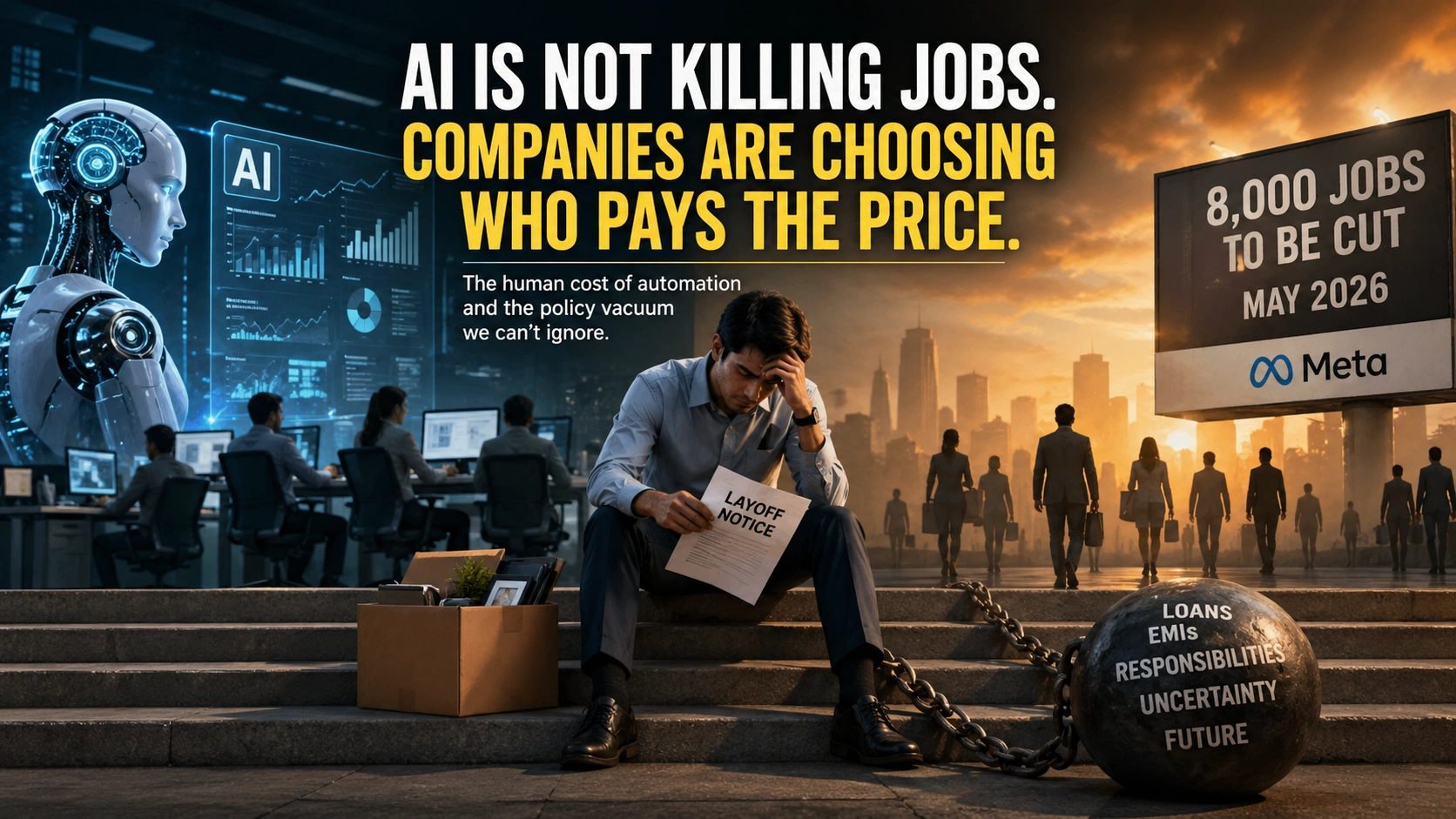
AI Is Not Killing Jobs. Companies Are Choosing Who Pays the Price.
There is a comforting narrative quietly circulating in the technology industry.
Some leaders suggest that artificial intelligence will not take away jobs—that it will “augment,” “enhance,” and “transform” work rather than destroy it. It is a reassuring story, one that calms markets, employees, and policymakers alike.
But step outside that narrative for a moment, and a different reality begins to take shape.
Layoffs are happening. Not hypothetically, not gradually—but in waves. And they are disproportionately hitting a specific group that rarely makes headlines: professionals with one to five years of experience.
This is not a coincidence. It is a structural shift.
The Comforting Lie the Industry Tells Itself
Companies are not lying when they say AI creates opportunities. Over the long term, it will. Entire categories of work will emerge, just as they have in every previous technological shift.
But what is conveniently left unsaid is something far more immediate. Artificial intelligence is compressing the need for early-career roles at a pace we have not seen before.
Work that once required teams of junior analysts, developers, designers, or support staff can now be handled by smaller, more experienced teams equipped with AI tools. The output is faster, often cheaper, and increasingly scalable.
For companies whose business models still depend heavily on human deployment, the transition appears slower, even cautious. But for product-driven and platform-based companies, the incentives are very different. Efficiency is rewarded, margins improve, and headcount becomes a variable rather than a necessity.
In that equation, early-career professionals become the most expendable layer.
The Invisible Casualty: India’s EMI Workforce
There is a section of the workforce that rarely features in policy discussions, yet sits at the centre of this shift.
Young professionals in their late twenties and early thirties—ambitious, educated, and recently absorbed into the formal economy—have built their lives around the promise of steady income. They have taken home loans, financed vehicles, and committed to a lifestyle that assumes continuity.
They are not traditionally vulnerable. But they are structurally exposed.
When layoffs hit this segment, the consequences do not remain confined to individual careers. They extend outward, quietly but steadily, into the financial system, into consumption patterns, and into the broader economy.
What appears as a company-level decision begins to echo at a societal level.
The Great Cost Transfer
Artificial intelligence is undeniably increasing productivity. That is not the problem.
The question is how the benefits and costs of that productivity are distributed.
Companies gain efficiency, speed, and improved margins. Shareholders see value. Products evolve faster.
But the cost of transition does not disappear. It moves.
It moves to individuals who must suddenly reskill or restart their careers. It moves to families that absorb financial uncertainty. It moves to economies that must adjust to sudden shifts in employment patterns.
AI is not eliminating work. But it is steadily redistributing risk—away from corporations and toward individuals.
And that redistribution is happening faster than most systems are prepared to handle.
When Responsibility Becomes Optional
Modern corporations speak the language of responsibility with increasing fluency. Sustainability, social impact, and governance have become integral to brand identity.
Yet moments of disruption often reveal a gap between narrative and action.
When companies report strong financial performance alongside large-scale layoffs, a difficult question surfaces: where does responsibility end?
If automation drives efficiency, does it also create an obligation to support those displaced by it? Or is that burden to be carried entirely by the workforce?
At present, there is no consistent answer. Responsibility, in this context, remains largely voluntary.
The Missing Layer No One Is Building
What makes this transition more fragile is not the technology itself, but the absence of a structured response.
There is no clear policy framework—either in India or globally—that directly addresses AI-driven job displacement at scale. Conversations around ethical AI and reskilling exist, but they are fragmented and often reactive.
Meanwhile, the pace of change continues to accelerate.
This creates a widening gap between technological capability and societal preparedness. And history suggests that such gaps rarely close without consequences.
Rethinking the Transition
The instinctive response to disruption is often resistance. But in the case of AI, resistance is neither practical nor useful.
The real challenge lies in managing the transition.
What would it mean to treat workforce displacement not as an unfortunate side effect, but as a central part of the innovation process? What would change if companies, policymakers, and institutions approached this shift as a shared responsibility rather than an individual burden?
Perhaps the answer lies not in slowing down technology, but in strengthening the systems that surround it.
Because an economy that accelerates without cushioning its workforce does not become stronger. It becomes unstable in ways that are not immediately visible, but deeply consequential.
The Question That Will Define This Decade
Much of the conversation around artificial intelligence has focused on capability—on what machines can do, how fast they can improve, and how widely they can scale.
But the more important question is not about capability. It is about consequence.
Who absorbs the shock while this transformation unfolds?
If the answer continues to be individuals navigating uncertainty on their own, then the system remains incomplete. And if the system remains incomplete, the effects will extend far beyond the technology sector.
Closing Thought
Artificial intelligence will shape the future of work. That is no longer in question.
What remains uncertain is whether that future will be inclusive or uneven—whether it will distribute opportunity as effectively as it currently distributes disruption.
Because in the end, this is not just a story about jobs. It is a story about how we choose to manage change.
If AI is the future, then protecting those displaced by it is not charity—it is infrastructure.https://thequantiq.com/ai-literacy-is-the-new-economic-divide/





One Comment