
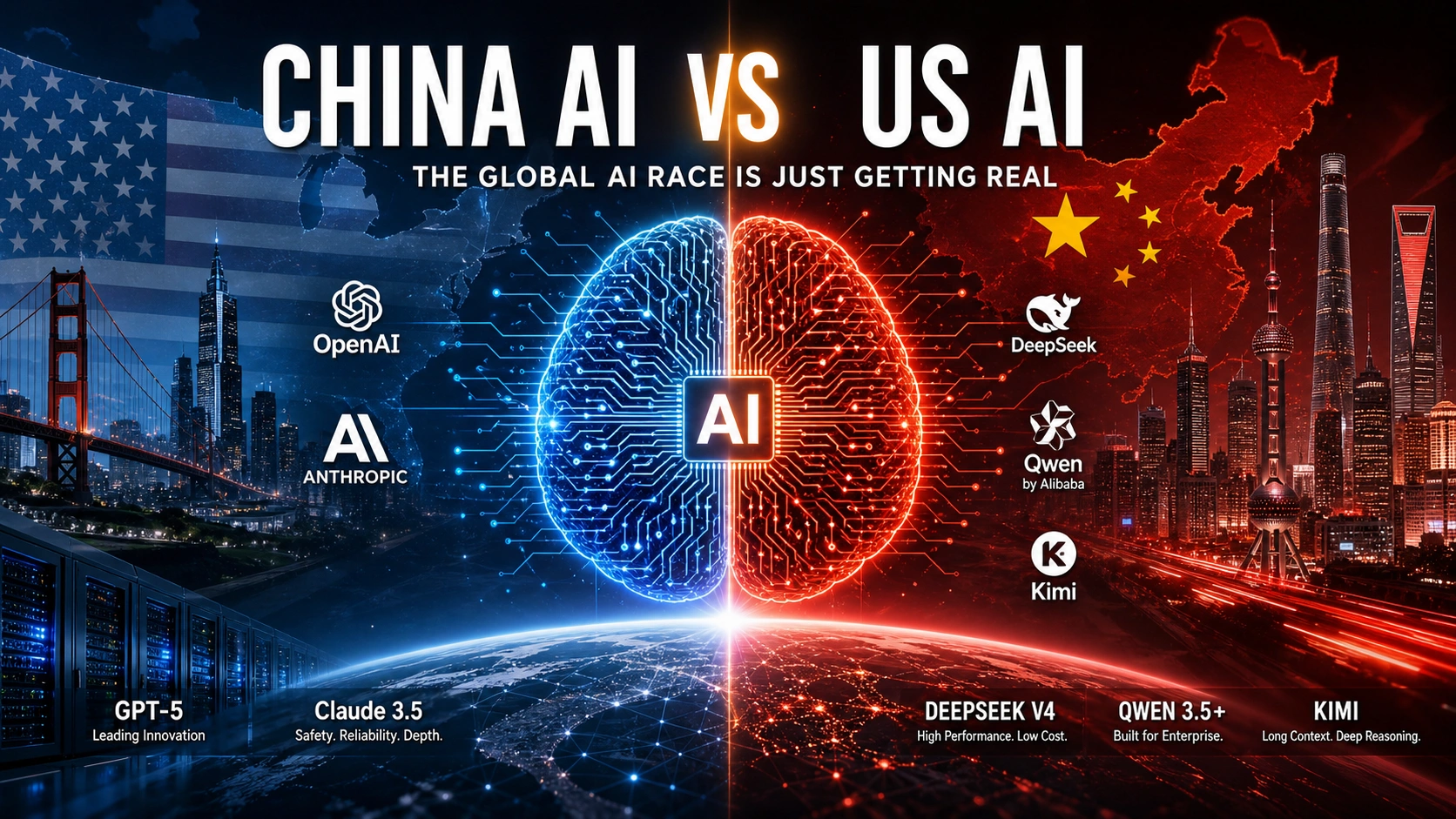
China AI vs US AI: The Quiet War Reshaping the Future of Intelligence
There was a time—not too long ago—when artificial intelligence had a clear geographic identity.
It spoke in the accents of Silicon Valley. It scaled through the infrastructure of companies like OpenAI, Anthropic, and Google. And it set the pace for the rest of the world. That certainty is now dissolving.
Quietly, methodically, and without the theatrical launches that characterize Western tech, a new class of AI models is emerging from China—models that are not just competitive, but increasingly disruptive. At the center of this shift stands DeepSeek.
The DeepSeek Moment
When DeepSeek introduced its latest generation of reasoning models, the industry did not simply take notice—it recalibrated. Here was a system delivering performance that approached top-tier Western models, yet operating at a dramatically lower cost.
In an ecosystem where the economics of compute had become the primary barrier to entry, DeepSeek introduced a dangerous and transformative idea: intelligence does not have to be expensive.
That idea did more than challenge companies like OpenAI and Anthropic. It challenged the very structure of the AI market. Once the economics shift, power rarely remains where it was.
Alibaba and the Infrastructure Play
While DeepSeek disrupted cost, Alibaba has been building something far more expansive with its Qwen models.
This is not AI as a standalone product. It is AI as infrastructure—embedded across commerce, logistics, cloud systems, and enterprise workflows. Qwen reflects a fundamentally different philosophy from the West. It does not aim merely to compete at the level of model performance. It aims to integrate intelligence into the bloodstream of digital ecosystems.
In this emerging paradigm, the competition is no longer model versus model. It is ecosystem versus ecosystem.
The Rise of Context Intelligence
Alongside these developments, models like Kimi are quietly redefining capability in a different dimension. While much of the global discourse remains focused on reasoning benchmarks, Kimi pushes the boundaries of context—handling vast documents, extended inputs, and layered information with surprising depth.
In a world increasingly overwhelmed by data, this shift is not incremental. It is foundational.
The question is no longer whether AI can answer questions. The question is whether it can understand the full scope of human knowledge in context.
A Comparative Snapshot of the New AI Landscape
To understand the shift more clearly, it helps to step back and examine the emerging players side by side.
At one end of the spectrum, systems like GPT-5 from OpenAI continue to define the frontier of general intelligence, offering advanced reasoning, multimodal capabilities, and global adaptability. Close behind, Claude from Anthropic distinguishes itself through structured thinking, safety alignment, and long-context comprehension.
On the other side, DeepSeek has positioned itself as a cost disruptor, delivering high performance at a fraction of traditional pricing. Qwen, developed by Alibaba, is rapidly becoming a backbone for enterprise-scale AI integration, while Kimi focuses on long-context intelligence and developer-centric workflows.
What emerges from this comparison is not a hierarchy, but a fragmentation.
The future of AI may not belong to a single dominant model, but to a constellation of specialized systems—each optimized not for superiority, but for context.
Two AI Worlds Are Emerging
The global AI landscape is no longer converging. It is diverging.
On one side, Western systems led by OpenAI and Anthropic continue to push the limits of performance, backed by strong developer ecosystems and premium pricing structures.
On the other, Chinese players such as DeepSeek and Alibaba are redefining accessibility, cost efficiency, and integration at scale.
These are not just competing technologies. They are competing philosophies of intelligence.
India’s Strategic Moment: Between Two AI Worlds
India now finds itself in a position it has rarely occupied in modern technological history.
Not behind. Not ahead. But perfectly placed in between.
On one side stand companies like OpenAI and Anthropic—pushing the frontiers of intelligence at a premium cost. On the other, players like DeepSeek and Alibaba are making AI dramatically more affordable.
For a country where innovation often operates under capital constraints, this shift is transformative.
If intelligence becomes affordable, innovation becomes democratic. A student in Guwahati, a founder in Bengaluru, or a small business owner in Silchar can suddenly access capabilities that were once restricted to well-funded enterprises.
Yet, beneath this opportunity lies a deeper risk.
If India builds entirely on external AI ecosystems—whether American or Chinese—it risks becoming a consumer of intelligence rather than a creator. History has shown how dependence on external technological platforms limits long-term value creation. AI, given its scale and influence, could amplify that dependency.
And yet, this is also India’s moment to leapfrog.
Unlike previous technological waves, the AI stack is still being built. Standards are still evolving. Dominance is not yet absolute. India does not need to replicate Silicon Valley, nor mirror China. It can design its own path—one that blends global innovation with domestic capability, one that prioritizes India-specific use cases across agriculture, education, healthcare, and governance.
This moment, however, cannot be left to startups alone. It demands strategic public investment, open infrastructure, and a coordinated push between academia and industry.
Because the stakes are no longer just economic.
They are civilizational.
The Final Divide
The world is moving toward two AI ecosystems.
India has three choices. It can align with the West. It can align with China. Or it can attempt something far more difficult—building a third path.
The first two are easier. The third is harder.
But it is also the only one that offers true sovereignty.
In the age of artificial intelligence, the real divide will not be between nations that use AI and those that don’t—but between those who build intelligence, and those who merely rent it.https://thequantiq.com/ai-is-not-killing-jobs-companies-are-choosing-who-pays-the-price/



One Comment