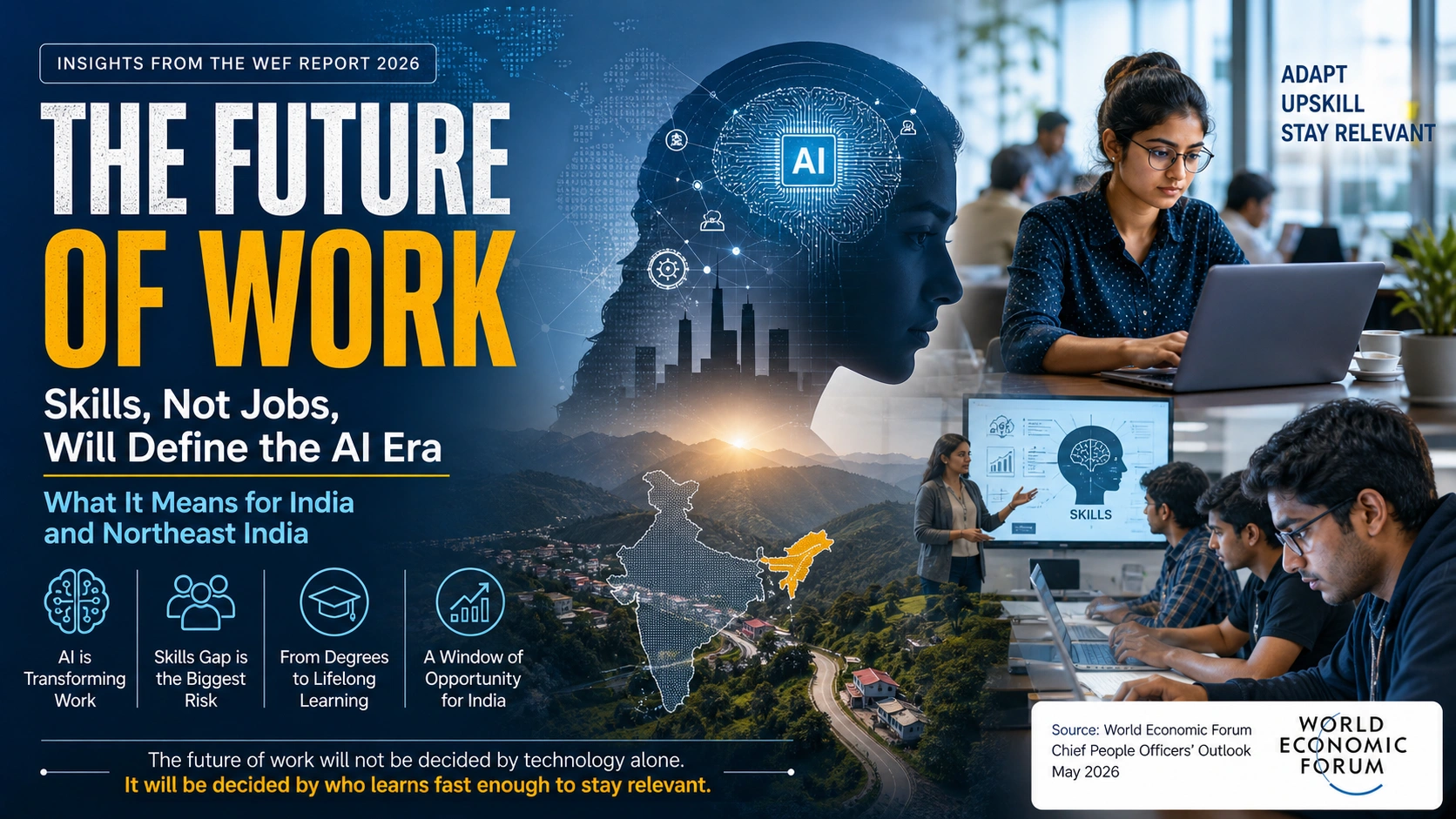
The Future of Work Is Here. The Real Question Is: Who Is Ready?
A young graduate in Guwahati steps out into the world with a degree that took years to earn. Across the country, in a glass-walled office in Bengaluru, a startup founder scrolls endlessly through resumes, unable to find someone who can do the job.
These two realities exist in the same economy, under the same sky. And yet, they rarely meet.
For years, we have been told to fear a future where machines take over human work. It is a compelling story, almost cinematic in its simplicity. But the truth unfolding quietly around us is far more complex—and far more urgent. The disruption is not arriving someday. It is already here, embedded in the way work is being redefined, task by task, skill by skill.
A recent report by the World Economic Forum—Chief People Officers’ Outlook, May 2026—does not speak in the language of alarm, but in the language of transition. Yet between its lines lies a stark realisation: the world is not running out of jobs. It is running out of people who are ready for them.
The Crisis That Doesn’t Look Like One
At first glance, the global labour market appears unsettled but not broken. Some sectors expand even as others contract. Opportunities emerge even as anxieties deepen. But beneath this surface lies a quieter fracture.
Employers are not simply struggling with hiring. They are struggling with alignment. The people are there. The jobs are there. What is missing is the bridge between the two.
This is not unemployment in the way we have understood it for decades. It is something subtler, and in many ways more dangerous. It is a growing mismatch between what people know and what the world now demands of them.
The old assurances no longer hold. A degree does not guarantee relevance. Experience does not guarantee adaptability. And time, which once allowed for gradual transitions, now moves too fast for comfort.
When Work Begins to Change Shape
One of the most important insights from the WEF analysis is that work is not disappearing—it is changing form. Entire professions are not vanishing overnight; they are being reshaped from within.
A marketing professional today is no longer only a storyteller but also an interpreter of data. A journalist is expected not just to report, but to navigate digital systems, analytics, and increasingly, artificial intelligence. A designer does not merely create; they collaborate with tools that can generate, iterate, and optimise at speeds no human can match.
This is not replacement. It is transformation.
And transformation demands something the traditional system was never designed to provide at scale: continuous learning. Not as an ideal, but as a condition for staying relevant.
India at the Edge of a Shift
India finds itself at a remarkable yet precarious moment. It has the advantage of youth, scale, and aspiration. It produces millions of graduates each year, each carrying the promise of participation in a growing economy.
And yet, a troubling disconnect persists.
The rhythm of education has not kept pace with the velocity of change. Institutions still move with the inertia of older paradigms, even as industries reinvent themselves in cycles that grow shorter with each passing year. Technology has compressed time. Adaptation has become urgent.
What emerges from this gap is not a lack of intelligence or ambition, but a lack of alignment. The system produces capability in one language, while the market demands fluency in another.
The Northeast at a Crossroads
In Northeast India, this transition acquires a deeper resonance. The region is young, aware, and increasingly connected. There is a quiet energy here—visible in small entrepreneurial ventures, in digital curiosity, in the desire to engage with a wider world.
But there are also constraints that cannot be ignored. Exposure to advanced tools remains uneven. Industry linkages are still evolving. Structured pathways for skill development are not yet as robust as they need to be.
This creates a moment of consequence.
The distance between Guwahati and Bengaluru is no longer defined by geography alone. It is defined by access—access to knowledge, to networks, to evolving systems of work. And in an economy where location matters less than capability, that distance can either collapse rapidly or widen silently.
The Northeast stands, therefore, not at the margins of this story, but at its threshold.
The Quiet Shift in Value
What the World Economic Forum report ultimately points toward is a deeper redefinition of value itself.
For generations, credentials served as signals of competence. They still matter, but no longer in isolation. Increasingly, what defines an individual’s place in the economy is not what they have studied, but what they can demonstrate. Not what they once learned, but how quickly they can learn again.
This is a subtle but profound shift—from a world that rewards accumulation of knowledge to one that rewards the ability to adapt, unlearn, and rebuild.
It is, in many ways, a more demanding world. But it is also a more open one.
A Window of Possibility
Every structural disruption carries within it a hidden symmetry. The same forces that displace also create. The same transitions that unsettle also open new pathways.
The emerging AI-driven economy is still fluid, still forming its contours. And that gives regions like India’s Northeast something rare: the opportunity to enter not as late participants, but as active shapers.
But this will not happen automatically.
It will require intent. It will require systems that prioritise skills over rote learning, exposure over isolation, experimentation over hesitation. It will require a shift not just in policy, but in mindset.
Above all, it will require speed.
The Moment We Are In
There are times in history when change is visible only in hindsight. And there are times when it is unfolding in plain sight, demanding recognition. This is one such moment.
Work is being rewritten—not dramatically, but steadily. Skills are being redefined—not in theory, but in practice. And relevance, once assumed, is now something that must be continually earned.
The report by the World Economic Forum does not predict a distant future. It reflects a present reality that is already reshaping economies across the world.
The question, then, is not whether change will come. It is whether we will meet it prepared.
The future of work will not be decided by technology alone. It will be shaped by the people who learn fast enough to stay aligned with it.
And in that unfolding race, the advantage will not belong to those who start ahead, but to those who refuse to stand still.https://thequantiq.com/china-ai-vs-us-ai-the-quiet-war-reshaping-the-future-of-intelligence/


2 Comments