India’s AI Workforce Challenge: Why 350 Million Indians Must Become AI-Literate by 2030
Artificial intelligence may soon reshape the future of work for millions of Indians — not just engineers, but almost every profession imaginable.
For decades, digital literacy was considered one of the most important requirements for participating in the modern economy. Governments promoted computer education, businesses encouraged internet adoption and societies gradually accepted that digital skills were no longer optional.
Now, another transition appears to be unfolding — one potentially far larger and more disruptive.
Artificial intelligence literacy may soon become as essential as digital literacy itself.
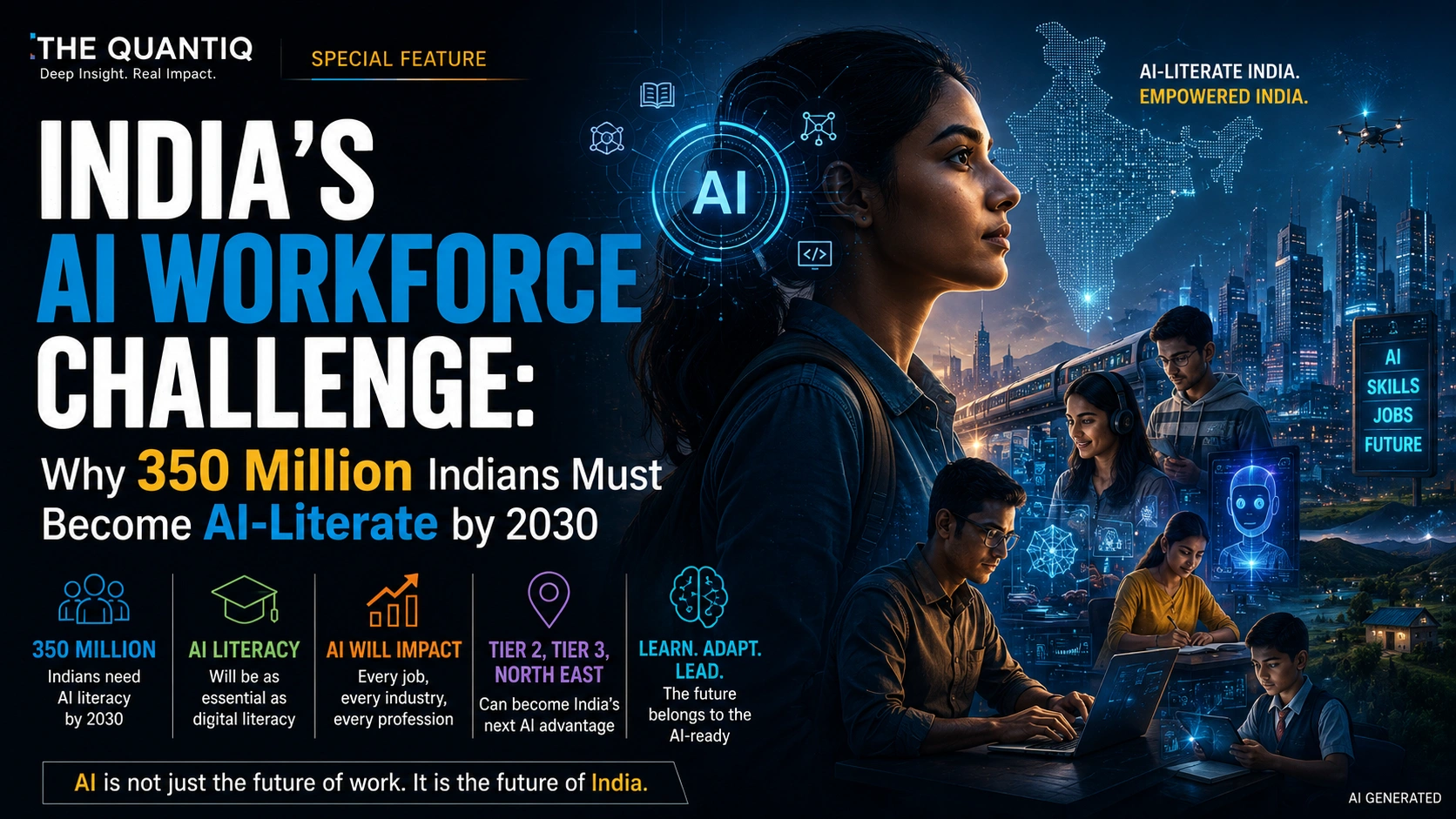
According to a recent report by IBM India, India may need nearly 350 million AI-literate workers by 2030 in order to remain competitive in the global economy.
The scale of that challenge is staggering.
India’s AI literacy rate currently stands at around 30 percent. The report suggests this may need to rise to nearly 57 percent within the next few years if the country hopes to keep pace with the rapidly changing technological landscape.
This is no longer a niche conversation restricted to the technology sector. Artificial intelligence is beginning to influence banking, healthcare, education, agriculture, logistics, journalism, retail, government services and creative industries simultaneously.
The AI revolution is not arriving quietly. It is beginning to reshape the foundation of work itself.
The Future of Work Is Changing Faster Than Many Realise
One of the biggest misconceptions surrounding artificial intelligence is that it only affects software engineers or technology companies.
In reality, AI is steadily entering professions that once appeared far removed from automation.
Doctors are beginning to use AI-assisted diagnostics. Lawyers are experimenting with AI research tools. Journalists are using AI for transcription, summarisation and workflow support. Teachers are exploring personalised learning systems. Small businesses are integrating AI chatbots, analytics tools and automated marketing platforms.
Even individuals who never considered themselves “tech professionals” may soon find AI tools becoming part of their everyday work environment.
This is precisely why AI literacy matters.
The challenge is not simply about learning to code. It is about understanding how artificial intelligence works, where it can help, where caution is needed and how humans can collaborate productively with intelligent systems.
The future workforce may increasingly reward people who know how to work alongside AI rather than compete directly against it.
India’s Workforce Transition Could Become Historic
India possesses one of the world’s largest workforces, estimated at nearly 600 million people. Even a modest technological shift affecting such a massive population carries enormous economic and social implications.
What makes this moment particularly significant is the speed at which AI capabilities are evolving.
Unlike earlier technological transitions that unfolded gradually over decades, artificial intelligence is advancing at extraordinary pace. Tools capable of generating text, images, software code, business analysis and customer support responses are already becoming mainstream.
This rapid evolution is forcing governments, educational institutions and businesses to rethink how skills are developed.
The report highlights another important indicator of India’s growing AI capability. India has already emerged as the world’s second-largest contributor to global AI-related GitHub projects. That signals not only technical participation, but also a rapidly expanding ecosystem of developers, researchers and AI enthusiasts.
Even more encouraging is India’s growing role in inclusive AI adoption. The report notes that Indian women are among global leaders in AI skill adoption trends.
These developments suggest that India possesses the human potential required to participate meaningfully in the AI economy. But potential alone will not guarantee success.
The next challenge is scale.https://thequantiq.com/ai-is-rewriting-the-startup-playbook-and-why-indias-next-wave-of-founders-may-choose-revenue-over-venture-capital/
AI Literacy Is No Longer Only About Technology
Perhaps the most important shift happening globally is the widening definition of AI skills themselves.
In the early stages of the AI boom, discussions focused heavily on coding, machine learning models and technical engineering expertise. While those remain critically important, organisations are increasingly recognising that the future AI economy also requires strategic thinking, ethics, communication, creativity and problem-solving abilities.
Artificial intelligence is becoming deeply intertwined with human behaviour and decision-making. That means future workers may need to combine technical familiarity with critical thinking and adaptability.
This could fundamentally reshape education systems.
Schools and colleges may eventually need to move beyond rote learning and examination-oriented structures toward interdisciplinary thinking, creativity and practical problem-solving. Memorisation alone may hold diminishing value in a world where AI systems can retrieve information instantly.
Curiosity, judgment and adaptability may become the defining skills of the AI age.
The Rise of AI India Beyond Metro Cities
One of the most promising aspects of India’s AI transition is that it may not remain confined to Bengaluru, Hyderabad, Delhi or Mumbai.
AI tools are gradually becoming cheaper, more accessible and cloud-based. This creates opportunities for smaller cities and emerging entrepreneurial regions to participate in the digital economy in ways that were previously difficult.
Government initiatives such as IndiaAI FutureSkills and language technology platforms like BHASHINI could play an important role in democratising access to AI learning and regional language participation.
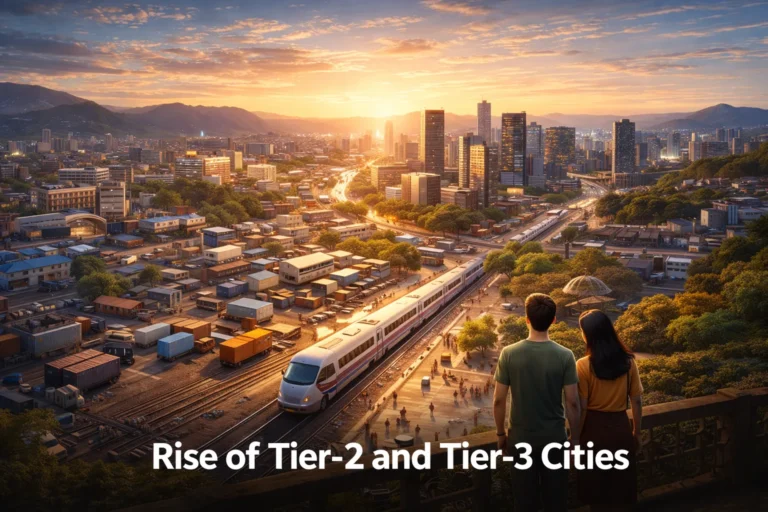
This matters because India’s next wave of economic growth may increasingly emerge from Tier-2 and Tier-3 towns where young populations are eager for new opportunities but often lack access to traditional industrial ecosystems.
Artificial intelligence could lower some of those barriers.
A student from a small town with internet access and AI literacy may now acquire skills, build products, create digital businesses or work remotely for global companies in ways that were almost unimaginable just a decade ago.
The geography of opportunity itself may begin to change.
Why the AI Revolution Could Become a Turning Point for North East India’s Youth
For North East India, this transformation could carry particularly deep significance.
The region has long faced challenges related to industrial development, connectivity and employment migration. Large numbers of young people often leave their home states in search of educational and professional opportunities elsewhere.
But the AI economy may create new possibilities that depend less on physical industrial infrastructure and more on digital capability.
Remote work, AI-enabled entrepreneurship, content creation, digital services and multilingual technology ecosystems could allow many young people in the region to participate in emerging economic opportunities without necessarily leaving their communities permanently.
The North East’s cultural diversity and linguistic richness may also become advantages in an AI-driven world increasingly interested in localisation and regional content ecosystems.
For entrepreneurs, educators and creators in the region, AI may not simply represent another technology trend. It may represent access.
Access to knowledge.
Access to markets.
Access to global audiences.
And perhaps most importantly, access to new forms of economic participation.https://thequantiq.com/the-72-hour-rule-northeast-india-tourism/
India’s AI Future Will Depend on How Fast It Learns
The AI revolution is no longer a distant possibility waiting somewhere in the future. It is already reshaping industries, workplaces and economies in real time.
For India, the next decade may become one of the most important learning transitions in modern history.
The country’s success may ultimately depend not only on how much AI technology it builds, but on how effectively it prepares ordinary citizens to live and work alongside intelligent systems.
Because in the AI age, literacy itself is being redefined.https://thequantiq.com/india-500-billion-ai-future/


One Comment