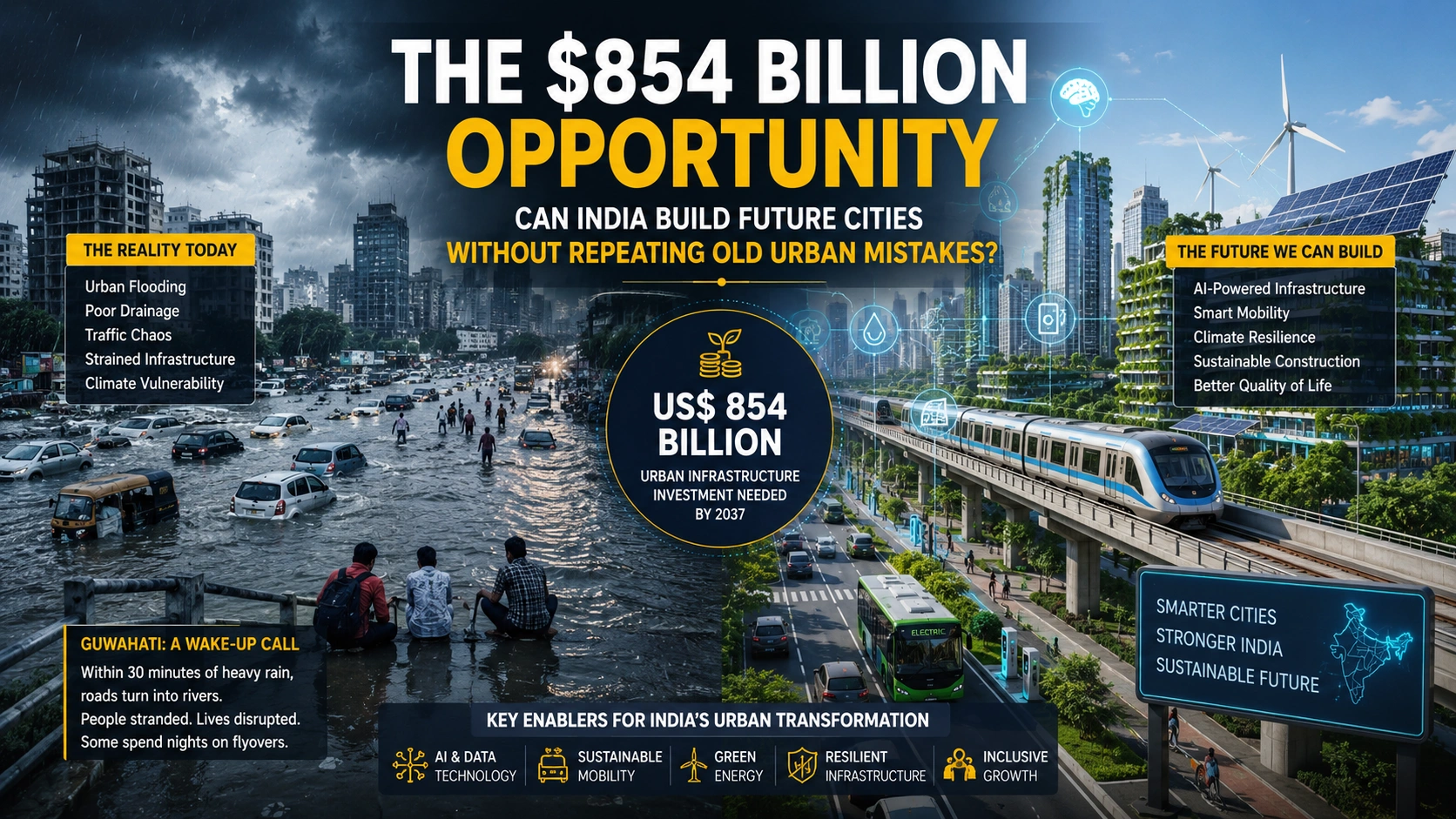
The $854 Billion Opportunity: Can India Build Future Cities Without Repeating Old Urban Mistakes?
India is urbanising at a pace few nations in modern history have experienced.
Every day, thousands continue moving toward cities in search of opportunity, education, healthcare, employment, connectivity, and economic mobility. Metropolitan regions are expanding beyond their historical boundaries. Highways are transforming into urban corridors. Smaller towns are evolving into emerging economic clusters.
But beneath the visible growth lies an uncomfortable truth.
India’s cities are struggling to keep pace with India’s ambitions.
According to recent infrastructure estimates, India may require nearly US$ 854 billion in urban infrastructure investment by 2037 to support its rapidly growing urban population and economic transformation. The scale of the figure is staggering. Yet the bigger story lies not merely in the number itself, but in what it represents.
This is not simply an infrastructure challenge.
It may become one of the largest economic, technological, sustainability, and entrepreneurial opportunities India has seen in decades.
For years, India’s startup ecosystem revolved largely around apps, fintech, food delivery, e-commerce, and digital consumer platforms. While those sectors transformed parts of the economy, the next wave of long-term wealth creation may emerge from something far more foundational — the reinvention of Indian cities themselves.
Because the reality is becoming increasingly difficult to ignore.
India cannot aspire to become a US$ 10 trillion economy while simultaneously battling collapsing drainage systems, urban flooding, severe traffic congestion, water shortages, unmanaged waste, overheating cities, and fragile public infrastructure.
The future of the Indian economy will increasingly depend on the future of Indian cities.
And that future will require enormous capital, technological innovation, climate resilience, and administrative transformation.
India’s urban population is projected to cross 600 million within the next decade. By the mid-2030s, nearly 40% of the country’s population may live in urban areas. This means millions of additional homes, roads, transit systems, schools, hospitals, water networks, digital infrastructure systems, and public spaces will need to be developed at extraordinary speed.
But unlike the industrial growth models of the past century, India no longer has the luxury of building cities without accounting for climate change.
The climate crisis has fundamentally altered the urban equation.
Cities like Bengaluru, Chennai, Mumbai, Delhi, Hyderabad, and Gurugram have repeatedly experienced severe flooding, water stress, heatwaves, pollution crises, and infrastructure vulnerabilities in recent years. In several cases, urban expansion itself has intensified the crisis through unchecked construction, shrinking wetlands, disappearing green spaces, and poorly planned drainage systems.
Ironically, even some of India’s celebrated “smart city” narratives have exposed these contradictions.
One of the most discussed examples emerged from Bengaluru — often projected globally as India’s technology capital and one of the country’s flagship smart-city success stories. Despite its reputation as an innovation hub, the city has repeatedly faced crippling floods, severe traffic paralysis, water scarcity, and infrastructure breakdowns following heavy rainfall.
Images of luxury tech parks submerged in water, employees using tractors to reach offices, and flooded residential neighbourhoods circulated globally, raising uncomfortable questions about the meaning of urban intelligence in the absence of basic resilience.
But Bengaluru is not alone.
Far away in Northeast India, Guwahati tells a similarly troubling story.
Every monsoon season, and sometimes even after a short but intense downpour, large parts of Guwahati begin sinking under water within minutes. Roads turn into streams. Vehicles remain stranded for hours. Commuters abandon cars and wade through knee-deep water trying to reach home. In some instances, residents have reportedly spent entire nights on flyovers because floodwaters made movement impossible.
For a city projected as the gateway to Northeast India and an emerging urban centre with enormous strategic importance, the scenes are deeply unsettling.
The problem is no longer merely about rainfall.
It is about decades of unplanned urbanisation, shrinking wetlands, hill cutting, encroachment on natural drainage channels, exploding vehicle density, and infrastructure systems struggling to cope with rapid population growth.
What makes the crisis even more alarming is that such urban paralysis is slowly becoming normalised across Indian cities.
The lesson is difficult but important.
Technology alone does not create a smart city.
A truly intelligent city must also be resilient, environmentally sustainable, administratively efficient, and capable of protecting everyday life during moments of stress.
This is where India’s urban opportunity becomes far more interesting.
The future Indian city could become one of the world’s largest laboratories for integrated urban innovation.
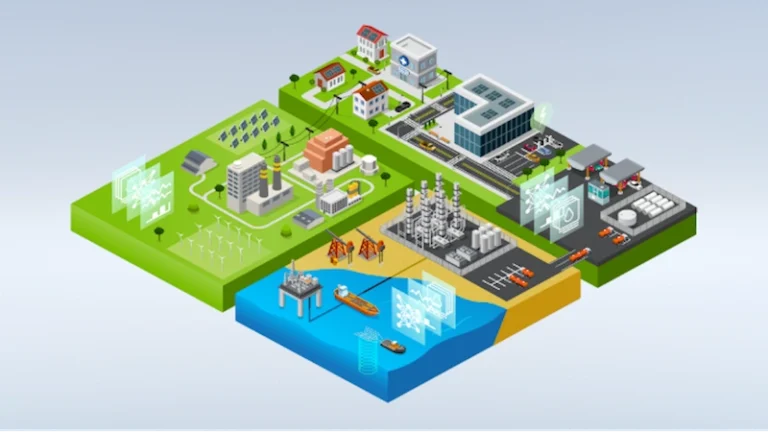
Artificial intelligence is already beginning to reshape how cities are managed globally. AI-powered traffic systems, predictive flood monitoring, intelligent electricity distribution, smart surveillance systems, digital twins, automated waste management, energy optimisation systems, and data-driven urban planning are rapidly becoming central to modern infrastructure ecosystems.
Several Indian cities have already started experimenting with elements of this transition.
Cities such as Surat, Pune, Hyderabad, and Indore have implemented varying forms of smart traffic management, integrated command centres, surveillance-based urban monitoring, and digital governance systems. Metro rail expansion across multiple Indian cities is also gradually reshaping urban mobility patterns.
India’s electric vehicle ecosystem is simultaneously gaining momentum. According to industry estimates, India’s EV market could become one of the world’s largest over the next decade, creating enormous demand for charging infrastructure, battery systems, smart grids, and sustainable mobility networks.
This creates opportunities far beyond traditional construction.
The urban transformation story increasingly intersects with artificial intelligence, climate-tech, renewable energy, sustainable materials, mobility innovation, water technology, waste management, and digital infrastructure.
A founder building a climate-resilient infrastructure startup today may ultimately contribute more to India’s long-term future than another consumer app company chasing short-term valuations.
Companies working in water purification, smart mobility, sustainable housing, recycling systems, modular infrastructure, urban farming, EV charging networks, and low-carbon construction technologies may emerge among the defining enterprises of the coming decade.
The transition also opens opportunities for regions often overlooked in mainstream infrastructure conversations.
Northeast India, for instance, possesses enormous potential in bamboo-based construction systems, sustainable materials, eco-tourism infrastructure, natural fibre ecosystems, and climate-sensitive design models. As global interest grows around low-carbon urban development and circular economy systems, sustainable materials may become increasingly valuable in future construction ecosystems.
Urbanisation is therefore no longer merely about building larger cities.
It is about reimagining how India houses, transports, powers, governs, and sustains human life at scale.
Financing this transformation, however, remains one of India’s biggest structural challenges.
Urban infrastructure requires massive long-term investment, stable policy frameworks, institutional coordination, efficient municipal systems, and governance continuity. Historically, many Indian cities have struggled with weak municipal finances, fragmented planning systems, delayed execution, and inconsistent urban governance.https://thequantiq.com/renewable-energy-india-economic-gatekeeper/
The proposed Urban Challenge Fund and growing focus on market-based financing mechanisms may help improve city-level investment capacity and attract institutional capital. Foreign investors, sovereign wealth funds, pension funds, and infrastructure-focused global investors are already viewing India as one of the world’s largest long-term urban growth markets.
From metro rail systems and airports to logistics corridors and renewable energy infrastructure, global capital is steadily flowing into India’s urban transformation story.
But the deeper question remains unresolved.
What kind of cities does India ultimately want to build?
If urban growth becomes dominated entirely by speculative real estate, ecological destruction, and infrastructure inequality, India may achieve expansion without achieving livability.
But if the country succeeds in integrating sustainability, technology, public infrastructure, climate resilience, and inclusive planning into its urban future, India could create one of the most important developmental transformations of the 21st century.
This is why the US$ 854 billion figure matters so profoundly.
It is not merely an estimate of future spending.
It is a signal that India is entering a historic phase where cities themselves may become the engines of industrial growth, AI integration, green entrepreneurship, climate innovation, and long-term economic transformation.
The business story of the next decade may not be hidden inside smartphone screens alone.
It may be unfolding instead through the roads, energy systems, transit networks, sustainable infrastructure, and future-ready cities of a rapidly urbanising nation trying to build its future in real time.https://thequantiq.com/india-export-growth-2026-manufacturing-economy/