
Vi’s Second Act: Can Shah Rukh Khan Turn a Telecom Comeback into Consumer Belief?
Brand & Media Intelligence
Vi has a refreshed identity, Shah Rukh Khan as its new brand face and a new campaign built around the idea that every customer is a VIP. But can a brand reset turn the telecom operator’s early business recovery into something much harder to build: consumer belief?
There is something almost cinematic about Shah Rukh Khan becoming the face of Vi at this particular moment.
The superstar has spent decades selling aspiration, emotion and possibility to India. Now he is helping a telecom company sell something rather different: the belief that Vi itself is changing.
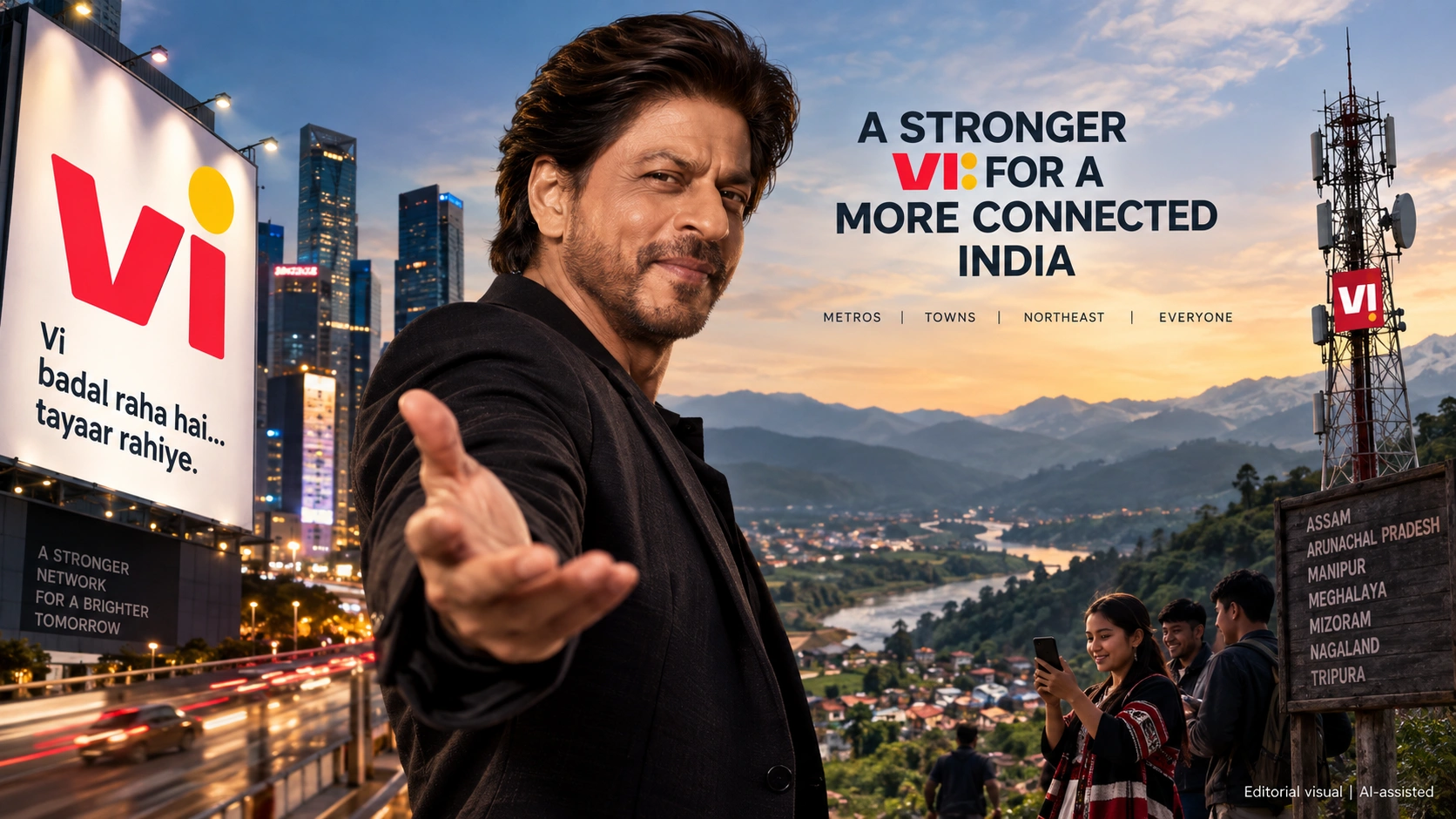
On September 1, Vi unveiled a refreshed visual identity, giving its familiar yellow element a fuller, more dynamic form and placing it above the “i”. Alongside the new identity came Khan and the message, “Vi badal raha hai… tayaar rahiye” — Vi is changing, get ready.
The story has now moved into its next chapter. On September 10, Vi launched “Vi Pe Sab Hai VIP”, a campaign in which Khan assumes that the operator’s latest upgrades and benefits have been introduced especially for him, only to discover that they are actually available to everyone on Vi.
It is an amusing advertising idea. But beneath the humour sits a much more serious brand question:
Can Vi persuade consumers that the company they remember is becoming a different company?
That is considerably harder than changing a logo.
Vi does not have an awareness problem
Vi was itself born from a transformation.
In 2020, Vodafone India and Idea Cellular came together under the single Vi identity. Six years later, the brand is effectively asking consumers to update that mental picture once again.
But this time the context is different.
Vi has spent years dealing with subscriber losses, financial pressure and intense competition from Reliance Jio and Bharti Airtel. Its challenge today is therefore not to make people recognise the name.
They already do.
The challenge is to make them reconsider what the name means.
That is why “Vi badal raha hai” is important. Vi is not saying everything has already changed. It is asking consumers to notice that change is underway.
And unlike a purely cosmetic rebrand, there is now some movement in the business behind the message.
The business is beginning to give the brand something to talk about
The latest TRAI subscription data shows that Vi’s subscriber trajectory has begun to improve after years of decline. The company added about 2.4 lakh mobile subscribers in July 2026, according to reporting based on the regulator’s data.
Vi has also been investing heavily in network expansion and 5G as part of its broader turnaround.
That matters because a telecom company cannot advertise its way into having a better network.
It can, however, use advertising to tell customers that improvements are happening and give them a reason to look again.
Vi’s current strategy therefore sits at an interesting point between promise and proof.
The turnaround is not complete. The company continues to face substantial financial pressures and remains behind its two larger private-sector competitors.
But there is enough movement for Vi to make a credible case that something is changing.
Now it has to make customers believe that the change matters to them.
Why Shah Rukh Khan?
The obvious answer is attention.
Khan is one of India’s most recognisable personalities, capable of crossing generations, regions and media platforms. But attention alone is not really what Vi needs.
It needs reconsideration.
That makes his role more interesting than a conventional celebrity endorsement.
A new brand can use a famous face to create awareness. Vi is using a famous face to help change an existing memory.
Millions of Indians already know Vodafone, Idea and Vi. Many also carry memories of the years when Vi struggled to compete.
Khan therefore has to do more than attract eyeballs.
He has to help make “Vi” feel contemporary again.
That is a much bigger assignment.
From the Vodafone pug to SRK
Vi also inherits one of the richest advertising histories in Indian telecom.
Vodafone had the pug. Then came the ZooZoos. Idea had its own distinctive advertising universe, including the famous “What an Idea!” platform.
Those campaigns achieved something rare: they became part of popular culture and, consequently, part of the brands themselves.
Shah Rukh Khan is different. The pug belonged to Vodafone. The ZooZoos belonged to Vodafone.
Shah Rukh Khan belongs to Shah Rukh Khan.
That creates an intriguing question for Vi.
Can it borrow Khan’s cultural power without allowing the celebrity to become bigger than the brand?
If consumers remember only “SRK is on Vi”, the campaign has generated attention.
If they begin remembering “Vi is getting better”, the campaign has created meaning.
That is the difference between celebrity advertising and brand building.
The Northeast makes the story more interesting
There is another dimension to Vi’s second act that deserves attention beyond India’s metros.
Assam and the North East are a dedicated operating market for Vi, and the company has been actively investing there. During 2025, Vi says it added more than 890 new network sites across the Assam and North East circles, expanding coverage to 19 additional towns. It also reported a 65% rise in data consumption across the two circles.
Vi says that growth has been supported by network enhancement and growing adoption of its unlimited-data propositions. It also positions itself as the only telecom operator offering unlimited 4G data plans in the Assam and North East circles, making the proposition particularly relevant in a region where 4G expansion remains central to its network strategy.
These are company-reported figures, and they should be read as such. But they point to an important truth about telecom branding.
A brand promise may be created in a Mumbai boardroom or launched through a national television campaign.
Its credibility is built market by market.
For a Vi customer in Guwahati, Jorhat, Shillong, Dimapur or Agartala, “Vi is changing” ultimately means something very concrete: Does the network work better where I live, travel, study or work? Can I actually do more with my phone?
That makes the Northeast more than a regional footnote in Vi’s comeback.
It is part of the test.
“Vi Pe Sab Hai VIP” is a clever second move
The new campaign takes Khan’s larger-than-life persona and turns it into the joke.
He assumes that Vi’s upgrades and benefits are being introduced especially for him. Then comes the reveal: there is no special SRK treatment. Everyone gets the benefits.
That gives the campaign a natural progression from “Vi badal raha hai”.
The first message says:
Something is changing.
The second says:
That change is for you too.
It is a smart way of turning a transformation story into a consumer proposition.
But there is still a considerable distance between communicating a better experience and actually delivering one.
The real test begins when the advertising stops
This is where Vi’s second act will ultimately be judged.
Not by how many people remember Shah Rukh Khan. Not by how many times the new logo appears. And not even by how much conversation the campaign generates.
The harder questions will emerge over the coming months.
Will subscriber additions continue? Will customers notice better network performance? Will 5G expansion strengthen Vi’s competitive position? Will existing customers have fewer reasons to leave?
And can the company turn improving operating indicators into sustainable financial performance?
The relationship between brand and business is ultimately quite simple:
Advertising creates expectation. The product creates experience. Experience creates belief.
Vi has created the expectation. Its network, customer experience and business performance now have to provide the proof.
Vi’s second act has begun
There is an appealing symbolism in the refreshed Vi identity. Its yellow element has moved upwards, representing, in the company’s own interpretation, optimism, progress and a new direction.
It is a neat metaphor for the company itself.
After years of fighting simply to remain relevant, Vi wants to be seen as a brand moving forward again. That makes this more than a story about a new telecom logo or another celebrity endorsement.
It is a story about what happens when a company’s brand begins catching up with a business that is trying to recover.
Shah Rukh Khan can make India look at Vi. The new identity can make people notice that something has changed.
But whether consumers believe the change is real will be decided somewhere much less glamorous than an advertising set — on the network, on the phone screen and in the everyday experience of millions of customers, from India’s biggest cities to its Northeast towns.
Vi has announced its second act.
Now it has to make India believe it.




One Comment