
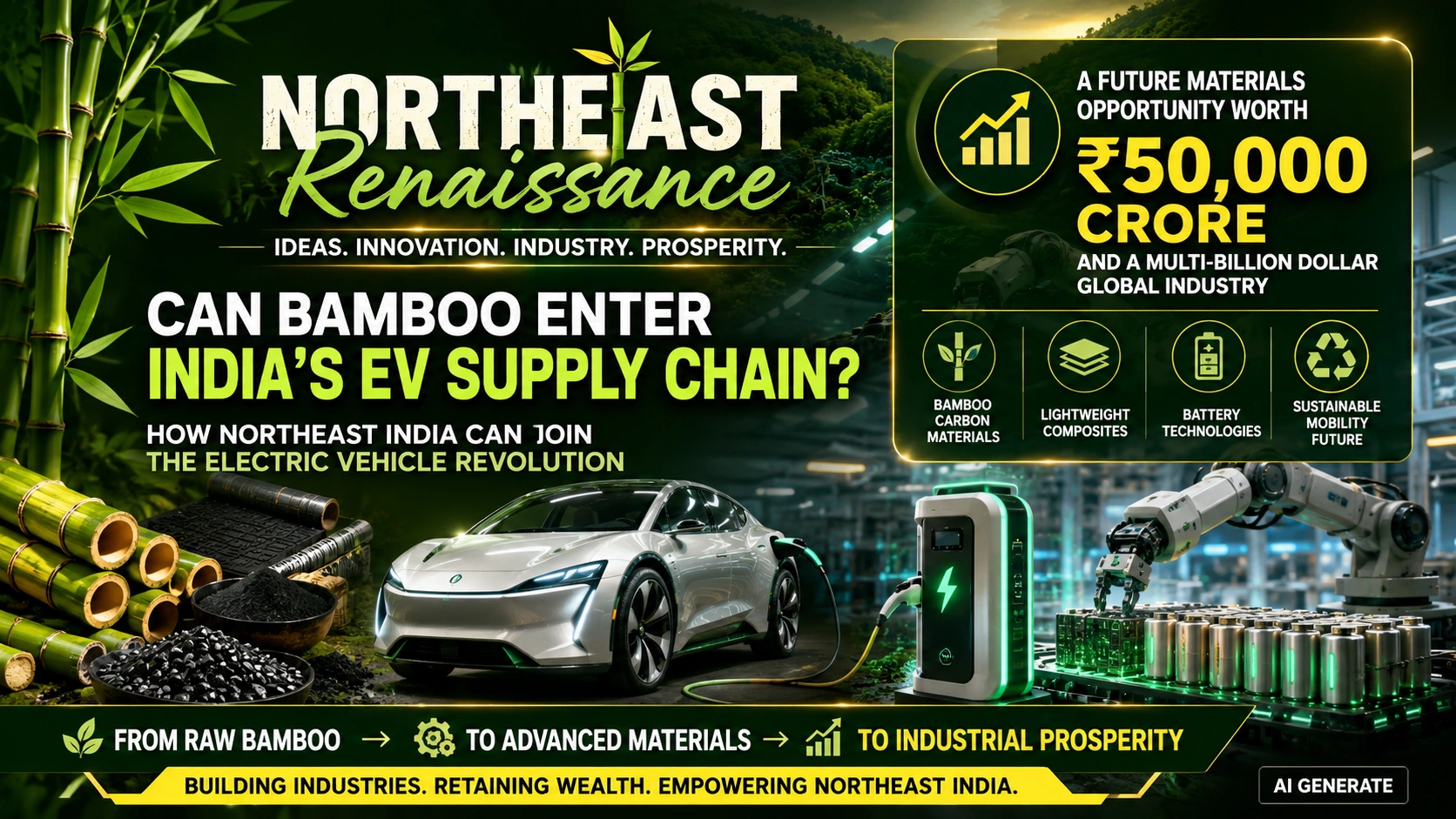
Can Bamboo Enter India’s EV Supply Chain?
The Northeast Renaissance Series
Ideas for a ₹50,000 Crore Future Materials Opportunity and a Multi-Billion Dollar Global Industry
The EV Revolution Is No Longer About Cars Alone
India’s electric vehicle revolution has begun.
Across the world, governments are pushing aggressively toward electric mobility as countries attempt to reduce fossil fuel dependence, lower carbon emissions and build cleaner transportation systems for the future.
India is moving rapidly in the same direction.
Industry estimates suggest that India’s electric vehicle market could cross US$ 150 billion by 2030, driven by rising fuel prices, government incentives, expanding charging infrastructure and increasing consumer adoption across two-wheelers, passenger vehicles, buses and commercial fleets.
Factories are being built. Battery plants are being announced. Global investors are entering the market. Billions of dollars are flowing into the sector.
Yet amid this massive industrial transformation, Northeast India remains largely absent from the conversation.
This raises an important question. Can Northeast India participate meaningfully in the EV revolution? More specifically, can bamboo become part of India’s future EV supply chain?
The question deserves serious attention.
Because the future EV economy will not reward only companies that manufacture electric vehicles. It will reward industries that control the advanced materials powering those vehicles. And surprisingly, bamboo may have a role to play.
Understanding the EV Supply Chain
Most people think electric vehicles are simply cars powered by batteries.
The reality is far more complex. An electric vehicle is supported by a vast industrial ecosystem involving multiple interconnected supply chains. At the centre lies battery manufacturing.
However, batteries themselves depend upon an extensive network of supporting industries.
The broader EV supply chain includes:
• Lithium, graphite, nickel and cobalt processing
• Battery-grade carbon materials
• Thermal management systems for battery cooling
• Lightweight structural materials for improving efficiency
• Carbon-based conductive materials
• Battery separators and filtration systems
• Composite materials used in automotive interiors
• Charging infrastructure components
• Battery recycling and circular economy systems
This distinction is important. The EV revolution is not merely creating automobile companies. It is creating entirely new advanced materials industries. This is where bamboo enters the conversation.
Why Bamboo Must No Longer Be Seen as a Primitive Material
Across much of Northeast India, bamboo continues to suffer from an outdated perception problem.
For decades, bamboo has largely been associated with furniture, handicrafts, temporary construction structures, baskets and low-value commodity applications.
This mindset is increasingly dangerous. Modern material science sees bamboo very differently. Bamboo is not simply a biological resource. It is a sophisticated industrial feedstock.
Through advanced processing technologies, bamboo can potentially support industries involving:
• Activated carbon production
• Carbon nanostructures
• Lightweight engineered composites
• Structural bio-composites
• Carbon-based filtration materials
• Sustainable polymer reinforcement systems
• Advanced carbon materials for future energy applications
The bamboo forests many still view as low-value resources may quietly hold the foundation for future high-tech industries.https://thequantiq.com/bamboo-activated-carbon-northeast-india/
Where Bamboo Can Potentially Enter the EV Ecosystem
This is where the story becomes particularly interesting.
1. Battery-Grade Carbon Materials
Battery systems require highly specialised carbon materials.
Researchers globally are increasingly studying biomass-derived activated carbon for use in supercapacitors, battery electrodes and future energy storage systems.
Bamboo possesses exceptionally high carbon content, making it an attractive renewable feedstock.
2. Lightweight Composite Materials
Weight reduction remains one of the biggest engineering challenges in electric vehicles.
The lighter the vehicle, the greater the battery efficiency and driving range.
Automotive companies increasingly seek lightweight composite materials capable of replacing heavier traditional materials.
Engineered bamboo composites may eventually find applications in automotive panels, lightweight structural components and sustainable interior materials.
3. Thermal Management Systems
Battery systems generate heat.
Thermal regulation remains one of the most critical engineering challenges in EV design.
Advanced porous carbon materials derived from bamboo may potentially support future heat management systems.
4. Filtration and Industrial Processing Systems
Battery manufacturing itself requires sophisticated filtration systems during chemical processing and controlled industrial production.
High-grade bamboo carbon filtration materials may potentially support such industrial applications.
5. Sustainable Automotive Interiors
Future consumers increasingly demand environmentally responsible products.
Natural fibre composites derived from bamboo may increasingly find applications in sustainable automotive interiors.
The opportunity is far bigger than most people realise.
A Market Worth Tens of Thousands of Crores
The EV revolution is far more than an automobile story. It is an advanced industrial materials story.
Opportunity Snapshot
| Indicator | Indicative Estimate |
| Indian EV Market by 2030 | ₹12–15 Lakh Crores |
| Global EV Industry | Multi-Trillion US$ Transition |
| Advanced Battery Materials Market | ₹50,000–80,000 Crores Potential (India) |
| EV Supply Chain Industries | Rapidly Expanding |
| Potential Bamboo-Derived Carbon Materials Opportunity | Emerging Future Industry |
| R&D and Innovation Scope | Extremely High |
These estimates are indicative and based on sectoral benchmarks. Actual commercial outcomes may vary depending on technology development, process innovation, regulatory evolution, scale, and future industrial demand.
The opportunity extends far beyond manufacturing electric vehicles themselves. The future wealth will increasingly flow toward advanced materials suppliers.
Assam Has Seen This Story Before
Northeast India should remember an uncomfortable chapter from its own industrial history.
For decades, Assam’s vast bamboo reserves supported two major industrial assets.
The paper mill at Jagiroad.
The paper mill at Panchgram.
These industries ensured that bamboo harvested within Assam was processed within Assam itself.
Local employment was created.
Transport ecosystems developed.
Contractors benefited.
Industrial wealth remained within the region.
Then both mills shut down.
The equation changed dramatically.
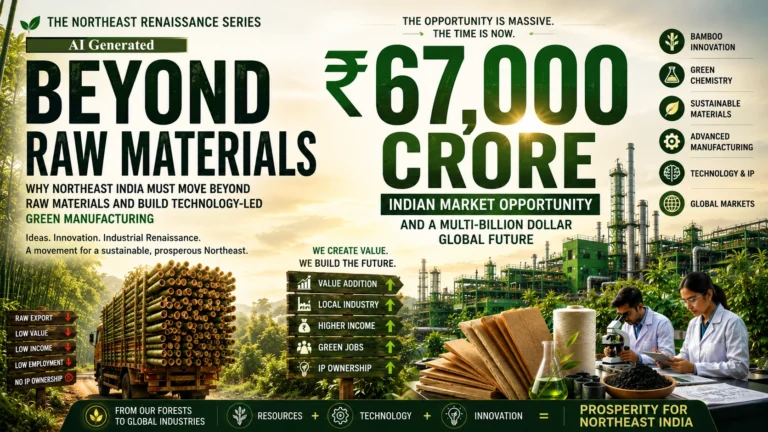
Today, large quantities of raw bamboo continue leaving Assam every single day.
Industry observers frequently note that truckloads of raw bamboo poles continue moving out of Assam every night toward paper mills and industrial facilities located elsewhere in India.
The bamboo still leaves.
The resource still exists.
But the industrial value addition no longer happens here.
Employment is created elsewhere.
Processing happens elsewhere.
Profits remain elsewhere.
The region once again remains what it has often been for decades.
A supplier of raw materials financing prosperity somewhere else.
The EV revolution now presents another opportunity.
The question is whether Northeast India has learned anything from the paper mill story.https://thequantiq.com/how-bamboo-fiber-is-made-northeast-sustainable-textile-future/
Why Process Intelligence Is the Real Moat
This may be the most important lesson in the entire article.
Many entrepreneurs assume industrial success comes from owning machinery.
That assumption is increasingly dangerous.
Machines can be purchased.
Competitors can buy similar machines.
Technology spreads quickly.
However, process intelligence is far harder to replicate.
The real advantage lies in understanding carbon activation parameters, advanced material chemistry, composite engineering, thermal behaviour, product specifications and customer requirements.
The machine is not the moat.
The process is.
This principle will define the future of manufacturing itself.
The AI Era and Future Manufacturing
Artificial intelligence is beginning to transform industrial development globally.
Engineers now use simulation software, digital twins, predictive analytics and AI-assisted optimisation to accelerate materials research faster than ever before.
This changes the equation dramatically.
In the coming decade, artificial intelligence may fundamentally reduce dependence on traditional employment structures.
The old idea of permanent jobs is quietly eroding.
Regions that fail to build future manufacturing ecosystems may soon confront an uncomfortable reality.
Technology will accelerate.
Job creation may slow.
Traditional economic models may weaken.
The future increasingly belongs to builders.
Not job seekers.
Northeast India must prepare accordingly.
From Raw Bamboo to Industrial Intelligence
Every night, trucks loaded with raw bamboo leave parts of Northeast India.
Few people stop to ask what happens next.
Some of that bamboo eventually becomes products worth many times the value originally received by the grower.
This has been happening for decades.
The EV revolution presents a chance to change that pattern.
The greatest value does not lie in harvesting bamboo.
It lies in transforming bamboo through science, engineering and process innovation.
This is where industrial prosperity is created.
The Quantiq Assessment
The electric vehicle revolution demonstrates why Northeast India must urgently rethink its economic future.
The opportunity is not simply to grow bamboo.
The opportunity is to transform bamboo into advanced industrial materials capable of serving future industries involving battery systems, sustainable composites, energy storage technologies, filtration systems and next-generation mobility infrastructure.
Assam has already witnessed what happens when local industries disappear while raw materials continue flowing outward.
Its bamboo once powered industries within the state.
Today, the bamboo still leaves.
But the industrial wealth remains elsewhere.
This pattern must eventually end.
In the age of artificial intelligence, regions that depend solely on natural resources will struggle to capture maximum value.
Regions that master process intelligence, however, will build durable competitive advantages.
Northeast India already possesses the resource base.
The next challenge is building the knowledge base.
Because ultimately, prosperity will not be determined by how much bamboo the region grows.
It will be determined by how much intelligence the region embeds into that bamboo before it reaches the market.https://thequantiq.com/bamboo-biochar-carbon-economy-northeast-india/

2 Comments