
Bamboo Biochar and the Carbon Economy: How Northeast India Can Turn Biomass into Climate Infrastructure
The Northeast Renaissance Series
Ideas for a ₹67,000 Crore Indian Market and a Multi-Billion Dollar Global Future
From Waste to Climate Capital
For generations, biomass has been treated as a fuel, a residue, or an agricultural input of limited economic significance. Across villages and farming landscapes of Northeast India, bamboo leaves, branches, culm residues, and agro-waste have been burned, discarded, or left to decompose without attracting serious industrial attention. Smoke rising from biomass has rarely symbolised innovation — it has usually signified disposal.
However, the world is changing in ways that make this traditional relationship with biomass economically obsolete. The climate crisis, carbon markets, regenerative agriculture, and sustainable materials are reshaping how humanity looks at biological resources. What was once considered waste is increasingly being reconsidered as industrial feedstock. Moreover, carbon itself — once discussed mainly as pollution — is now emerging as a strategic economic asset commanding real commercial prices in a rapidly expanding global market.
Inside this changing global landscape lies one of the most intriguing opportunities for Northeast India: bamboo biochar. The term may sound technical at first hearing, and many dismiss it as merely refined charcoal or another agricultural amendment. Such assumptions, however, overlook the scale of transformation taking place around carbon systems worldwide. Biochar is not simply charcoal. It is carbon infrastructure — and bamboo may become one of its most powerful feedstocks.
Why Northeast India Has a Structural Advantage
The conversation around biochar becomes especially relevant for Northeast India.
The reason is simple.
Few regions possess the combination of bamboo abundance, ecological urgency, agricultural demand, and industrial potential that exists across the Northeast.
The region possesses vast bamboo resources. At the same time, policymakers, entrepreneurs, and communities are searching for industries that can generate economic value without undermining environmental sustainability.
Agricultural productivity also requires improvement across many landscapes.
Consequently, several powerful forces are converging simultaneously.
Yet much of this bamboo still exits the region as raw material.
In many cases, producers burn biomass without creating value. As a result, neither significant revenue nor environmental benefit is generated.
This raises an important question.
Can Northeast India transform bamboo not merely into products, but into climate intelligence?
The economics suggest that it can. The global biochar market, valued at approximately $340 million in 2024, is projected to grow at a CAGR of 13.2% through 2030. Specifically, three converging forces drive this growth: corporate net-zero commitments requiring verifiable carbon removal, regenerative agriculture adoption across premium food supply chains, and government-mandated soil health programmes in the EU, the US, and increasingly India. The world is consequently no longer searching only for cleaner industries — it is searching for ways to remove carbon, regenerate soil, and build circular economies simultaneously. Bamboo biochar sits at the intersection of all three.
The Agricultural Crisis That Creates the Market
To understand why biochar matters commercially, it is necessary to understand the problem it solves. Modern agriculture faces an uncomfortable paradox: food production has increased dramatically, yet soil health across many regions has steadily deteriorated. Excessive chemical dependence, declining organic matter, and weakening microbial ecosystems increasingly threaten long-term agricultural resilience across India’s farming landscapes, including the Northeast’s tea gardens, paddy fields, and horticulture belts.
Simultaneously, climate change has intensified concern over atmospheric carbon accumulation, creating regulatory and market pressure on corporations to demonstrate measurable carbon removal rather than merely carbon reduction. The search for solutions has produced many ideas — some theoretical, some expensive, some struggling with scalability. Biochar, however, presents an unusually practical proposition because it improves soil, sequesters carbon, produces value from waste material, and creates a product that multiple commercial buyers pay for independently of carbon credit markets.
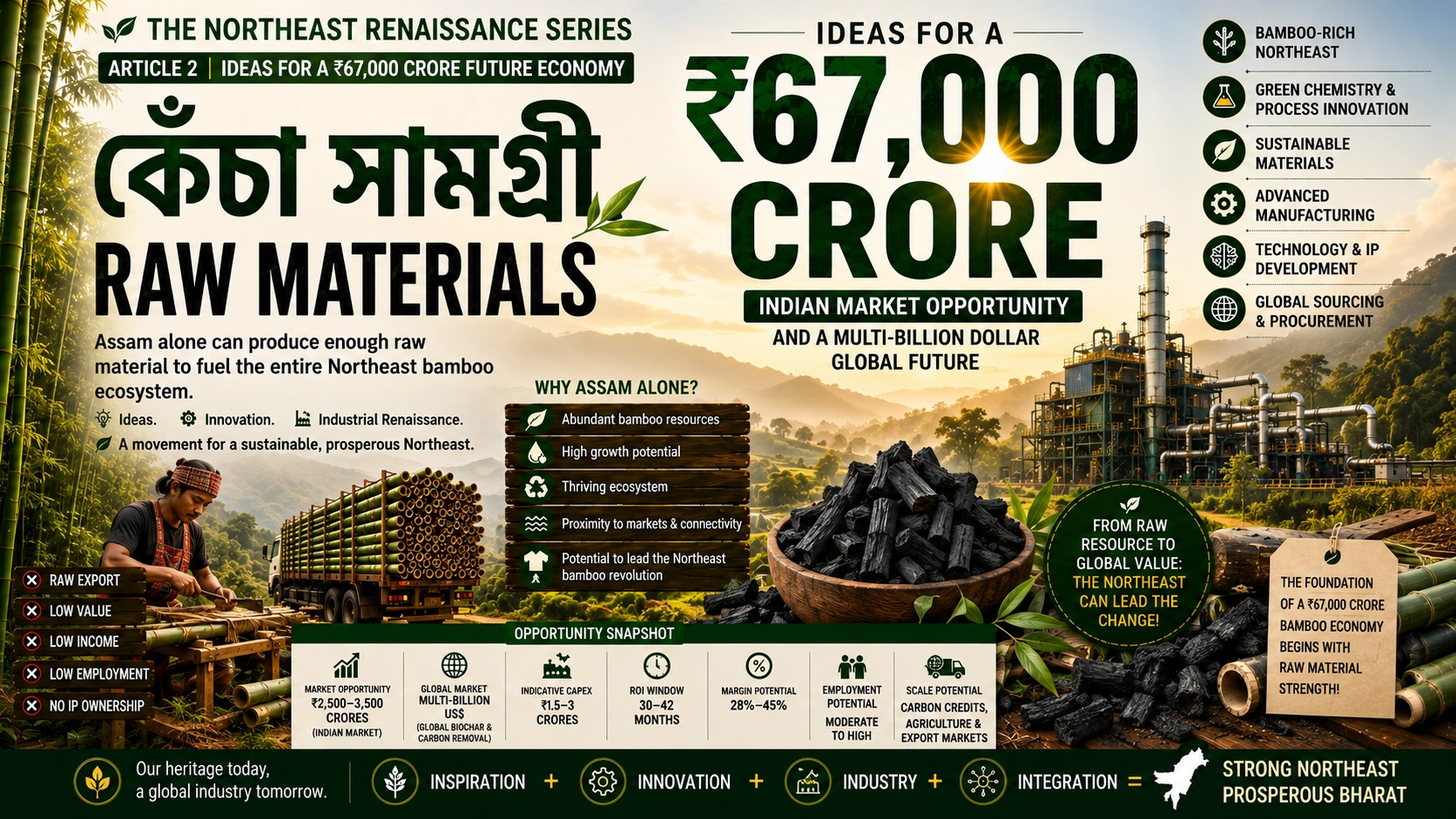
Opportunity Snapshot
| Indicator | Indicative Estimate |
| Indian Biochar & Carbon Agriculture Opportunity | ₹2,500–3,500 Crores |
| Global Biochar & Carbon Removal Market | Multi-Billion USD Economy |
| Indicative Capital Investment | ₹1.5–3 Crores |
| Estimated ROI Window | 30–42 Months |
| Potential Margin Range | 28–45% |
| Employment Potential | Moderate to High |
| Scale Potential | Carbon Credits, Agriculture & Export Markets |
Credibility Note: The financial indicators presented are directional estimates based on prevailing sectoral trends, climate-market developments, and emerging biochar industries. Commercial outcomes may vary depending on technology, feedstock quality, carbon certification systems, scale, logistics, and market access. Readers are encouraged to undertake independent technical and financial due diligence before investment decisions.
How Bamboo Biochar Is Made: The Process Intelligence That Defines the Business
The production of bamboo biochar begins with a thermal conversion process called pyrolysis — and understanding the distinction between pyrolysis and ordinary burning is the first step toward understanding why biochar carries commercial value that ordinary charcoal does not.
In open burning, most carbon escapes into the atmosphere as carbon dioxide. In controlled pyrolysis, by contrast, the process heats bamboo biomass inside oxygen-limited chambers where thermal energy transforms the material without complete combustion. This distinction is critical because it determines where the carbon goes. Substantial carbon becomes stabilised within the resulting material rather than entering the atmosphere — which is precisely what makes biochar both an agricultural product and a carbon removal instrument.https://thequantiq.com/northeast-india-green-industrialisation-bamboo-manufacturing/
Stage 1 — Feedstock Preparation.
The journey begins with bamboo biomass, which may include culm residues, branches, leaves, sawdust, processing rejects, and waste from furniture, construction, or fibre industries.
Notably, biochar does not compete with bamboo manufacturing.
Instead, it complements it.
The process converts waste streams from other bamboo industries into an additional revenue layer.
The biomass undergoes drying and moisture stabilisation before entering pyrolysis systems because excess moisture reduces efficiency and destabilises thermal behaviour.
Stage 2 — Pyrolysis
The prepared biomass enters closed-retort or oxygen-controlled reactors.
Temperatures generally range between 400 and 700 degrees Celsius.
Inside these chambers, bamboo decomposes thermally.
Volatile compounds separate.
Moisture exits.
Combustible gases emerge.
Meanwhile, carbon gradually reorganises itself into a stable porous structure.
The temperature profile determines the biochar’s properties.
Lower temperatures generally produce biochar with higher carbon content and nutrient-retention capacity.
Higher temperatures create biochar with greater surface area and improved moisture-holding characteristics.
Stage 3: Product Recovery
What finally emerges from the reactor is biochar.
Dark.
Lightweight.
Highly porous.
And surprisingly sophisticated.
This porous architecture gives biochar its remarkable agricultural properties.
Unlike ordinary charcoal, biochar possesses enormous internal surface area capable of interacting with water, nutrients, and microbial life.
Indeed, one gram of high-quality biochar can have an internal surface area exceeding 300 square metres.
This characteristic explains its ability to improve soil structure, water retention, and nutrient availability simultaneously.
Stage 4 — Co-Product Capture
During pyrolysis, the process releases vapours and gases alongside solid carbon. These can be captured and utilised rather than released into the atmosphere. Combustible gases may support internal thermal energy systems, reducing the operation’s energy cost and improving overall efficiency. Additionally, condensable vapours may produce pyroligneous acid — commonly known as bamboo vinegar — which carries documented agricultural and ecological applications as a natural pesticide and soil conditioner. What appears to be a simple kiln therefore resembles an integrated carbon refinery when properly engineered.
The Three Revenue Streams That Make This Business Viable
The commercial strength of a bamboo biochar enterprise lies in its ability to generate revenue from multiple sources.
This diversification reduces the vulnerability that often affects single-product businesses.
Revenue Stream 1: Agricultural Amendment Sales
Agricultural amendment sales remain the most immediately accessible revenue stream.
Nurseries, horticulture systems, tea gardens, organic farms, and regenerative agriculture networks increasingly seek soil-enhancement solutions aligned with sustainability commitments.
Furthermore, quality biochar can improve water retention, nutrient availability, and microbial biodiversity across a wide range of agricultural settings.
Northeast India’s tea industry alone represents a potentially significant institutional market.
Revenue Stream 2: Carbon Credit Generation
Carbon-credit generation represents the higher-margin, longer-term revenue layer.
When bamboo absorbs atmospheric carbon during growth and that carbon subsequently becomes stabilised through pyrolysis, the process creates a measurable carbon-removal event.
As a result, certified biochar projects may qualify for carbon-credit programmes.
The voluntary carbon market continues to expand as corporations pursue net-zero commitments.
Consequently, biochar can generate value not only as an agricultural product but also as a carbon asset.
Revenue Stream 3: Industrial and Specialty Applications
Industrial and specialty applications form the third revenue layer.
Biochar’s adsorption properties make it valuable in water-filtration systems.
Researchers are also exploring biochar-enhanced construction materials.
Although these markets are smaller in volume, they often deliver higher margins.
Moreover, they provide diversification independent of agricultural commodity cycles.
Why Process Intelligence Is the Real Competitive Moat
In the age of artificial intelligence, a critical distinction separates businesses that endure from businesses that get disrupted. Industries built solely around imported machinery or copied production systems are increasingly vulnerable to competition, because if the machine is the only competitive advantage, someone else can acquire a similar machine tomorrow. The real moat lies in process intelligence — thermal engineering expertise, carbon management systems, feedstock optimisation knowledge, and continuous innovation in reactor design and heat recovery.
Bamboo biochar presents precisely this opportunity for Northeast India. Accordingly, the region can move beyond importing technology and begin developing localised know-how around reactor design, heat recovery, gas utilisation, carbon stabilisation, and certification pathways. Closed-retort engineering, temperature optimisation, and carbon characterisation all present opportunities for local innovation and potentially patentable process technology. Furthermore, artificial intelligence, thermal modelling, and simulation tools increasingly make such innovation accessible to teams that could not have attempted it a decade ago.
The Northeast therefore faces a clear industrial choice. It can continue exporting biomass and importing carbon products. Or it can build the carbon intelligence infrastructure that processes its own biology into globally valued assets. The former requires no investment in knowledge. The latter, however, builds a competitive position that compounds over time and cannot be easily replicated by regions without the bamboo resource base that the Northeast possesses in abundance.
The Vision: Climate Infrastructure for the Coming Decade
The coming decades may witness a new category of economic infrastructure — not only roads and factories, but climate infrastructure. Systems designed to manage carbon, restore ecological balance, and create economic value simultaneously represent one of the defining investment themes of the 21st century. Bamboo biochar belongs to this future not as a peripheral product but as a foundational input.
Instead of treating bamboo residue as waste, Northeast India can therefore build decentralised carbon systems. Instead of burning biomass without value creation, it can manufacture soil amendments, ecological products, and carbon assets. Instead of remaining dependent on distant industrial ecosystems, it can develop localised green manufacturing rooted in renewable biology that grows back faster than any industrial crop.
The world is increasingly searching for carbon solutions that are simultaneously scalable, verifiable, and locally beneficial. Few regions, moreover, possess the combination of bamboo abundance, agricultural demand, ecological urgency, and institutional support that Northeast India currently has available. The question is therefore not whether the opportunity exists — it is whether the entrepreneurial imagination to build it will emerge from within the region before others outside it recognise what is sitting in its forests.
The Quantiq’s Assessment
Northeast India should not view bamboo residue as waste or low-value fuel. The deeper opportunity lies in building carbon-smart industries where bamboo, thermal engineering, and climate-conscious manufacturing converge to create agricultural value, ecological restoration, and globally relevant carbon economies. The process intelligence required to build this industry is learnable, the market is growing at double-digit rates, and the raw material grows back annually. What the region needs now is not more bamboo. It needs the decision to treat what it has as the foundation of climate infrastructure rather than the feedstock for someone else’s supply chain.https://thequantiq.com/how-bamboo-fiber-is-made-northeast-sustainable-textile-future/




5 Comments