
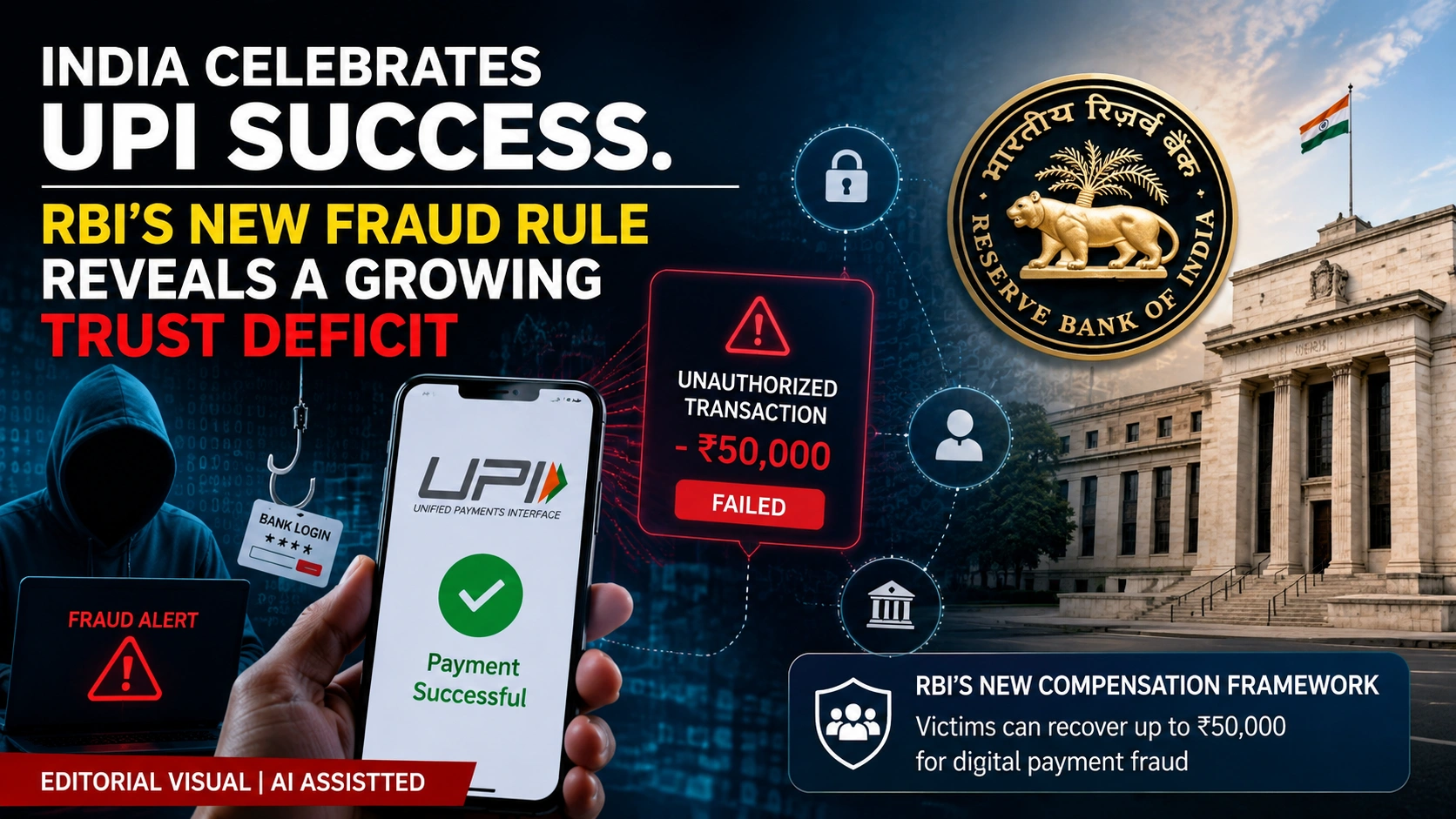
India Celebrates UPI Success. RBI’s New Compensation Framework Reveals A Growing Trust Deficit
For the better part of the last three years, India has been celebrating what is arguably one of the country’s biggest technological success stories.
Digital payments have exploded across the economy. Unified Payments Interface, better known as UPI, has transformed the way Indians transact, making the country one of the world’s largest real-time digital payments ecosystems. Street vendors now accept QR code payments. Small kirana stores have gone digital. Urban consumers increasingly move through entire days without touching physical cash.
India’s digital payment revolution has become a matter of national pride.
It is regularly projected as proof that India has successfully leapfrogged traditional financial infrastructure and built one of the world’s most sophisticated public digital systems.
But sometimes policy announcements quietly reveal truths that public celebrations tend to ignore.
This week, Reserve Bank of India introduced a new fraud compensation mechanism that allows victims of unauthorized digital transaction fraud to recover losses of up to ₹50,000 under specific conditions.
At first glance, the announcement appears reassuring.
The central bank is protecting consumers.
But beneath that reassurance lies a more uncomfortable question that deserves far greater attention.
If India’s digital payment infrastructure is functioning so successfully, why does the country’s central bank suddenly need to create an entirely new compensation architecture for digital fraud victims?
The answer may reveal a growing structural problem hidden beneath India’s digital success story.https://thequantiq.com/india-ai-sovereignty-imported-ai-risk/
India Built Scale Faster Than It Built Trust
India’s digital payments revolution has been extraordinary by almost every measurable standard.
Platforms operated by National Payments Corporation of India now process billions of transactions every month. UPI has fundamentally altered consumer behavior, accelerated financial inclusion and positioned India as a global case study in digital public infrastructure.
Countries across the world now study India’s payments architecture as a model for the future.
But scale and trust do not always grow at the same speed.
As digital transactions expanded rapidly, a parallel economy of digital fraud quietly expanded alongside it.
Unauthorized account debits, phishing attacks, fake payment links, fraudulent banking calls, SIM swap frauds and account takeover scams have become increasingly common across the country.
For millions of first-generation digital users, especially elderly citizens and less digitally literate consumers, the convenience of digital payments has also created entirely new forms of vulnerability.
The problem is no longer anecdotal.
It has become systemic enough for the country’s central bank to intervene directly.
RBI’s New Framework Is More Than Consumer Protection
The new compensation mechanism introduced by the RBI allows victims of digital transaction fraud to recover a substantial portion of their losses if complaints are lodged within prescribed timelines.
On paper, this strengthens consumer confidence.
But central banks do not create entirely new regulatory frameworks without deeper systemic concerns.
Every compensation mechanism tells a hidden story.
In this case, the story is simple.
India’s digital payments ecosystem has grown so rapidly that fraud risks are beginning to threaten public trust itself.
And trust, more than technology, is what ultimately determines whether digital financial systems survive long term.
A payment system can process billions of transactions.
But if ordinary users begin fearing that their money is no longer safe, adoption eventually slows.
Technology infrastructure alone cannot sustain confidence.
Trust infrastructure matters equally.https://www.rbi.org.in/?utm_source=chatgpt.com
The Most Vulnerable Citizens Are Carrying The Greatest Risk
The burden of digital fraud rarely falls equally across society.
Urban professionals may recover quickly from fraudulent transactions.
Large businesses often possess stronger cybersecurity awareness.
But millions of ordinary citizens operate differently.
A retired pensioner receiving a suspicious banking call. A small shopkeeper unknowingly clicking a malicious payment link. A rural consumer using digital banking systems without understanding fraud detection mechanisms.
For these citizens, a fraudulent transaction is not merely an inconvenience.
It can wipe out savings accumulated over years.
India’s digital inclusion story has succeeded in bringing millions into the formal financial system.
But inclusion without adequate protection creates a dangerous imbalance.
The faster technology spreads, the more vulnerable inexperienced users become.
Artificial Intelligence Could Make This Problem Far Worse
What makes this development particularly significant is what lies ahead.
The current wave of digital fraud largely depends on conventional phishing attacks, impersonation scams and fake transaction requests.
But the next generation of fraud may be fundamentally different.
Artificial intelligence is already enabling technologies that can dramatically expand fraud sophistication.
Voice cloning systems can imitate family members. Deepfake video technology can create convincing fake identities. AI systems can automate personalized phishing attacks at scale. Synthetic identity fraud may soon allow cybercriminals to replicate entire digital identities with alarming precision.
The digital fraud landscape that exists today may look primitive compared to what emerges over the next five years.
This raises an uncomfortable possibility.
The RBI may be solving today’s fraud problem while a far more dangerous AI-driven fraud ecosystem quietly approaches.https://thequantiq.com/the-rise-of-the-agentic-fraudster/
India Must Build Trust Infrastructure Alongside Payment Infrastructure
India deserves credit for building one of the world’s most advanced digital payment ecosystems.
Few countries have scaled public digital infrastructure with comparable speed.
But infrastructure alone does not guarantee resilience.
The long-term success of India’s digital economy now depends on building an equally sophisticated trust architecture around the payment ecosystem.
Consumer education must improve. Cyber awareness programs need deeper penetration beyond urban India. Fraud reporting systems require faster resolution mechanisms. Banks must strengthen customer protection systems long before fraudulent transactions occur.
Most importantly, digital trust can no longer remain an afterthought.
Technology adoption and consumer protection must evolve together.
If one grows significantly faster than the other, systemic fragility begins to emerge beneath the surface.https://thequantiq.com/vernacular-sovereignty-ai-data-security-northeast-india/
The Quantiq Assessment
India’s UPI revolution remains one of the country’s greatest technological achievements.
That success deserves recognition.
But the RBI’s new fraud compensation framework quietly reveals an uncomfortable institutional truth.
India’s digital economy is becoming increasingly vulnerable to fraud at precisely the moment when society is becoming more dependent on digital systems than ever before.
The larger question is not whether RBI’s compensation mechanism will help fraud victims.
It certainly will.
The more important question is what this announcement reveals about the health of India’s digital trust architecture itself.
India has successfully built payment infrastructure at extraordinary scale.
The next challenge may be far more difficult.
Building trust at the same speed.
Because every digital revolution ultimately depends on one fragile human assumption.
That money moving through invisible systems remains safe.
The moment that trust begins to weaken, even the strongest technology architecture begins facing systemic stress.
And perhaps that is the deeper story quietly hidden behind this week’s RBI announcement.