
When the World Rewires Trade, Northeast India Gets a Historic Economic Opening
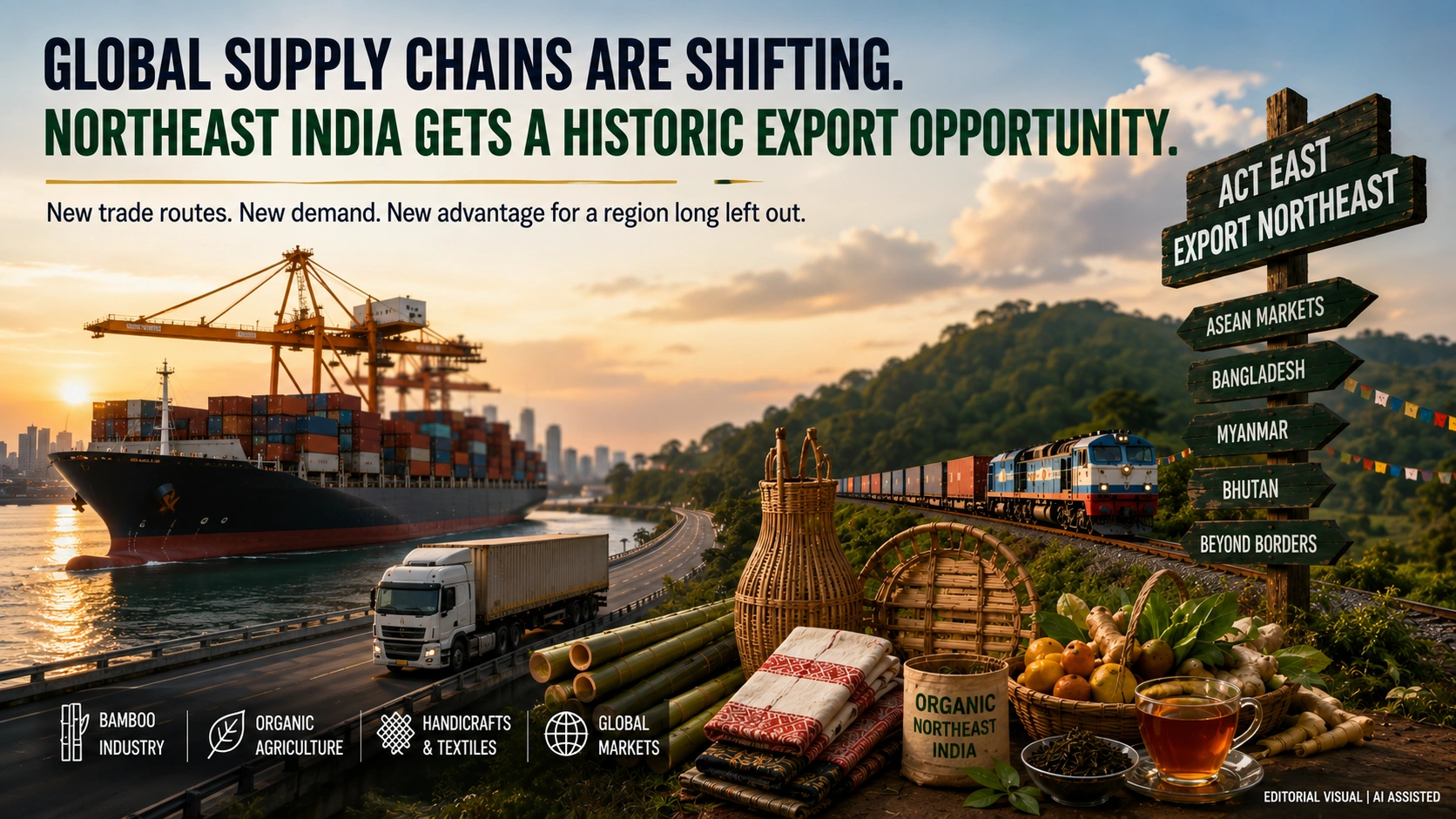
As global supply chains fracture and the world begins redesigning trade architecture, Northeast India may be standing before the biggest export opportunity it has seen since independence.
When policymakers, economists, business leaders and technology executives gathered recently in Dalian, China, for the World Economic Forum’s 2026 Annual Meeting of the New Champions, more commonly known as Summer Davos, much of the global conversation understandably revolved around innovation, industrial transformation and the future of economic growth.https://www.weforum.org/stories/2026/06/summer-davos-2026-key-highlights-must-reads/
The world is entering one of the most significant periods of structural economic realignment since globalization began reshaping international trade in the early 1990s.
For nearly three decades, global commerce operated through relatively predictable supply chains. Manufacturing hubs became concentrated in a handful of countries, logistics corridors matured around these production ecosystems, and international trade gradually settled into a rhythm shaped largely by efficiency, cost optimisation and increasingly interconnected markets.
That era is beginning to change rapidly.
Across industries, governments and corporations are now confronting a very different reality shaped by rising tariffs, geopolitical tensions, supply chain diversification, strategic decoupling and growing pressure to reduce dependence on concentrated manufacturing ecosystems. International institutions, including the World Trade Organization and the International Monetary Fund have repeatedly cautioned that global trade growth is slowing as businesses worldwide begin rethinking long-established sourcing strategies.
What discussions emerging from the World Economic Forum’s Summer Davos 2026 gathering reflected very clearly is this: the architecture of global commerce is entering a period of structural realignment, and economies capable of positioning themselves early may benefit disproportionately from this transition.
For Northeast India, this is not simply another global economic story unfolding somewhere far away. For the region, this development should not be seen as a warning to manage cautiously, but as a strategic opening that may fundamentally redefine its economic future.
Perhaps for the first time in decades, global economic disruption elsewhere is creating an opportunity here.
Why Global Trade Disruption Matters to Northeast India
For decades, Northeast India remained largely disconnected from formal global trade architecture despite possessing extraordinary geographic and natural advantages. The region’s economic relationship with the rest of India has historically been shaped by structural limitations that are now deeply familiar — inadequate logistics infrastructure, weak industrial processing ecosystems, colonial-era transport assumptions, policy neglect, and a development model that encouraged extraction of raw materials rather than creation of value-added export products.
This relative exclusion from global trade networks was manageable when international trade routes remained stable and deeply concentrated around established manufacturing hubs. But when global trade begins reorganising itself, old disadvantages sometimes begin transforming into new opportunities.
The world is increasingly searching for alternative production bases, diversified sourcing locations and greater regional supply chain resilience. Suddenly, regions that were once considered peripheral begin acquiring strategic relevance.
That is precisely where Northeast India finds itself today.
The question before the region is no longer whether opportunity exists. The question is whether Northeast India recognises the scale of this moment early enough.https://www.wto.org/english/res_e/reser_e/gtdw_e/wkshop22_e/yuan_tian_paper.pdf
Northeast India Has Always Had the Geography. It Never Built the Economic Systems
One of the great ironies of India’s development story lies in the way Northeast India has traditionally been viewed.
For decades, the region has been discussed largely as a remote frontier economy disconnected from India’s mainstream industrial centres. Yet geographically, Northeast India occupies one of the most strategically significant positions anywhere in South Asia.
The region effectively serves as India’s principal land gateway to Bangladesh, Myanmar, Bhutan and wider Southeast Asian markets, placing it in direct proximity to some of the fastest-growing trade corridors in Asia. Despite this extraordinary geographic advantage, Northeast India continues contributing only a very small fraction of India’s formal export economy.
This disconnect between geography and economic output reveals one of India’s biggest development contradictions.
The opportunity existed. The systems required to exploit that opportunity never evolved.
The Region Already Possesses Resources the World Increasingly Wants
Beyond geography, Northeast India possesses something far more important.
It controls some of India’s most strategically valuable biological and natural resource ecosystems at a time when global markets are increasingly shifting toward sustainability, circular economy frameworks and premium agricultural products.
Consider bamboo.
Northeast India holds nearly two-thirds of India’s bamboo reserves, making the region one of Asia’s most significant bamboo-producing ecosystems. As sustainability conversations accelerate globally, bamboo is increasingly being recognised not merely as a traditional material but as a strategic industrial resource capable of replacing plastics, engineered wood, construction materials, packaging inputs and several carbon-intensive industrial alternatives.
The same applies to agriculture.
While Sikkim continues to enjoy global recognition as the world’s first fully organic state, states like Meghalaya, Nagaland and Mizoram have steadily emerged among India’s most promising regions for organic agriculture adoption. In a world increasingly demanding traceable, chemical-free and premium agricultural products, this positioning is becoming economically valuable.
The same logic extends to handicrafts and textiles.
Northeast India possesses one of Asia’s richest artisanal ecosystems, yet remains significantly underrepresented in India’s formal export basket despite producing world-class handloom, bamboo craft, cane furniture, natural fibre products and several geographically distinctive products carrying deep cultural value.
The world increasingly rewards authenticity.
Ironically, Northeast India has spent decades underpricing authenticity.
Infrastructure Alone Was Never the Problem
The conventional explanation for Northeast India’s weak export presence has always centred around infrastructure.
But that argument is gradually weakening.
India’s Act East Policy, launched in 2014, created the broad strategic framework. Major connectivity projects including the Kaladan Multi-Modal Transit Transport Project, the India-Myanmar-Thailand Trilateral Highway, and the Agartala-Akhaura rail link are steadily progressing.
Physical connectivity, while still incomplete, is improving. But infrastructure was never the only problem. The bigger challenge lies elsewhere.
Northeast India still lacks the economic architecture required to convert raw material abundance into export-grade finished products. And that distinction matters enormously.
The Real Problem Is Not Production. It Is Processing.
If Northeast India possesses strong resource fundamentals, why does the region still continue exporting raw bamboo instead of engineered bamboo panels?
Why does the region continue shipping agricultural produce instead of globally branded processed food products?
The answer lies in a structural gap that has remained largely invisible in policy discussions.
The region has resources. The region has artisanal skill. The region has product depth. But it lacks the mid-chain industrial layer that transforms primary production into export-ready value.
The bamboo processing plants.
The textile finishing units.
The food processing infrastructure.
The packaging ecosystem.
The certification systems.
The quality standardisation infrastructure.
This is not a resource problem.
This is an industrial design problem.
And industrial design problems can be solved.https://thequantiq.com/northeast-india-green-industrialisation-bamboo-manufacturing/
Market Access Architecture Remains Missing
Even when producers in states like Manipur, Nagaland or Meghalaya create globally competitive products, they face another obstacle.
Market access.
A producer in Gujarat or Tamil Nadu operates inside a mature export ecosystem built around freight networks, export consultants, buyer linkages, trade finance, quality certification and institutional support systems.
Northeast India largely does not have this ecosystem.
A bamboo entrepreneur in Assam may produce globally competitive products, yet still lack reliable pathways to buyers in Bangkok, Singapore or Europe.
The corridors may be opening.
But nobody has built the economic architecture on top of those corridors.
That gap remains the real bottleneck.
Northeast India Has Failed to Build Export Identity
There is another structural weakness rarely discussed.
Even when Northeast India’s products enter larger markets, they rarely carry Northeast identity.
Assam tea is often marketed simply as Indian tea.
Several indigenous products reach buyers without origin-based branding strong enough to command premium pricing.
The lesson is obvious.
Products alone do not create export power.
Identity creates export power.
The success of globally protected geographical brands elsewhere has repeatedly shown that provenance often carries as much economic value as the product itself.
Northeast India has not yet built that identity architecture systematically.
Why Global Trade Realignment Changes Everything
What Summer Davos discussions indirectly reinforced is something global businesses already understand.
Companies are actively diversifying supply chains.
Overdependence on concentrated manufacturing ecosystems is increasingly seen as a strategic vulnerability.
As ASEAN economies continue expanding and businesses search for alternative sourcing ecosystems across Asia, Northeast India suddenly finds itself positioned much closer to future trade opportunities than it was even five years ago.
This creates three immediate business opportunities.
First, Northeast India can emerge as an alternative supplier for premium agricultural products, natural fibre products, forest-based materials and sustainable industrial inputs.
Second, the region can develop ASEAN-facing processing ecosystems designed specifically for export markets rather than domestic consumption.
Third, fragmented global markets increasingly reward premium niche products carrying strong provenance stories, precisely the kind of products Northeast India already produces naturally.
The opportunity is no longer theoretical.
It is becoming increasingly visible.
Policy Framework Exists. Execution Architecture Does Not
To be fair, India’s policy framework around Northeast development has improved substantially over the past decade.
The Act East Policy created strategic direction.
The Ministry of Development of North Eastern Region (DoNER) expanded infrastructure investment.
NITI Aayog’s Vision 2047 framework increasingly speaks about Northeast India as a future production hub.
APEDA has improved organic certification support.
One District One Product (ODOP) has helped identify region-specific products.
Yet one critical piece remains missing.
There is still no dedicated Northeast export facilitation architecture.
There is no integrated institutional system combining processing support, export certification, freight support, buyer linkage, branding development and market intelligence into one coordinated export framework.
Without this institutional layer, opportunity remains unrealised.
The Revenue Potential Is Far Larger Than Most People Imagine
The economic potential is substantial.
The Quantiq estimates that a structured export facilitation strategy focused on five high-potential sectors — organic agriculture, bamboo products, handicrafts and textiles, forest products including agarwood, and processed horticultural products — could potentially unlock between ₹2,600 crore and ₹4,100 crore in incremental export value over the next five years.
What makes this particularly remarkable is that no entirely new product categories need to be invented.
The products already exist.
The raw material already exists.
The demand increasingly exists.
The global trade restructuring currently underway is creating buyer motivation.
The missing variable is Northeast India’s own institutional readiness.
The Quantiq Assessment
Summer Davos 2026 unintentionally delivered an important message to Northeast India.
Global trade architecture is no longer static.
The old supply chains that historically concentrated opportunity in specific manufacturing centres are entering a period of structural change.
This validates something The Quantiq has argued consistently for years.
Northeast India’s exclusion from global trade was never simply geography.
It was institutional design.
And institutional design can be redesigned.
The region already possesses extraordinary natural resources, cultural products, geographic access and sustainability-linked industrial potential.
The question is no longer whether opportunity exists.
The opportunity is already here.
But opportunity alone guarantees nothing.
Northeast India’s entrepreneurs, producer organisations and state governments now have a narrow strategic window, perhaps no more than the next three years, before new global supply chains begin settling into long-term patterns.
The region does not need to wait for Delhi to solve this problem.
The Export Northeast agenda — built around sovereign producer identity, ASEAN-facing industrial infrastructure, processing capacity and globally recognised regional brands — can begin immediately.
Global trade disruption is creating the tailwind.
The response now depends entirely on whether the region chooses action over hesitation.
The Quantiq Position
Northeast India does not need to become another manufacturing copy of Western India.
It needs to build an export economy rooted in what it already possesses — biological wealth, cultural products, sustainable materials and geographic access to Asia’s fastest growing markets.
The world is rewiring global trade architecture at extraordinary speed. For decades, Northeast India remained an observer of economic opportunities designed elsewhere. This time, the region has an opportunity to become an active architect of its own export future.
History may not offer this window twice.https://thequantiq.com/bamboo-toy-industry-northeast-india/

One Comment