

Midweek AI Brief
The Global AI Race Is No Longer About Chatbots — It Is About Who Controls the Infrastructure
For nearly three years, the world has been mesmerized by the visible side of artificial intelligence.
Every week brings another chatbot launch, another AI image generator, another promise that machines are about to redefine how humans work, learn, communicate and create. Yet beneath this highly visible consumer layer, a far more consequential battle is quietly unfolding — one that may ultimately determine who controls the future of the global digital economy.
This week offered a powerful reminder that the real AI race is no longer about who builds the smartest chatbot. Increasingly, it is becoming a contest over infrastructure: computing power, semiconductor access, proprietary data, cybersecurity control and talent ownership.
And for countries like India, this shift carries lessons that deserve urgent attention.
Anthropic’s Alibaba Allegation Signals a New Kind of AI Conflict
One of the most serious developments this week emerged when Anthropic reportedly informed US lawmakers that operators allegedly linked to Alibaba’s Qwen AI division had created nearly 25,000 fake accounts to extract roughly 29 million conversations from Claude, Anthropic’s flagship AI model.
The allegation, which remains independently unverified, has immediately reignited one of the most sensitive debates in the AI ecosystem — whether frontier AI models can realistically be protected once they are deployed publicly.
The issue goes beyond corporate rivalry.
Artificial intelligence companies are now spending billions of dollars training advanced reasoning systems. If competitors can simply replicate or “distill” those capabilities through extraction techniques, then ownership itself becomes fragile.
The AI economy, it appears, is entering its first era of industrial espionage.
Washington Tightens Control Over Frontier AI Systems
Artificial intelligence is increasingly becoming a geopolitical issue rather than just a technology story.
This became evident this week when the United States reportedly moved to restrict access to certain advanced AI systems developed by Anthropic. The decision reportedly stems from concerns over potential access by China and other strategically sensitive regions.
At nearly the same time, reports suggest that OpenAI has limited access to its upcoming GPT-5.6 release to a small group of carefully selected partners.
So far, only Google’s Gemini 3.5 Pro appears to have temporarily escaped similar restrictions.
The message coming out of Washington is becoming increasingly clear.
Artificial intelligence is no longer being treated as a purely commercial technology sector.
Governments are now beginning to see AI through the lens of national security, strategic dominance and long-term geopolitical influence.
In many ways, artificial intelligence is slowly becoming the nuclear technology of the digital era.
Google’s Talent Crisis Reveals a Hidden AI War
Technology companies have traditionally competed for market share.
The AI era is forcing them to compete for something even scarcer — talent.
This week, four senior researchers working on Google’s Gemini AI division reportedly left the company for rival firm Anthropic, following earlier high-profile departures including celebrated AI researcher John Jumper and transformer architecture pioneer Noam Shazeer.
The market reacted sharply.
Alphabet, Google’s parent company, reportedly witnessed its steepest single-day stock decline this year as investors questioned whether the company was losing momentum in the increasingly aggressive AI race.
The episode highlights a reality often overlooked by the broader public.
The world’s most valuable AI asset may not be the model itself.
It may simply be the small group of scientists capable of building the next one.
The Biggest AI Money Is Moving Somewhere Else
Perhaps the most revealing development of the week had little to do with chatbots at all.
Reports indicate that SpaceX has signed a massive computing infrastructure agreement with Reflection AI reportedly valued at nearly $150 million per month, potentially reaching billions over the coming years.
This follows other major infrastructure commitments involving companies like Anthropic, Google and emerging AI coding platform Cursor.
What becomes evident from these numbers is that the biggest profits in the AI boom are not currently flowing to the companies building AI models.
Instead, the financial winners are increasingly the firms selling the infrastructure underneath.
Semiconductor manufacturers, GPU providers, cloud infrastructure companies and memory manufacturers are quietly capturing enormous value while many AI labs themselves continue burning vast amounts of capital simply to remain competitive.
OpenAI Moves Closer Toward Hardware Independence
Meanwhile, OpenAI announced fresh moves designed to reduce its dependence on external suppliers.
The company has reportedly partnered with Broadcom to develop specialized inference chips optimized specifically for large language models.
Alongside this, OpenAI also introduced new cybersecurity initiatives aimed at protecting organizations against AI-enabled attacks and launched support programs for open-source software maintainers.
This strategy reveals an important evolution underway in the AI ecosystem.
Leading AI firms are no longer content merely building software.
Increasingly, they want control over the entire stack — from hardware and compute infrastructure all the way to deployment and security.
The Productivity Debate Is Finally Becoming Real
Since the launch of consumer AI systems in late 2022, businesses around the world have been told repeatedly that artificial intelligence would dramatically improve workplace productivity.
Three years later, the evidence appears far more complex.
Emerging enterprise data suggests AI is indeed creating meaningful productivity gains in specific workflows, particularly software development and repetitive research tasks.
But the gains remain highly uneven.
Several large enterprises are reportedly burning through annual AI budgets far faster than expected, forcing leadership teams to rethink unrestricted access to expensive AI coding assistants and enterprise AI subscriptions.
Artificial intelligence may be powerful.
But power comes with cost.
And businesses are beginning to notice.https://thequantiq.com/hidden-cost-of-ai-rising-smartphone-pc-prices/
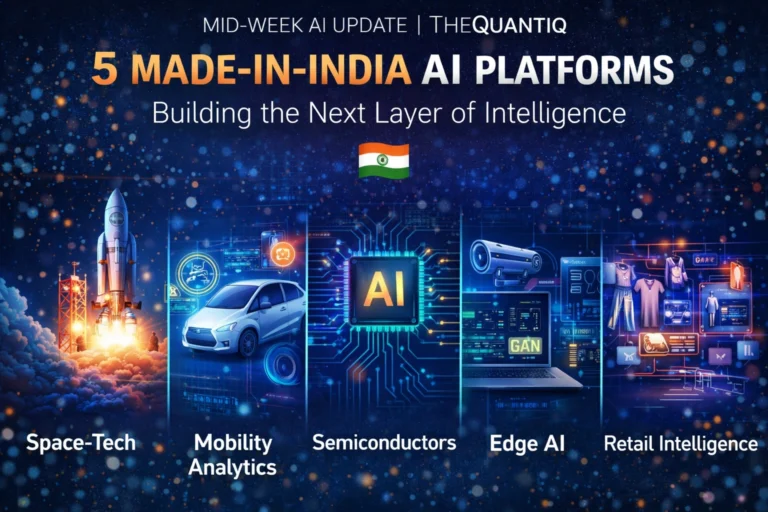
Why India Should Pay Close Attention
For countries like India, this week’s developments reveal a reality that is often missing from public conversation.
India is rapidly becoming one of the world’s largest consumers of artificial intelligence technologies.
Startups, enterprises, educators and governments are embracing AI at remarkable speed.
Yet India still remains largely dependent on foreign infrastructure.
The foundational layers that power artificial intelligence — advanced semiconductor manufacturing, frontier model development, high-performance computing infrastructure and proprietary training datasets — remain concentrated elsewhere.
The uncomfortable truth is this.
A nation may use artificial intelligence extensively and still remain technologically dependent.
The lesson extends equally to emerging digital economies like Northeast India.
Simply adopting AI tools will not create durable competitive advantage.
Long-term value will come from building proprietary systems, sector-specific intelligence platforms, local language models and specialized datasets that solve uniquely regional problems.
In the age of artificial intelligence, consumption creates convenience.
Ownership creates power.https://thequantiq.com/india-ai-sovereignty-imported-ai-risk/
The Quantiq Takeaway
This week confirms a pattern that is becoming impossible to ignore.
The visible AI race may be dominated by chatbots and flashy product launches, but the real contest is happening far deeper.
Infrastructure ownership is emerging as the decisive factor.
The companies controlling compute capacity, semiconductor supply chains, memory systems and proprietary data pipelines are quietly becoming the most powerful players in the global AI economy.
For India, and particularly for emerging innovation ecosystems across Northeast India, the lesson is profound.
The future will not belong to those who merely use artificial intelligence.
It will belong to those who build the systems underneath it.
And in the age of AI, perhaps the most valuable technology is not intelligence itself.
It is control over the infrastructure that makes intelligence possible.https://thequantiq.com/40-percent-jobs-ai-disruption-india/




One Comment